EU naval mission escorts commercial ships safely through Red Sea amid Houthi attacks
 Yemen Herald News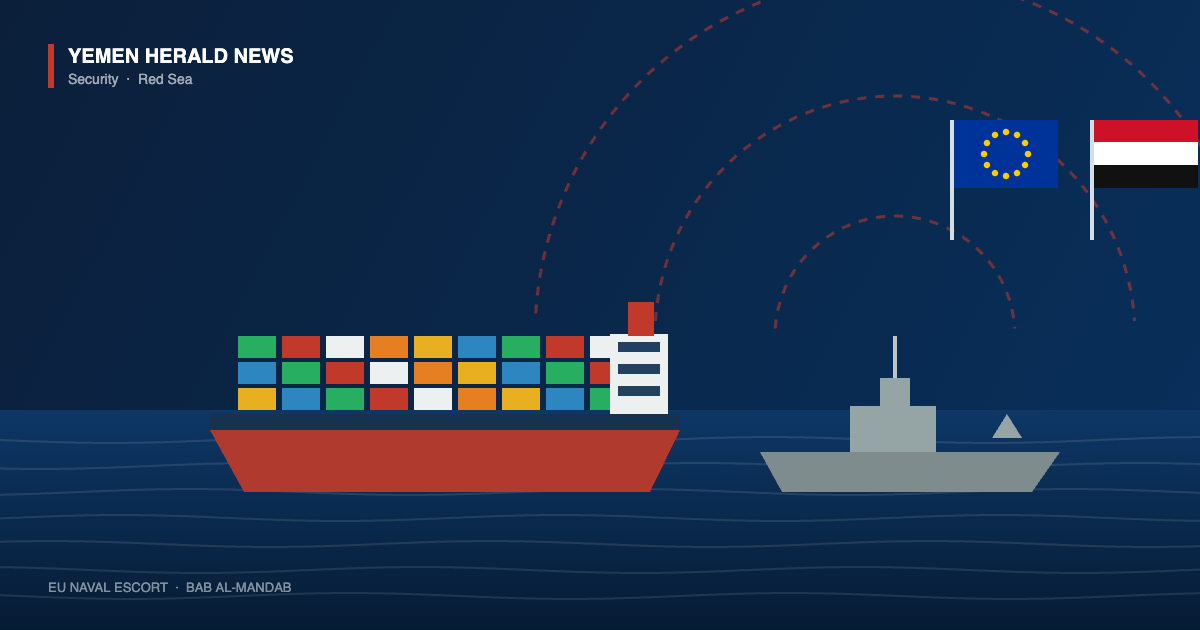
The European Union’s naval mission in the Red Sea has escorted another group of commercial vessels safely through waters west of Yemen, the operation said, as Houthi forces continue to target merchant shipping along one of the world’s busiest trade routes. EUNAVFOR ASPIDES announced on social media that its warships had accompanied the ships for the length of their transit through the high-risk corridor, and that every vessel completed the passage without incident.
The escort was the second the mission has publicised this month, a rhythm that reflects how heavily merchant operators now lean on naval protection to move cargo between the Suez Canal and the Gulf of Aden. ASPIDES has said demand for its close protection rose sharply through 2026: the mission reported that requests for protection climbed by roughly 39 percent between February and August, a measure of how far confidence in unescorted transits has fallen.
ASPIDES was launched in February 2024 as a defensive operation with a deliberately narrow remit. Its ships accompany merchant traffic and shoot down missiles and drones aimed at it, but they do not strike targets ashore. That mandate has been renewed repeatedly. In February 2026 the Council of the European Union extended the operation to 28 February 2027 and allocated close to 15 million euros in common costs to keep it running. The mission is headquartered in Larissa, Greece, under the command of Rear Admiral Vasileios Gryparis.
Its area of operations is wide. The mission is active along the main shipping lanes around the Bab al-Mandab Strait and covers international waters in the Red Sea, the Gulf of Aden, the Arabian Sea and the Gulf of Oman, while also monitoring the maritime picture at the Strait of Hormuz. Force levels vary as European navies rotate ships in and out of the theatre, and individual escorts are typically carried out by a single frigate or destroyer assigned to a convoy for the duration of the run.
By its own count the operation had seen more than 1,450 commercial vessels safely through the corridor in its first 23 months, a figure it published in January 2026. The tally is a reminder both of how much traffic still uses the route and of how much of it now moves under naval cover. Shipping that once passed Bab al-Mandab without a second thought is now routed, timed and in many cases physically accompanied according to the threat assessment of the day.
The Houthi movement, which controls Sanaa and much of northern and western Yemen, began attacking merchant ships in late 2023 and has paused and resumed the campaign several times since. The group frames the attacks as pressure connected to the war in Gaza. Vessel operators and Western governments describe them as indiscriminate, noting that crews with no connection to the stated dispute have been killed and that ships have been struck, set alight and in some cases abandoned in open water.
The maritime campaign sits on top of a civil war that has run since 2015 and shows no sign of resolution. The conflict pits the Houthis against the internationally recognised government seated in Aden, which is backed by a Saudi-led coalition. Western governments and United Nations experts say the Houthis receive weapons and technical support from Iran, an allegation Tehran denies. Front lines have been broadly static for several years, but the political and economic damage has continued to accumulate.
The humanitarian consequences are severe. The United Nations humanitarian needs and response plan for Yemen, published in March 2026, estimates that more than 22 million people require assistance or protection, among them 5.2 million people displaced inside the country. Some 18.3 million people are acutely food insecure, and more than 2.2 million children under five are acutely malnourished. Cholera and measles continue to circulate in a health system that has operated far below capacity since the war began.
Insecurity at sea feeds directly back into that picture. Yemen imports the overwhelming majority of its food and fuel, and higher war-risk insurance premiums, longer routings and reluctance among shipowners all raise landed costs in a country where most households already cannot absorb them. Relief agencies move much of their supply through the same ports and the same sea lanes that the attacks have made dangerous, so every disruption to commercial traffic narrows the humanitarian pipeline as well.
Yemen’s internationally recognised government has repeatedly urged stronger international action against the attacks, arguing that securing the Red Sea and restoring normal traffic through Yemeni ports cannot be separated from any wider political settlement. Its officials have also pressed partners for help rebuilding port infrastructure and coastguard capacity, on the argument that the corridor cannot be policed indefinitely by foreign navies alone.
For Europe the calculation is commercial as much as strategic. Bab al-Mandab is the southern gate of the Suez route between Asian producers and European markets, and a sustained diversion of traffic around the Cape of Good Hope adds days and cost to every voyage. Keeping the corridor usable without being drawn into the war ashore is the balance ASPIDES was designed to strike, and the escorts announced this month are what that balance looks like in practice.
About the Author