Yemen and Syria Review Draft Agreements Ahead of Expected Signing
 Yemen Herald News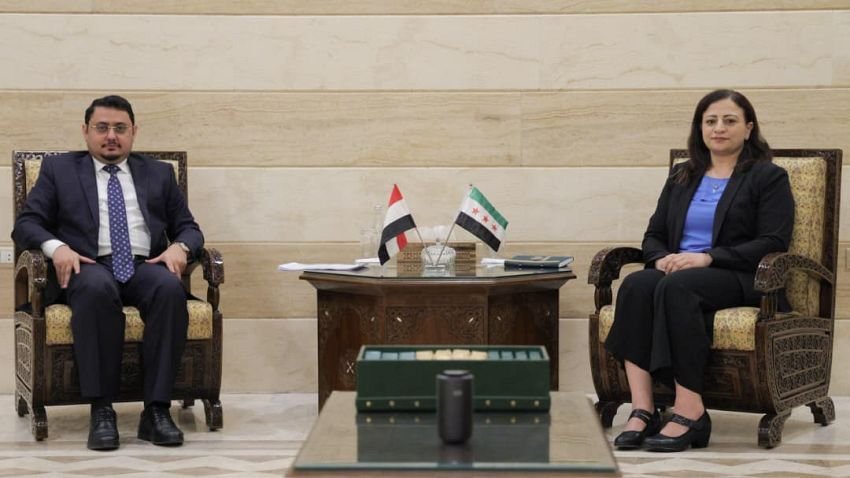
Yemen’s chargé d’affaires in Damascus, Mohammed Baaker, has held talks with Dima Al-Mousa, who heads the Department of Agreements and Treaties at Syria’s Ministry of Foreign Affairs and Expatriates, to review a package of draft bilateral agreements and memoranda of understanding that the two governments expect to sign in the coming period. The state news agency Saba reported that the meeting concentrated on the procedural and implementation steps each text still requires before it can enter into force.
According to the agency’s account, the drafts span academic, health, economic and diplomatic cooperation. Neither government has published the texts, so their specific provisions remain unclear, and no date has been announced for a signing ceremony. What the meeting does establish is that the two foreign ministries are now working through the technical stage that normally precedes signature — legal review, translation of terms into each side’s domestic procedure, and agreement on which ministry carries responsibility for implementation.
The talks are the product of a diplomatic reset that is barely a year old. Yemen reopened its embassy in Damascus on 27 April 2025, ending a nine-year interruption in the mission’s work. The Houthi movement had taken control of the embassy building in 2016 with the backing of Bashar al-Assad’s government, leaving Yemen’s internationally recognised administration without a functioning mission in the Syrian capital. Following the collapse of the Assad government in December 2024, Yemen’s foreign ministry moved to recover the premises and appointed Mohammed Azzi Ba’kr as chargé d’affaires.
Yemen was one of a series of Arab states that re-established or upgraded their presence in Damascus after that change of government, as regional capitals moved to rebuild channels frozen for more than a decade. For Yemen’s government, seated in Aden, restoring the mission also removed one of the few remaining diplomatic footholds the Houthis had retained abroad.
Beyond the agreements themselves, Baaker used the meeting to brief his Syrian counterpart on conditions inside Yemen. He described what the government characterises as continued Houthi offensive activity, including attacks on civilian infrastructure and threats to commercial shipping in the Red Sea. Those claims are contested by the Houthi authorities in Sanaa, and independent verification of specific incidents is often difficult.
The maritime dimension has given Yemen’s internal conflict an unusually wide reach. The Bab al-Mandab strait, at the southern entrance to the Red Sea, is one of the world’s most heavily used shipping corridors, and disruption there affects traffic through the Suez Canal and the cost of moving goods between Asia and Europe. Attacks on vessels since late 2023 pushed a substantial share of that traffic onto the longer route around southern Africa, with knock-on effects on freight rates and delivery times well beyond the region.
Baaker also set out the government’s position on the humanitarian emergency that has accompanied the conflict since 2015. The scale of that emergency has grown rather than eased. In its 2026 Humanitarian Needs and Response Plan, the United Nations Office for the Coordination of Humanitarian Affairs estimated that more than 22 million people in Yemen would require humanitarian assistance and protection during the year, among them close to 11 million women and girls.
The same assessment counted around 5.2 million internally displaced people, alongside several hundred thousand migrants, refugees and asylum seekers who remain in the country. Some 18.3 million people were assessed as acutely food insecure, and successive rounds of integrated phase classification analysis have shown districts sliding from crisis into emergency conditions. More than 2.2 million children under the age of five were acutely malnourished, including over half a million with severe acute malnutrition.
Funding has not kept pace. Aid agencies appealed for 2.16 billion dollars for the 2026 plan, with the stated aim of reaching 12 million people and prioritising 9.4 million in the areas assessed as most severe — a deliberate narrowing of ambition driven by the gap between need and available resources. Damaged water and sanitation infrastructure has left roughly 14.4 million people requiring assistance in that sector alone, and has contributed to recurrent outbreaks of cholera and measles.
Saba reported that Al-Mousa, for her part, indicated Syria’s readiness to provide the legal and technical support needed to accelerate the signing and implementation of the proposed agreements, and voiced support for Yemen’s sovereignty and territorial integrity. That language is standard in bilateral communiqués of this kind, and the agency’s report is the only public account of the exchange.
Neither side has suggested that the agreements will carry significant financial weight. Their value is more likely to lie in restoring the administrative plumbing of a relationship that lapsed almost entirely — consular services, recognition of qualifications, and the frameworks that allow ministries on either side to deal with one another directly rather than through third parties.
For Damascus, the engagement forms part of a broader effort to rebuild a diplomatic network after years of isolation. For Yemen’s government, which continues to compete with the Houthi authorities for international recognition and access, each restored mission strengthens its claim to represent the state abroad. Whether the agreements reviewed at this meeting move from draft to signature, and how quickly, will be the practical measure of how much substance the relationship has recovered.
About the Author