Yemen Takes Part in UN Desertification Conference COP17 in Mongolia
 Yemen Herald News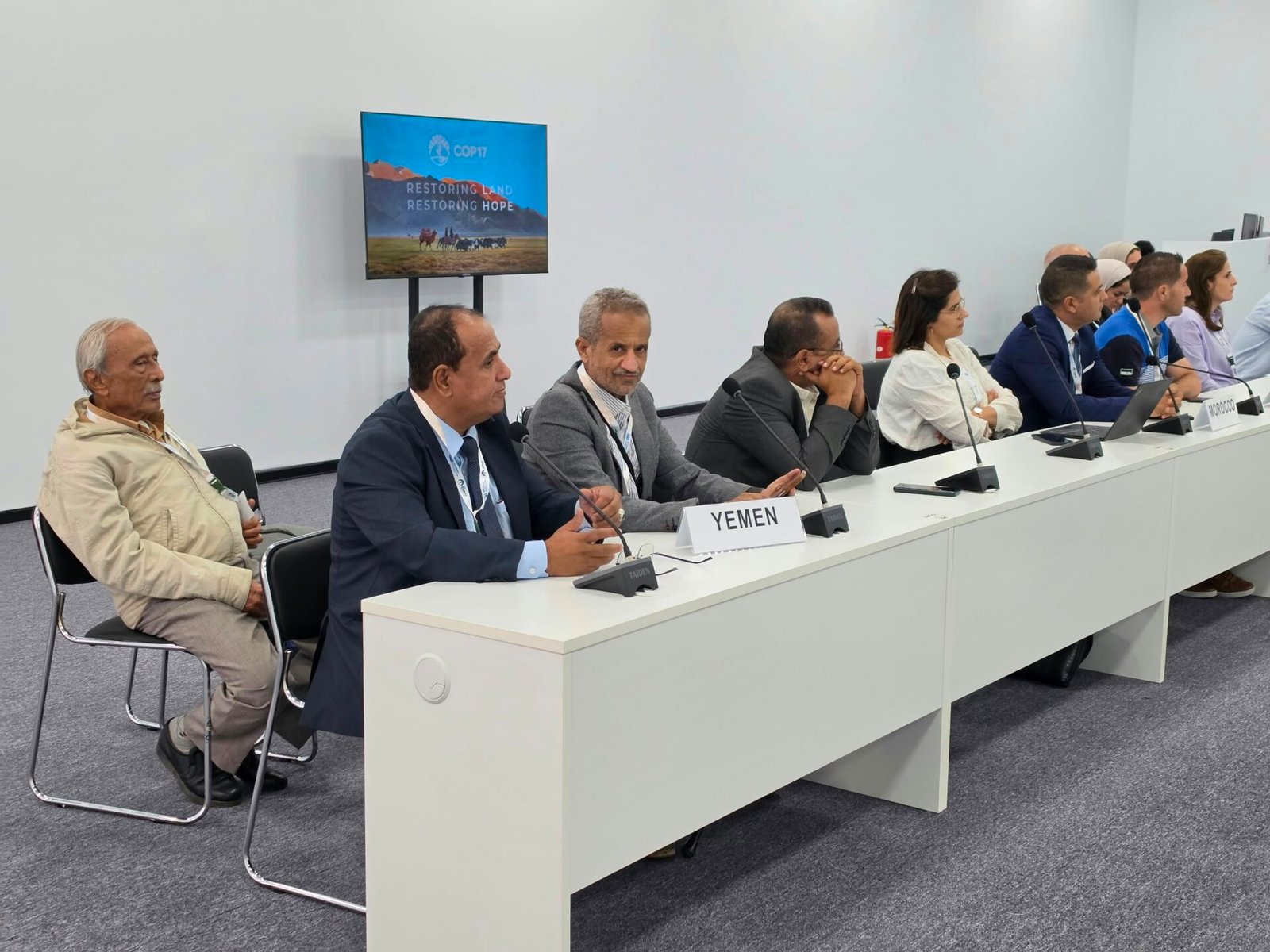
Yemen has begun taking part in the 17th session of the Conference of the Parties to the United Nations Convention to Combat Desertification, known as COP17, which opened this week in the Mongolian capital Ulaanbaatar under the theme “Restore Land, Restore Hope.” The Yemeni delegation is headed by the Deputy Minister of Agriculture and Irrigation, Eng. Ahmed al-Zamaki.
The conference runs from 17 to 28 August and brings together representatives of the convention’s 197 Parties. Alongside government delegations, the session has drawn business leaders, civil society organisations, scientists, youth representatives, Indigenous Peoples, pastoralists and smallholder farmers, reflecting an agenda that reaches well beyond environment ministries into questions of land tenure, agricultural livelihoods and rural finance.
The convention itself is one of the three treaties opened for signature after the 1992 Rio Earth Summit, alongside the agreements on climate change and biological diversity. It remains the only legally binding international instrument that ties environment and development specifically to the sustainable management of land, and its conferences of the parties are where its work programme and financing arrangements are negotiated.
Yemen’s attendance, according to the official account of the delegation’s participation, is intended to underline the pressing need to step up both national and international efforts against land degradation, desertification and drought. The delegation is also expected to press the case for sustainable management of natural resources, better use of scarce water and soil, and stronger food and water security for rural communities whose livelihoods depend on them.
Over the course of the session the Yemeni delegation will follow negotiations on international funding for desertification control and land restoration projects, and on drought response and early-warning systems. Those two files matter particularly to countries such as Yemen, where the capacity to anticipate a failed rainy season and to move resources before a crisis becomes acute has been badly eroded.
Few countries have a more direct stake in the outcome. Yemen is among the states most vulnerable to climate change, and for decades it has faced a deepening water crisis alongside widespread land degradation, soil erosion and advancing desertification. The deterioration of the country’s historic mountain terracing systems has been a particular concern, since those terraces hold soil in place on steep slopes and capture rainfall that would otherwise run off.
The water picture is the starkest measure of the problem. The United Nations Development Programme has warned that at current rates of groundwater extraction, all of Yemen’s groundwater sources could be exhausted in less than twenty years. Aquifers in several basins have already been drawn down far faster than they recharge, pushing wells deeper and raising the cost of pumping beyond the reach of many farmers.
Agriculture remains central to how Yemenis live. Roughly 16 million people depend on farming in some form, yet irrigation systems across the country have been severely damaged by a combination of environmental degradation and war. More than 80 percent of the population requires humanitarian assistance of some kind, and the collapse of rural production has been one of the drivers pushing households into that category.
The pressure comes from two directions at once. Farmland is being lost to drought-induced desertification in some regions while, in others, torrential rains and flash flooding strip topsoil and destroy channels and retaining walls. The same degraded catchments that fail to hold water in a dry year also fail to slow it in a wet one, which is why land restoration and flood protection are increasingly treated as a single problem rather than two.
Yemen is not alone in this. The Food and Agriculture Organization has noted that countries across the Near East and North Africa face mounting and overlapping pressures from land degradation, water scarcity, climate change and rising food insecurity, a combination that has moved land restoration up the regional policy agenda. Yemen sits at the more severe end of that spectrum because conflict has stripped away much of the institutional capacity that would normally manage the response.
International agencies have begun responding on that basis. The Food and Agriculture Organization in Yemen, with support from the Kingdom of the Netherlands and the German development bank KfW, has launched work to rehabilitate critical water infrastructure, strengthen flood protection and promote more sustainable water governance. Projects of that kind are limited in geographic reach relative to the scale of need, but they establish templates that larger financing could extend.
That gap between demonstrated need and available finance is what makes the funding negotiations in Ulaanbaatar consequential for Yemen. Land restoration is capital-intensive and slow to show returns, and it competes for donor attention with immediate humanitarian requirements. Countries in Yemen’s position have generally argued that the two should not be traded off against each other, on the grounds that restoring productive land reduces future humanitarian caseloads.
Yemen’s presence at the conference also carries a diplomatic dimension. Participation in the machinery of a major multilateral environmental convention keeps the country inside processes that allocate technical assistance and concessional finance, and it gives Yemeni officials a forum in which to make the case for their needs directly to donors and implementing agencies rather than through intermediaries.
The session continues until 28 August, when Parties are expected to adopt decisions across the conference agenda. What those decisions contain on finance, drought preparedness and early warning will determine how much of practical value the Yemeni delegation carries home from Ulaanbaatar.
About the Author