Local Administration Minister and Taiz Governor Discuss Decentralisation
 Yemen Herald News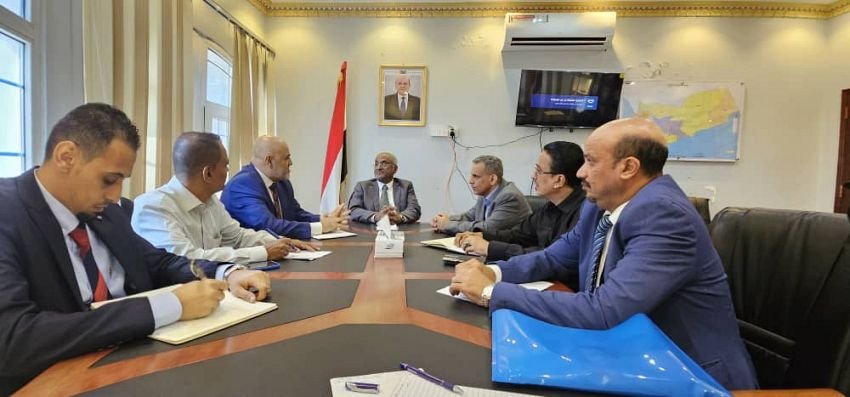
Yemen’s Minister of Local Administration, Eng. Badr Basalma, has stressed the need for closer coordination between his ministry and the local authority in Taiz governorate, describing such cooperation as essential to building an institutional environment capable of supporting administrative stability and local development. He made the remarks during a meeting in the interim capital, Aden, with Taiz Governor Nabil Shamsan.
The talks addressed a range of administrative and developmental challenges confronting the local authority in Taiz, one of Yemen’s most populous and hardest-hit governorates. Both officials sought to identify effective strategies for tackling these difficulties and for improving governance at the local level, where the daily business of delivering services to citizens ultimately takes place.
The session was attended by Deputy Minister of Local Administration Moeen Mahmoud, who contributed to a discussion that ranged over the government’s strategic direction. The officials reviewed the government’s stated commitment to strengthening administrative and financial decentralisation, a policy intended to empower local authorities and give them greater capacity to respond to the needs of their communities.
Decentralisation has long been a prominent theme in Yemeni political debate. Advocates argue that devolving authority and resources to governorates and districts allows decisions to be made closer to the people they affect, improving responsiveness and accountability. In a country as geographically and socially diverse as Yemen, the case for local empowerment has featured in successive discussions about how the state should be organised.
The war has lent that debate fresh urgency. With central authority weakened and the country fragmented, local authorities have often been left to shoulder responsibilities that would ordinarily fall to national institutions, from maintaining basic services to managing local security and responding to humanitarian needs. Their capacity to do so, however, varies widely and is frequently constrained by shortages of funding and trained personnel.
Taiz occupies a especially difficult position. Once a thriving commercial and cultural centre, the city has endured years of conflict that have left parts of it divided by front lines and cut off by road closures. Residents have faced shortages, damaged infrastructure and the daily hardships of life in a contested area, placing extraordinary demands on a local administration operating under severe strain.
Against this backdrop, the coordination Basalma called for takes on practical significance. Effective cooperation between the ministry and the governorate can help align national policy with local realities, ensure that scarce resources are directed where they are most needed and provide local officials with the backing required to function amid exceptionally challenging conditions.
The emphasis on financial decentralisation is particularly consequential. Without the ability to raise and manage revenues locally, governorates remain heavily dependent on transfers from the centre, which can be unpredictable in a time of fiscal crisis. Granting local authorities greater financial autonomy, its proponents argue, could improve their capacity to plan and deliver services, though it also raises questions about oversight and the equitable distribution of resources.
Administrative stability, another goal highlighted in the meeting, is closely linked to the broader effort to restore confidence in state institutions. When local governance functions predictably and fairly, it can strengthen the relationship between citizens and the state, reduce grievances and contribute to social cohesion. Where it falters, the resulting vacuum can deepen instability and erode trust.
The involvement of senior ministry officials, including the deputy minister, signalled the importance the government attaches to the relationship with Taiz. Such engagement reflects an awareness that the challenges facing the governorate cannot be resolved by local authorities alone, but require sustained attention and support from national institutions working in partnership with them.
Development initiatives, referenced throughout the discussion, are bound up with these governance questions. Rebuilding infrastructure, restoring services and creating economic opportunity all depend on functioning local administration capable of planning and implementing projects. Strengthening that administrative foundation is therefore a prerequisite for the kind of recovery that residents of Taiz and other governorates urgently seek.
The meeting also formed part of a wider pattern of engagement between the Ministry of Local Administration and governorate authorities across the country, as the government works to knit together a coherent approach to local governance amid fragmentation. Coordinating policy across diverse and often isolated regions is a considerable challenge, but one the ministry has identified as central to its mandate.
The stakes for Taiz are magnified by its scale and significance. Home to a large population and long regarded as one of Yemen’s principal urban and cultural centres, the governorate matters both symbolically and practically to the country’s future. The prolonged closure of key routes into the city has been among the most contentious humanitarian issues of the war, complicating the movement of people and goods and adding to the burdens placed on local officials. Strengthening the governorate’s administration is thus closely tied to easing the everyday hardships its residents continue to endure.
Whether the commitments expressed in Aden translate into tangible improvements in Taiz will depend on resources, political will and the evolution of the security situation. Decentralisation and administrative reform are long-term projects, and their success is measured less in declarations than in the steady improvement of the services and stability experienced by ordinary citizens. For now, the talks reaffirmed the government’s stated intent to empower local authorities as part of its broader agenda for governance and recovery.
About the Author