Yemen’s Transport Minister Presses for a National Maritime Security Committee
 Yemen Herald News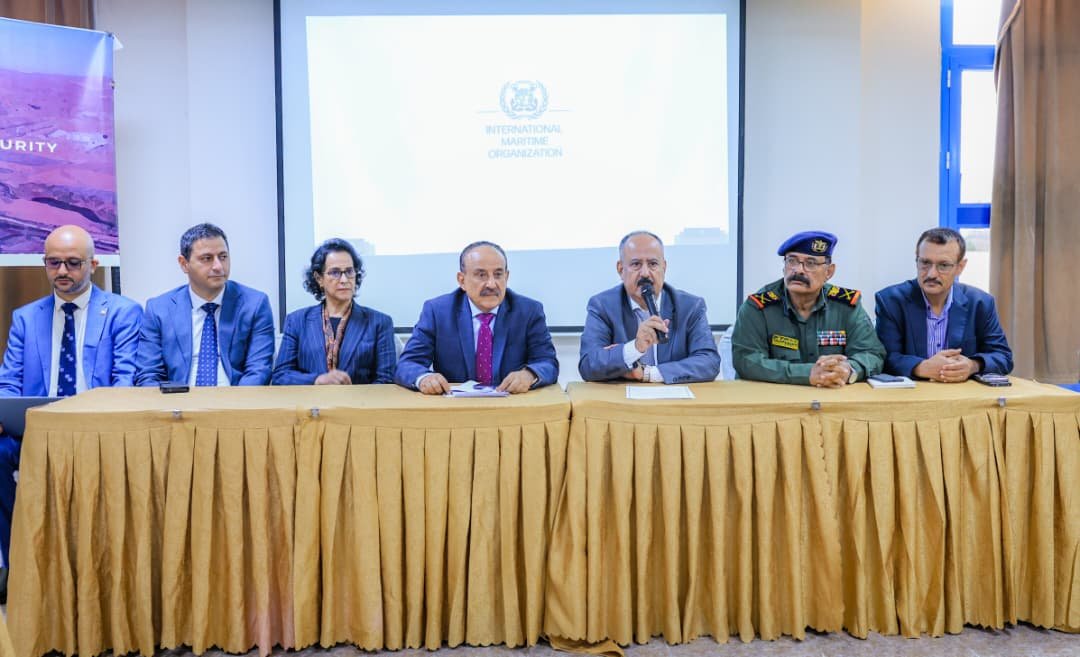
Yemen’s Transport Minister, Mohsen Haidara al-Omari, has called for the establishment of a National Maritime Security Committee to coordinate the government’s response to threats in the Red Sea, the Gulf of Aden and the Bab al-Mandab Strait. He set out the proposal in Aden at the conclusion of a five-day workshop organised by Yemen’s Maritime Affairs Authority with support from the International Maritime Organization, the state news agency Saba reported.
The minister cited recent attacks on Mokha Port, on the Red Sea coast, in which he said Houthi forces used ballistic missiles, drones and explosive-laden boats, damaging port infrastructure and causing casualties. Those strikes formed part of a wider escalation across several fronts during August 2026, and the government has presented them as evidence that the threat to Yemeni ports has moved beyond attacks on passing merchant traffic.
As described by al-Omari, the proposed committee would draw together bodies that currently operate largely in parallel: naval forces, the coast guard, port authorities, customs and other relevant agencies. Its stated purpose would be to strengthen maritime security and to protect international navigation, functions that are at present distributed across several ministries without a single coordinating structure.
The committee would also be charged with preparing a national maritime security strategy. According to the account of the minister’s remarks, that document would cover coastal protection, port and shipping security, fisheries, maritime investment, legislation and international cooperation, a scope that extends considerably beyond the immediate military threat and into the regulatory and economic governance of Yemen’s coastline.
Participants at the workshop called for the committee to be established urgently. No timetable, budget or founding decree was announced, and the proposal at this stage represents a ministerial recommendation rather than a decision of the cabinet or the Presidential Leadership Council. Whether it proceeds will depend on approvals that had not been granted at the time of the announcement.
The involvement of the International Maritime Organization gives the initiative a degree of external technical backing. The organisation is the United Nations agency responsible for the safety and security of shipping and the prevention of marine pollution, and it maintains capacity-building programmes with member states whose maritime administrations require support. Its participation does not carry funding commitments of the kind the proposed strategy would ultimately require.
The geography explains the urgency. The Bab al-Mandab Strait, at the southern entrance to the Red Sea, is among the world’s principal shipping chokepoints, and Yemen holds the eastern shore of it. Attacks on commercial vessels in those waters since late 2023 have prompted many operators to route cargo around southern Africa instead, adding time and insurance cost to voyages and reducing traffic through the Suez Canal.
For Yemen itself the consequences are more direct than for the shipping lines. The country imports the overwhelming majority of its food and fuel, and virtually all of it arrives by sea. Disruption at Hodeidah, Mokha or Aden translates rapidly into shortages and price increases in local markets, which is the mechanism by which maritime security becomes a humanitarian question rather than solely a naval one.
The proposal also arrives alongside a regional initiative. On 30 July 2026, Saudi Arabia announced the formation of a Multinational Maritime Defence Alliance alongside Yemen and a dozen other regional and Red Sea littoral states, presented as a defensive coalition intended to protect freedom of navigation through the Bab al-Mandab, the Red Sea and the Gulf of Aden. A national committee of the kind al-Omari described would give Yemen a domestic counterpart through which to engage with that structure.
Yemeni officials have framed the threat in increasingly stark terms, with the government warning that the Houthis intend to turn the Bab al-Mandab into what it has characterised as the Red Sea’s equivalent of the Strait of Hormuz. That is the government’s characterisation; the Houthi movement describes its maritime operations as a response to actions by Israel and by the states supporting the Yemeni government, and rejects the account of its intentions offered from Aden.
Institutional coordination has been a persistent difficulty for the recognised government, whose component factions maintain separate armed forces and whose administrative capacity has been fragmented since 2014. Proposals to unify security functions under a single body have been announced before in other sectors and have often proceeded slowly, constrained less by the merits of the design than by the distribution of authority among the groups represented on the Presidential Leadership Council.
The humanitarian context remains severe. The United Nations Office for the Coordination of Humanitarian Affairs estimated in its March 2026 response plan that more than 22 million people in Yemen require assistance, with 18.3 million acutely food insecure and more than 2.2 million children under five acutely malnourished, of whom 516,157 are severely malnourished. Around 5.2 million people remain internally displaced, and the appeal seeks 2.16 billion US dollars to reach 12 million people.
For now the committee exists as a recommendation supported by workshop participants and endorsed by the transport minister. Its practical significance will rest on whether it is formally constituted, whether the agencies it is meant to coordinate accept its authority, and whether the strategy it is tasked with drafting attracts the financing that its stated scope would demand.
About the Author