Yemen’s vice foreign minister receives new UNDP representative Noura Hamladji in Aden
 Yemen Herald News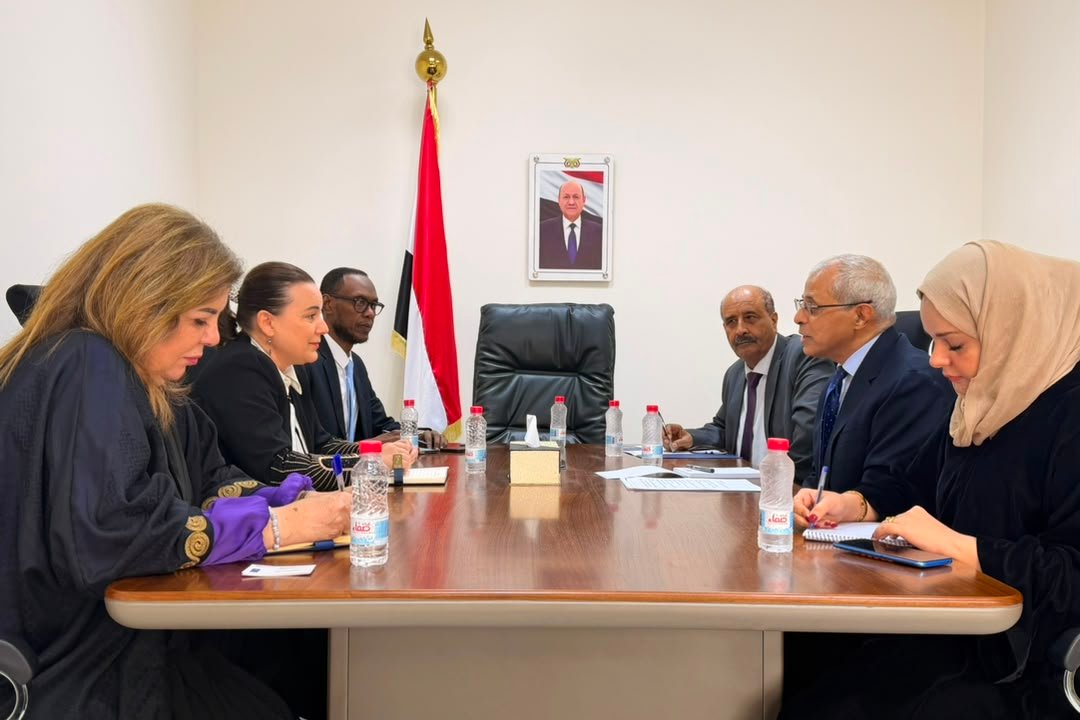
ADEN, Yemen — Yemen’s vice foreign minister, Mustafa Noman, met the new UN Development Programme resident representative, Noura Hamladji, in Aden on Aug. 25.
Hamladji presented her credentials to Noman the same day, the state news agency Saba reported.
The two discussed cooperation and the programme’s work to support recovery and stability in Yemen, according to the agency.
Noman praised UNDP support for the government, for state institutions and for development projects, Saba said.
He said the programme’s interventions should be aligned with government priorities and with citizens’ needs.
Hamladji reviewed the programme’s recent work and the projects it has planned for 2027, according to the agency.
She affirmed UNDP’s commitment to strengthening its partnership with the government, and to supporting recovery, institution-building and stability, Saba said.
Yemen Herald could not independently confirm Saba’s account of the meeting, and no independent report of the discussion has been published. Hamladji’s appointment is listed separately by UNDP and by the UN country team in Yemen.
Noman was appointed vice foreign minister in January 2025 by Rashad al-Alimi, chairman of the Presidential Leadership Council.
He became the first head of Yemen’s diplomatic mission in South Africa in 1996, and was appointed ambassador to Bahrain the same year.
He served as ambassador to Canada from August 1999 to November 2003, then as under secretary of state for the Americas, Europe and international organizations.
He was ambassador to Spain from 2010 to 2014.
He joined the Consultation and Reconciliation Commission in April 2022, and was named advisor to the chairman of the Presidential Leadership Council in September 2024.
Hamladji has more than 23 years of experience in development, humanitarian action, peacebuilding and stabilization, according to UNDP.
She most recently served as deputy executive secretary of the UN Framework Convention on Climate Change.
Before that she was UNDP’s deputy regional director for Africa.
She joined UNDP through its Leadership Development Programme in 2003, the agency says.
She worked at UNDP headquarters in New York as a programme specialist in its Iraq unit.
She was assistant resident representative for programme in Djibouti from 2003 to 2005.
She then ran the governance programme in Timor-Leste as assistant resident representative from 2006 to 2007.
She served as UNDP country director in Libya from 2015 to 2017.
Her postings also include Iraq and Azerbaijan, and her work has covered Africa, the Arab region and Asia-Pacific.
Hamladji holds a doctorate in political science from the European University Institute in Florence.
She holds a master’s degree in political science and the history of the Middle East from the Sorbonne in Paris.
UNDP lists its priorities in Yemen as supporting a peaceful settlement and transition, economic recovery and livelihoods, restoring basic services, and work with women, youth and vulnerable groups.
One of its larger programmes is Strengthening Institutional and Economic Resilience in Yemen, with a budget of $89 million.
The European Union has contributed more than $60 million over the past three years to that and related projects, according to UNDP.
The Emergency Social Protection Enhancement and COVID-19 Response Project is valued at $232.9 million.
It is implemented by the Social Fund for Development, the Public Works Project and the Small and Micro Enterprise Promotion Service, in partnership with UNDP.
UNDP also works with the World Bank on the Yemen Emergency Crisis Response Project.
Forty-five districts across nine governorates have drawn up three-year district recovery plans under the programme’s work, according to UNDP.
Those plans have supported more than 177 local priorities, including health and waste facilities, water infrastructure, solar energy systems and road openings.
UNDP puts the reach of that work at more than seven million people.
More than 152 public service facilities have received solar energy equipment since 2023, according to UNDP. They include schools, health centres and local administration offices.
UNDP puts the number of people benefiting from that equipment at 199,745, of whom 16,175 are women.
Its HEAL project is installing solar systems at four hospitals, with support from the Kuwait Fund for Arab Economic Development.
They are Al-Jumhori Hospital in Hajjah, 26th September Hospital in Sanaa, Al-Shaheed Muhnaf Hospital in Abyan and Al-Waht Hospital in Lahj.
The project covers Aden, Lahj, Abyan, Sanaa and Hajjah governorates, and addresses both energy supply at health facilities and income opportunities for women and youth. UNDP puts its reach at more than 200,000 people.
The meeting comes against the humanitarian assessment set out by the UN Office for the Coordination of Humanitarian Affairs in March.
That plan puts more than 22 million people in Yemen in need of assistance. It records 18.3 million as acutely food insecure.
More than 2.2 million children under five are acutely malnourished, according to the plan. It counts 516,157 of them as severely malnourished.
The plan also records 5.2 million internally displaced people. OCHA sought $2.16 billion to reach 12 million people over the year.
Yemen’s conflict dates to 2014, when Houthi forces took control of Sanaa. A Saudi-led coalition intervened the following March.
The internationally recognized government operates from Aden, which it uses as an interim capital. The Houthis administer Sanaa and much of the north.
Saba did not detail which projects UNDP has scheduled for 2027.
About the Author