Masam says it cleared 819 mines and explosive devices in Yemen in a week
 Yemen Herald News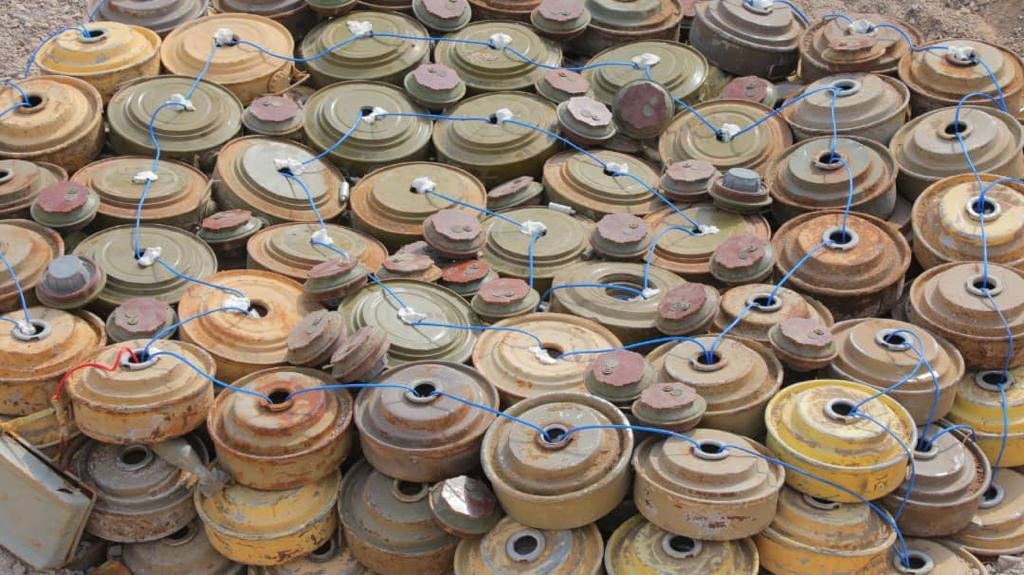
ADEN, Yemen — A Saudi-funded mine clearance project said it removed 819 mines and explosive devices across Yemen during the fourth week of August.
Masam, run by Saudi Arabia’s King Salman Humanitarian Aid and Relief Centre, said the week’s haul included 23 anti-personnel mines, 29 anti-tank mines, 764 pieces of unexploded ordnance and three improvised explosive devices, the Yemeni state news agency Saba reported.
The project said the operation brought its August total to 10,099 devices.
Saba put Masam’s running total since the project began at 588,325. Published cumulative tallies for the project vary between sources, and Yemen Herald could not reconcile the figures.
The account of the week’s clearance rests on Masam’s own reporting, relayed by Saba. No independent body has published a separate count for the period.
Masam and Saba attributed the devices to the Houthis. The movement rejects the description of its forces as an Iranian proxy and has not commented on the weekly tally.
The project has operated since July 2018 under the Saudi relief centre, which describes it as the Saudi Project for Landmine Clearance in Yemen.
It is carried out by Saudi and international specialists working with trained Yemeni demining teams, according to the centre.
The relief centre extended the project’s contract for a further year with funding of about USD 52.5 million.
Weekly totals swing widely. Masam has reported clearances ranging from several hundred to more than 3,000 devices in a single week during 2026.
Mines and unexploded ordnance are among the longest-lasting hazards of Yemen’s war. They remain in place after fighting moves on, and they sit in farmland, on roads and around water points.
Clearance work is concentrated in areas held by the internationally recognised government. Masam does not operate in territory controlled by the Houthis.
That leaves a large share of contaminated ground unsurveyed, and no comprehensive national map of contamination has been published.
The Houthis seized Sanaa in September 2014 and the government moved its seat to Aden. Several ministries and the central bank work from the southern port city; others operate from Riyadh.
A UN-brokered truce took effect in April 2022 and lapsed that October. Formal negotiations have not resumed.
Front lines have been broadly static since, but shelling, drone strikes and mine incidents continue.
Yemen’s humanitarian position remains among the worst tracked by the United Nations.
The UN Office for the Coordination of Humanitarian Affairs said in its March 2026 response plan that more than 22 million people need assistance and that 18.3 million are acutely food insecure.
More than 2.2 million children under five are acutely malnourished, 516,157 of them severely, the plan said. It recorded 5.2 million internally displaced people.
The plan seeks USD 2.16 billion to reach 12 million people this year.
Contamination bears directly on those figures. Blocked roads slow aid convoys, and mined farmland cannot be planted.
Saudi Arabia is among Yemen’s largest donors and leads the military coalition that intervened in 2015 on the side of the government.
The relief centre also funds health, nutrition, water and shelter programmes in Yemen.
Saba did not name the governorates covered by the latest week’s work, and gave no figure for the area cleared.
Nor did it report any casualties among the clearance teams during the period.
Demining is slow work. Teams survey ground on foot, mark hazards and destroy devices in controlled detonations.
The Presidential Leadership Council, chaired by Rashad al-Alimi, has governed the internationally recognised side of the conflict since April 2022. Prime Minister Shaya Zindani has led the cabinet since February.
Saba said the council held a joint session with the government on Wednesday to review what the agency called comprehensive deterrent measures. It gave no detail.
Unexploded ordnance made up the great majority of the latest week’s total, at 764 of the 819 items. Anti-tank mines outnumbered anti-personnel mines, 29 to 23. Improvised devices accounted for three.
The 819 figure is lower than several weekly totals Masam reported earlier in the year, including 2,676 and 2,157 devices in separate weeks. The project reported clearing about 3,500 devices during March.
Masam publishes its weekly clearance figures through Saudi state media.
Yemen ratified the 1997 Mine Ban Treaty in 1998. The treaty prohibits the use, production, stockpiling and transfer of anti-personnel mines.
The King Salman Humanitarian Aid and Relief Centre was established in 2015 and runs Saudi aid programmes worldwide. It said the extended contract covers a further year of operations.
Yemeni officials have repeatedly linked the return of displaced families to the clearance of farmland and access roads.
The report came during a sharp escalation between Iran and the United States across the wider Gulf.
Iran fired ballistic missiles and drones at US bases in Kuwait, Bahrain, Jordan and Erbil in northern Iraq, Gulf News and Asharq Al-Awsat reported. Yemen’s foreign ministry condemned the attacks on Wednesday.
Saudi Arabia’s foreign ministry separately condemned Iran’s targeting of the tanker Sidr in the Strait of Hormuz, saying crew members were killed. Yemen Herald has not independently verified that toll.
The Houthis have attacked commercial shipping in the Red Sea and the Gulf of Aden since late 2023, targeting more than 100 vessels between November 2023 and January 2024.
Saba filed its report on the clearance figures from Aden on Tuesday.
About the Author