Yemen’s water minister and UNDP’s Nora Hamladji review projects and COP31 preparations
 Yemen Herald News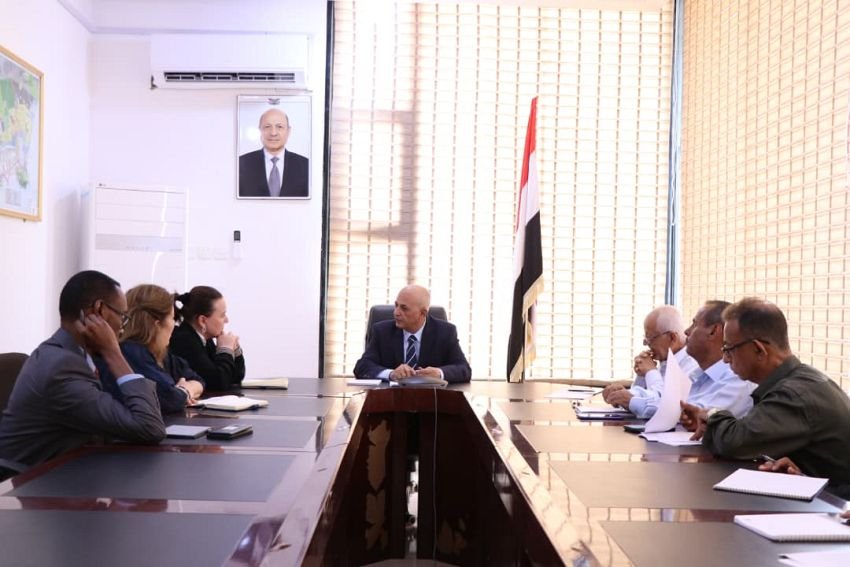
ADEN, Yemen — Yemen’s water minister met the UN Development Programme’s new resident representative on Sunday to review joint projects and prepare for the COP31 climate talks.
Eng. Tawfiq al-Sharjabi, the minister of water and environment, held the talks with Nora Hamladji, the UNDP resident representative in Yemen, the state news agency Saba reported.
The two reviewed the projects and programmes the UNDP runs in partnership with the ministry and its affiliated institutions, Saba said.
They went through how far those initiatives had progressed and what they had delivered to local communities.
Obstacles took up part of the meeting. The two sides discussed the difficulties holding up a number of projects, and ways to clear them and speed up implementation, according to the agency.
Al-Sharjabi said support and interventions should be directed to what he called the actual priorities of the water and environment sectors.
He said the ministry wanted to draw on the expertise and resources the programme has available to develop existing projects.
The minister praised the UNDP’s role in supporting government efforts. He said the ministry was committed to developing cooperation and coordination mechanisms that make projects and services more durable.
Hamladji said the programme would continue to cooperate with the ministry and would support priority projects in the two sectors, Saba reported.
The account of the meeting rests on Saba, the news agency of the internationally recognised government. Yemen Herald found no independent confirmation of it.
Hamladji is new in the post. She presented her credentials to Vice Foreign Minister Mustafa Noman in Aden on Aug. 25, Saba reported at the time. The two discussed cooperation and the programme’s work in the country.
The officials also discussed coordination ahead of Yemen’s participation in the 31st UN climate change conference.
COP31 runs from Nov. 9 to Nov. 20 at the Antalya Expo Center in southern Türkiye, according to the UN Framework Convention on Climate Change. A World Leaders Climate Action Summit is scheduled for Nov. 11 and 12.
Each of the conference’s twelve days is set aside for a priority area of climate action, organisers say. They expect about 100,000 participants, among them UN agencies, observer organisations, civil society groups, business representatives, academics and accredited press.
Al-Sharjabi said Yemen should use the conference to set out its priorities and needs on climate change.
The country has little water to work with. Renewable freshwater availability is about 86 cubic metres a person a year, among the lowest figures in the world, according to research published by the Sana’a Center for Strategic Studies.
That is well under the 500 cubic metres a person a year that the Falkenmark indicator treats as absolute scarcity.
Other estimates put the figure at 81 cubic metres and project a fall to 55 by 2030.
Groundwater extraction has run ahead of recharge for decades in the Sana’a, Taiz, Dhamar and Tuban-Abyan basins and in the Tehama and Middle Highlands systems, the research says. Water tables there are dropping by two to six metres a year.
Drought, flooding and storms have become more frequent and dry spells longer, the same research says. It projects that droughts will grow more intense and more frequent.
In Aden, aquifers are expected to run dry and outdated infrastructure loses more than 40 percent of the available supply, the UNDP says.
Much of the programme’s work in the sector has leaned on solar power. It says it is working to pair desalination with renewable energy.
It opened a solar-powered desalination plant in the Burr area of Seiyun that it says gives about 20,000 people access to clean water.
A solar-powered water system and pipeline in Al-Akahel serves 5,827 people, according to the programme. It has also installed 12 solar-powered pumping systems for irrigation in Al-Mosaymer.
Among its named schemes is one on integrated water resources management intended to strengthen the resilience of agriculture and food security.
The programme has drawn up a blueprint for water, sanitation and hygiene and for solid waste management in Aden. The document assesses whether solar- and wind-powered desalination plants would work in the city.
The UNDP lists climate change, water, energy and the environment as one of its focus areas in Yemen. It designs interventions with the ministry on climate adaptation, disaster risk reduction, sustainable energy and ecosystem conservation.
Water sits inside a wider relief operation that is short of money. The UN Office for the Coordination of Humanitarian Affairs counted more than 22 million people in need of assistance in its 2026 humanitarian plan for Yemen.
The plan lists 18.3 million people as acutely food insecure and more than 2.2 million children under five as acutely malnourished, 516,157 of them severely. It records 5.2 million internally displaced people.
OCHA asked donors for $2.16 billion to reach 12 million of them. It issued the plan in March.
The ministry sets water and environment policy in areas held by the internationally recognised government, which has been based in Aden since 2015. The Houthi authorities run a parallel administration in Sanaa.
Saba did not say whether the two sides agreed on any new projects. It did not name the projects they discussed.
About the Author