Rights groups say Houthi missile strike on Marib camp killed two children
 Yemen Herald News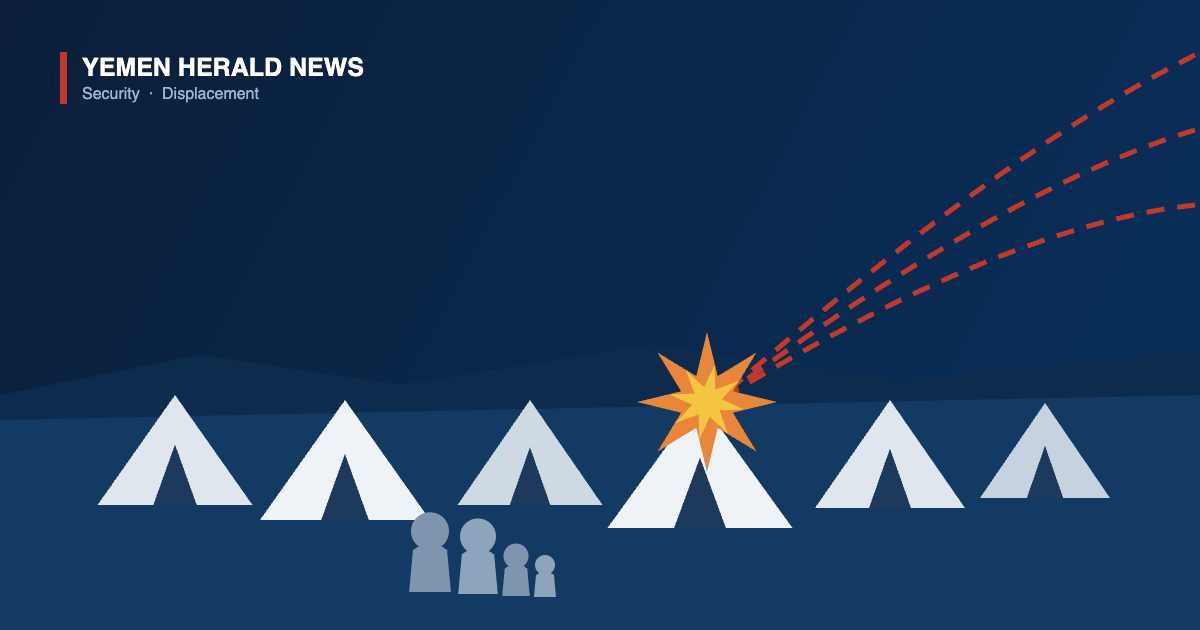
MARIB, Yemen — A ballistic missile struck a camp for displaced people in northern Marib on Monday evening, killing two children and wounding about 15 others, a Yemeni rights group said.
The Siyaj Organization for Childhood Protection said the two children who died were aged five and seven.
The group put the combined number of dead and wounded at 17. It said most were children, and that eight of the wounded were children.
The camp lies in Raghwan district, north of Marib city. Siyaj set out the toll in a statement on Tuesday.
Siyaj attributed the attack to Houthi forces. It quoted witnesses as saying the camp was hit by a ballistic missile.
The organisation described the strike as a crime against civilians and children. It called for those responsible to be held to account.
Yemen’s Ministry of Human Rights condemned the attack in a separate statement. The ministry said the strike violated international humanitarian law and international human rights law.
The ministry said the attack formed part of a pattern of strikes on populated areas and on civilian infrastructure. It urged international organisations to document the incident.
The American Center for Justice, a rights group that monitors Yemen, condemned the attack on Tuesday. It said field information indicated the Houthi group had hit the camp with a ballistic missile.
The centre described the strike as a direct attack on civilians who had been forced to flee their home areas to escape armed confrontations.
It called the targeting of displacement sites and civilian facilities a grave violation of the rules of international humanitarian law. Such attacks compound the suffering of civilians and displaced people in Yemen, it said.
The centre urged the United Nations and the international community to strengthen accountability and open independent investigations into the attack.
It also called for the prosecution of those responsible, so that perpetrators do not go unpunished.
TASS, the Russian state news agency, reported on Monday that at least two people had been killed. It cited the Al Hadath television channel.
TASS said several more people were wounded. Al Hadath reported that the projectile was a ballistic missile fired by the Houthi movement, which calls itself Ansar Allah.
Yemen Herald found no public Houthi statement on the Raghwan strike. The movement has previously rejected accusations that it targets civilians.
Siyaj said the attack came against the background of what it called a widespread recruitment campaign involving thousands of children and adolescents in areas under Houthi control.
The group said those recruits had been sent to front lines in Hodeidah, Taiz, Marib, al-Bayda and al-Jawf.
Siyaj also accused the Houthis of expanding the planting of anti-personnel mines, particularly in Hodeidah province.
The organisation said hundreds of families had been forced from their homes in Taiz and Hodeidah. It called for an immediate halt to the practices it listed.
The Houthi movement has denied recruiting children into its ranks. It disputes government accounts of civilian casualties in areas under its control.
Fighting has widened across several Yemeni fronts since late August. Clashes have been reported in Taiz, Hodeidah, Marib, al-Jawf and al-Bayda.
The United Nations said the escalating fighting had displaced more than 5,600 families within days.
The Executive Unit for the Management of Displaced Persons Camps, a government body, said 2,183 families were displaced in Taiz and Hodeidah by early September.
The UN Population Fund said its emergency teams had reached 8,365 newly displaced people in Taiz and on Yemen’s west coast.
Hans Grundberg, the UN special envoy for Yemen, has said the recent escalation risks widening the war.
Marib has taken in one of the largest displaced populations in the country. Local authorities have described the province as hosting a substantial share of Yemen’s displaced.
The province was the focus of a prolonged Houthi offensive in 2021 and 2022. Front lines around it have shifted repeatedly since then.
The UN Office for the Coordination of Humanitarian Affairs said in its humanitarian needs and response plan for 2026 that more than 22 million people in Yemen need assistance.
The plan recorded 18.3 million people as acutely food insecure. It counted 5.2 million people as internally displaced.
More than 2.2 million children under five are acutely malnourished, according to the plan. It recorded 516,157 of those cases as severe.
OCHA sought $2.16 billion this year to reach 12 million people.
The International Organization for Migration said aid agencies had reached 663 households with household items across Taiz and Hodeidah by the end of last week. It said further supplies were in transit.
The Masam demining project, which is funded by Saudi Arabia, said it removed 863 mines in a single week. It has cleared more than 589,000 devices since 2018.
The International Committee of the Red Cross reviewed prosthetics and physiotherapy services at a rehabilitation centre in Marib this month.
Yemen’s war began when the Houthis took the capital, Sanaa, in September 2014. A Saudi-led coalition intervened in March 2015.
The Houthi movement holds Sanaa and much of northern Yemen. The internationally recognised government is based in Aden.
Raghwan lies in the north of Marib province, near the boundary with al-Jawf. Marib city is about 170 kilometres east of Sanaa.
About the Author