Al-Sharjabi asks German lawmakers in Berlin to widen Yemen development cooperation
 Yemen Herald News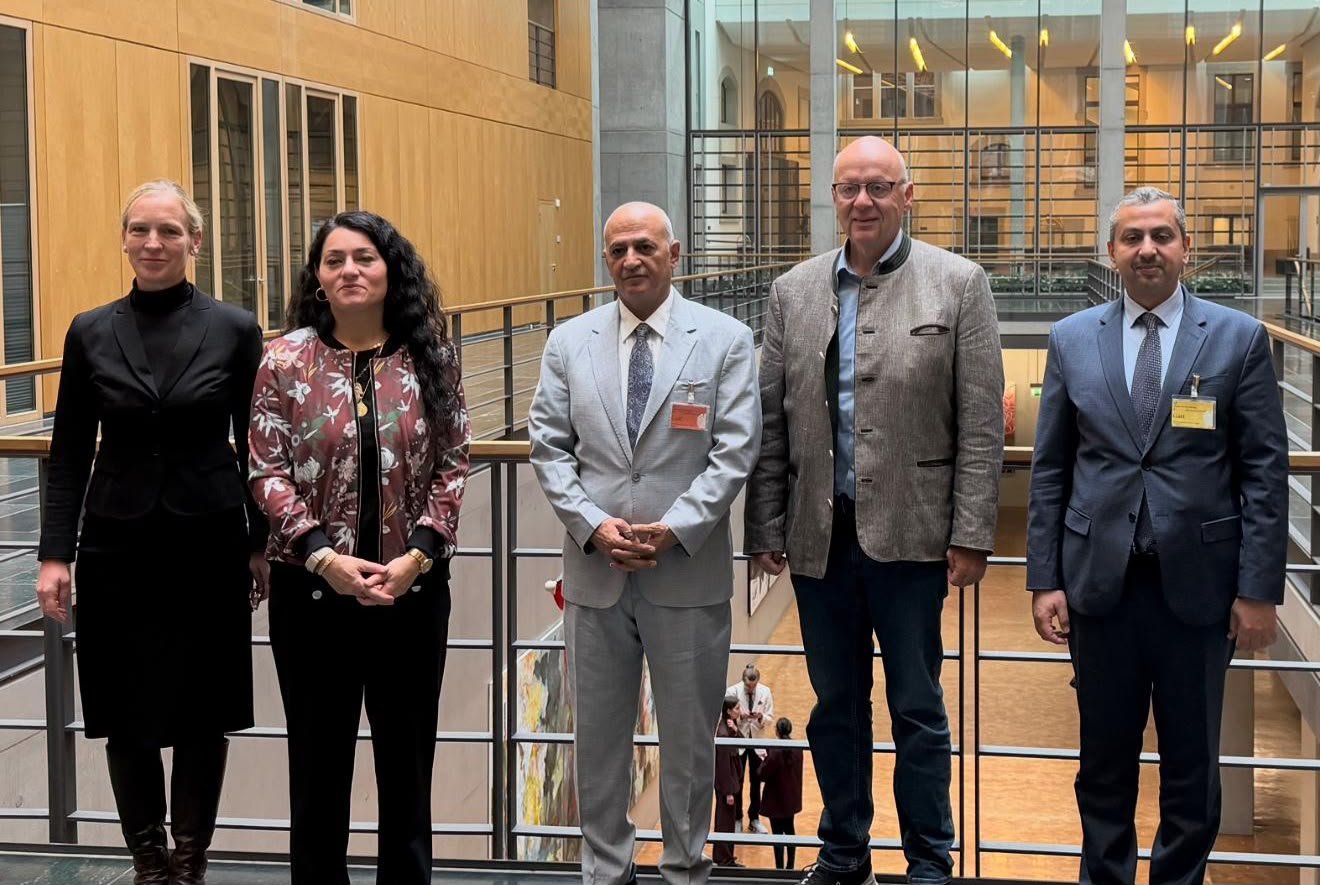
BERLIN, Germany — Yemen’s water and environment minister asked German lawmakers to widen development cooperation with his government, the Yemeni state news agency reported Friday.
Tawfiq al-Sharjabi met Alexander Radwan in the German capital, Saba said. The agency identified Radwan as chairman of the German parliament’s committee on Arab-German relations.
Committee member Lamia Kaddour attended, along with Aline von Steffens of Germany’s federal environment ministry, according to the agency.
Al-Sharjabi pressed for cooperation to be expanded in priority sectors, Saba said. He singled out the role of KfW, the German state development bank, in supporting projects in Yemen.
The minister also raised maritime security. Protecting waterways and ensuring safe international navigation require stronger international coordination with the Yemeni government to safeguard the Red Sea and Bab al-Mandab, he said, according to the agency.
He told the lawmakers that Houthi escalation had deepened humanitarian and security pressures, Saba reported. The Houthi administration rejects the government’s account of the fighting and attributes the escalation to its opponents.
Radwan reaffirmed German support for Yemen and a commitment to continued humanitarian assistance for Yemenis, the agency said.
The account of the meeting rests on Saba, which is run by the internationally recognised government. Yemen Herald found no independent confirmation of the talks, and no second origin for the remarks attributed to either man.
Radwan has sat in the Bundestag since 2013 for the Christian Social Union. He is his parliamentary group’s rapporteur for relations with the Middle East, the Maghreb and Sudan, and sits on the finance committee and the foreign affairs committee.
Germany is among Yemen’s larger bilateral donors. The federal foreign office says it provided 50 million euros in development cooperation and more than 25 million euros in humanitarian assistance in 2025.
Water is one of the sectors Berlin has concentrated on. The development ministry lists drinking water supply and sanitation among its priorities in Yemen, alongside education, health, food security and good governance.
The ministry says about 11.3 million people have gained improved access to water and sanitation since 2015. It puts the rural figures at 285,000 households connected to safe drinking water and 140,000 households given adequate sanitation.
Its most recent published country commitment covers 2023, when it allocated 163.7 million euros. That comprised 63.9 million euros for financial and technical cooperation, 95.6 million euros in transitional development assistance and 4.2 million euros under a programme for displaced people and host communities.
KfW and the technical agency GIZ carry out much of that work. The ministry also channels money through the World Food Programme, the Food and Agriculture Organization and UNICEF.
KfW’s published work in the sector includes agreements signed in 2018 worth 31.5 million euros. Of that, 21.5 million euros went to drinking water and sanitation through the Yemeni Social Fund for Development, and the bank said 420,000 people would benefit from 116 separate projects.
Two further agreements that year each carried 5 million euros. One funded family planning work with the Yamaan Foundation. The other extended a maternal health voucher scheme that KfW said had distributed 57,500 vouchers for pre- and post-natal checks and supported 24,000 safe deliveries.
The development ministry also reports results in health. It says more than 100,000 children have been born in certified health facilities since 2017, and that renovations at 43 facilities reach about 3.4 million patients a year.
It says 49 health centres have been through quality certification, and that it helped 44 facilities restart operations.
In education, the ministry counts 787,000 pupils reached since 2015, among them 383,000 girls and 92,000 displaced children. It says more than 2,560 classrooms have been repaired.
More than 44,500 school employees, including 17,400 women, work in better conditions as a result, according to the ministry.
Employment programmes make up another strand. The ministry says cash-for-work schemes have created more than 56,300 jobs since 2015, and that 9,900 microfinance loans issued since 2021 have generated 22,400 more.
Cultural cooperation runs alongside the aid programmes. The federal foreign office lists archaeology as a field of joint work with Yemen.
German reach is uneven across the country. The federal foreign office says only a very limited number of humanitarian projects are running in areas the Houthis control.
The wider funding picture was set out in the humanitarian needs and response plan published in March. That plan counted more than 22 million people in Yemen needing assistance and 18.3 million who were acutely food insecure.
It recorded 5.2 million internally displaced people. It sought 2.16 billion dollars to reach 12 million of them.
The same plan put the number of children under five facing acute malnutrition at 2.2 million, with 516,157 of them severely malnourished.
Displacement has risen since. UNICEF said on Friday that nearly 130,000 people had been forced from their homes in the previous three weeks, among them an estimated 71,000 children.
More than one in four of nearly 2,900 children screened by UNICEF mobile teams in recent weeks were acutely malnourished, the agency said. More than 200 of them had severe acute malnutrition.
The agency also counted 243 schools closed or with classes suspended, affecting more than 137,000 students.
Berlin backs the UN-led effort to end the war. Yemen’s embassy in the German capital organised a separate bilateral cooperation conference there on Thursday.
About the Author