Al-Zouba tells New York panel Yemen is preparing a 2026-2030 health strategy
 Yemen Herald News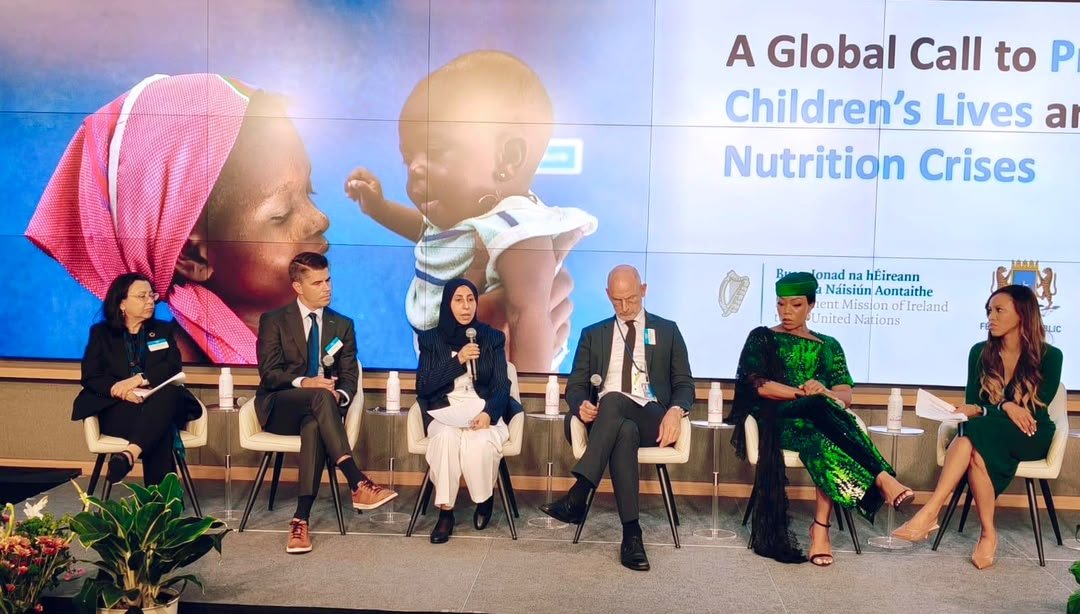
NEW YORK, United States — Yemen’s foreign minister told a UNICEF panel in New York that her government is preparing a national health strategy running from 2026 to 2030.
Afrah al-Zouba said the plan centres on primary healthcare, maternal and child health, nutrition and immunisation.
She said it also aims to build a health system that can keep operating under strain.
Al-Zouba spoke at a high-level panel on the sidelines of the 81st session of the UN General Assembly. The backdrop on stage carried the title “A Global Call to Protect Children’s Lives and Prevent Nutrition Crises”, alongside the emblem of the Permanent Mission of Ireland to the United Nations.
Saba, Yemen’s state news agency, reported her remarks on Friday. Yemen Herald found no independent account of the panel, and the description of what she said rests on that agency report alone.
The minister said Yemen needs to raise national investment in children and keep essential services running through its economic and humanitarian pressures.
She said continued Houthi escalation and attacks on populated areas had worsened conditions and displaced thousands of civilians.
Al-Zouba also said vaccine access was being obstructed in areas under Houthi control, and that health workers taking part in immunisation campaigns had been detained.
The Houthi administration disputes the government’s accounts of the fighting. It has said Saudi Arabia carried out air strikes in Taiz, al-Jawf and Marib. Riyadh has not confirmed those strikes.
The minister said her government is trying to hold two lines at once. It is keeping medicines, vaccines and clinics running while meeting the needs of people displaced by the latest fighting.
Al-Zouba credited UNICEF with helping prevent a collapse of essential health services. She asked for continued assistance and closer cooperation with her government.
Her remarks come during renewed fighting. Reporting by Al Jazeera described government losses along the Red Sea coast in early September, with clashes continuing through the month.
That reporting recorded fighting in al-Jawf on 15 September, and government claims a week later to have taken high ground in Taiz and near Kahboub, overlooking the Bab al-Mandab strait. The Houthis dispute such accounts.
The International Organization for Migration counted about 132,000 people displaced in the recent fighting, including about 75,000 in Taiz governorate, according to that reporting.
UNICEF projects that 2.2 million children under five will be acutely malnourished in Yemen this year. It expects more than 500,000 of them to be severely malnourished.
Akhil Iyer, the agency’s country representative in Yemen, gave that projection at a press briefing in Geneva on Friday, separately from the New York panel.
UNICEF also reported that 243 schools had closed or suspended classes, affecting more than 137,000 students.
The agency said it was expanding its response around the recent fighting to reach 231,000 people.
Its appeal for Yemen this year seeks 146.3 million dollars to provide services to 5.2 million people, including 3.5 million children.
Under that appeal UNICEF plans to admit 412,100 children with severe wasting for treatment during 2026.
The wider relief picture was set out in the humanitarian needs and response plan published in March.
That plan counted more than 22 million people in Yemen needing assistance and 18.3 million who were acutely food insecure.
It recorded 5.2 million internally displaced people, and sought 2.16 billion dollars to reach 12 million of them.
The same plan put the number of children under five facing acute malnutrition at 2.2 million, with 516,157 of them severely malnourished.
Al-Zouba took office in July. She was appointed by republican decree, the first woman to run Yemen’s foreign ministry.
She served as minister of planning and international cooperation earlier in 2026. Before that she ran a government bureau set up to speed the absorption of aid and support policy reform.
She trained as a pharmacist at Sanaa University and holds a master’s degree in community health and health economics.
She was first deputy secretary-general of the National Dialogue Conference between 2013 and 2015, and later sat on the committee that drafted a new constitution.
She is from al-Bayda in central Yemen, and worked for more than 25 years in development and peacebuilding before entering the cabinet.
She has used the General Assembly to press Yemen’s case with several governments.
Italy’s foreign minister, Antonio Tajani, spoke with her by telephone on 16 September about de-escalation and freedom of navigation in the Red Sea, according to the Italian foreign ministry.
Tajani said Italy backs the internationally recognised government, and referred to Italy’s part in the European Union’s Aspides naval operation in the Red Sea.
Tajani condemned Houthi attacks on civilians and on Saudi Arabia during the same call, the ministry said.
Aspides is the European Union’s naval operation in the Red Sea and the Gulf of Aden, tasked with protecting merchant shipping.
Al-Zouba told him she would attend the second meeting of the Rome Coalition on food security in New York during the assembly, the ministry said.
The Rome Coalition is an Italian-led initiative on food security in vulnerable countries, according to the ministry.
Abdullah al-Alimi, a member of the Presidential Leadership Council, is leading Yemen’s delegation to the assembly.
About the Author