Bawazir discusses Houthi escalation and Red Sea security with UN chief Guterres in New York
 Yemen Herald News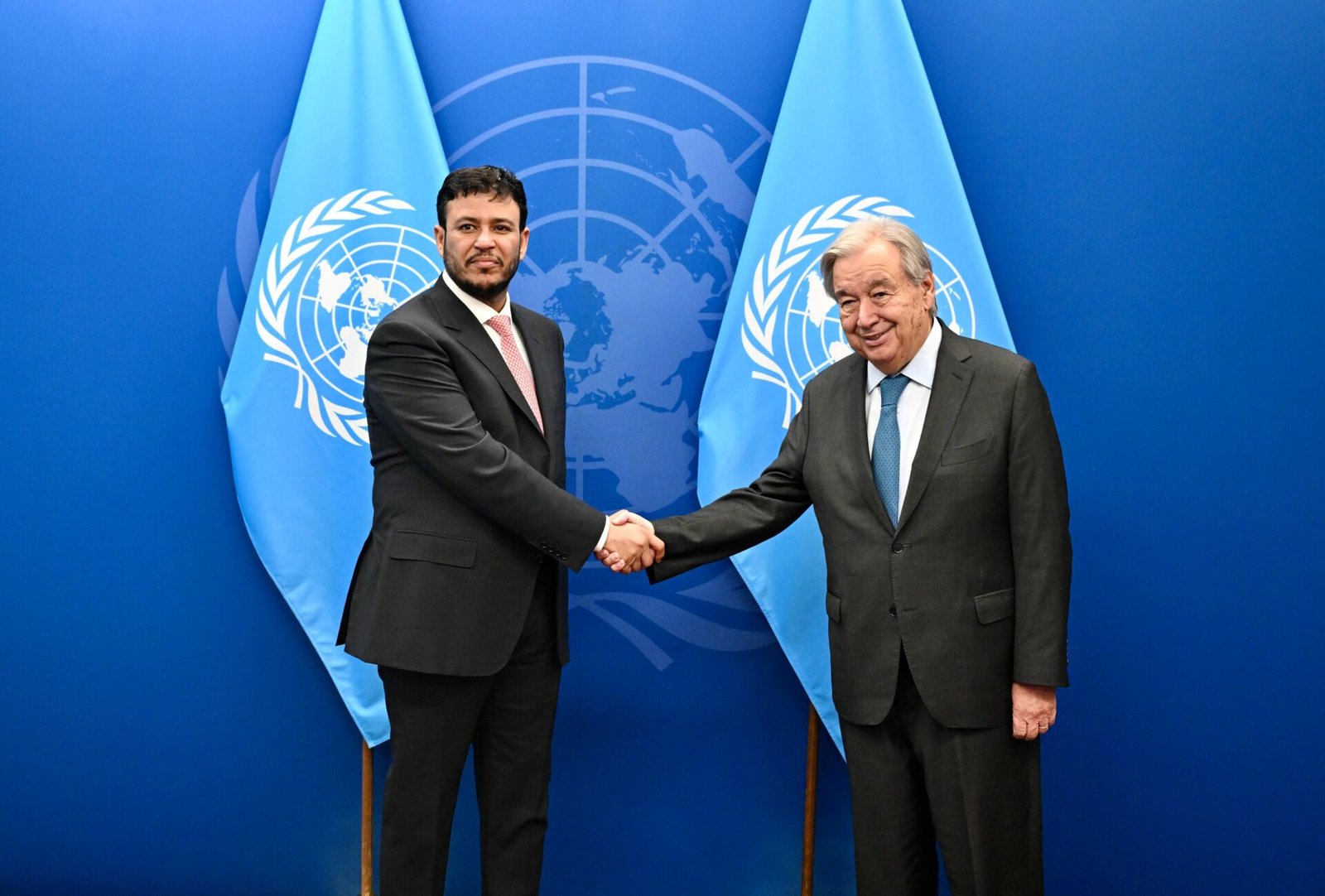
NEW YORK, United States — Yemeni Presidential Leadership Council member Abdullah al-Alimi Bawazir met UN Secretary-General António Guterres on Saturday on the sidelines of the General Assembly.
Bawazir thanked Guterres for the United Nations’ work on Yemen, according to Saba, the state news agency of Yemen’s internationally recognised government.
“Thank you very much Mr. Guterres, we’re deeply grateful to you,” Bawazir said in remarks carried by the agency. “We highly appreciate your interest in Yemen.”
Bawazir credited Guterres with mobilising international efforts to ease the suffering of Yemenis, end the war and make peace, Saba said.
Saba is the only source for the meeting. Yemen Herald found no independent confirmation of it, and the United Nations has published no readout.
The United Nations describes Bawazir as vice-president of the Presidential Leadership Council. Saba refers to him as a member of the council.
The talks covered the military escalation by the Houthi group, the political, security and humanitarian situation in Yemen, and threats to shipping in the Red Sea and the Bab al-Mandab strait, the agency said.
They also covered United Nations peace efforts and the humanitarian and economic effects of the fighting, including displacement, according to Saba.
Guterres restated the organisation’s commitment to Yemen and repeated a call for the release of UN personnel and aid workers held by the Houthis, the agency reported.
Those detentions are documented independently. The United Nations said in March that 73 of its staff were being held in Yemen by the Houthi authorities, part of 118 UN personnel detained worldwide.
Eight of those held in Yemen work for the UN human rights office. Some have been in custody for about five years.
The Houthi authorities have not released them, and the United Nations repeated its demand in June.
Volker Türk, the UN high commissioner for human rights, said in March that detainees had been “deprived of their liberty for five years now” and called for their immediate and unconditional release.
Guterres said in the same statement that “no colleague is forgotten”.
Bawazir addressed the general debate of the 81st session on 24 September, two days before the reported meeting.
He spoke on the third day of the debate, which opened on 22 September.
He told the assembly that Yemen’s government had engaged with peace initiatives while the Houthis refused to cooperate, according to the United Nations’ own account of the speech.
“An entire generation was born amid war, grew up amid hunger, fear and weapons,” he said.
Bawazir said the Houthis had used humanitarian truces to build military capability and had turned maritime navigation into “a tool for blackmail” that threatened global commerce.
He tied shipping security to the condition of the Yemeni state. “The path to a secure sea requires a stable Yemen,” he said, adding that there is no stability in Yemen without restored government institutions.
He said the government’s fight was not against Yemeni citizens but against “an armed coup” that had seized state institutions.
Bawazir asked governments to support Yemen’s national institutions and economy rather than intervene directly.
The Red Sea file has moved during 2026. The Houthis took the port city of Mokha and Perim Island, at the mouth of the Red Sea, and government forces mounted counterattacks to retake them, Time reported on 14 September.
The Houthis have also fired missiles at Saudi Arabia and struck Saudi oil infrastructure, and declared a blockade on Saudi vessels in July, according to the same report. The group has framed its campaign against shipping as support for Palestinians in Gaza.
Oman postponed diplomatic talks between Iran and Gulf states, its foreign minister Badr Albusaidi said, in the same report.
The US Maritime Administration has kept an advisory in force for the Red Sea, the Bab al-Mandab strait, the Gulf of Aden, the Arabian Sea and the Somali Basin. It was issued on 26 March and ran through 22 September.
The advisory recorded more than 100 Houthi attacks on commercial vessels affecting more than 60 nations between November 2023 and October 2025. It said two vessels were sunk in July 2025 and four seafarers were killed.
It advised US-flagged ships to keep clear of Yemen’s coastline, vary course and speed, and register with the UK Maritime Trade Operations centre before entering the voluntary reporting area.
It also told them to switch off their automatic identification system transponders where that did not compromise safety, and to coordinate voyage planning with US Naval Forces Central Command.
The UN Office for the Coordination of Humanitarian Affairs set out the humanitarian position in a plan published in March. It put the number of people needing assistance at more than 22 million.
The office recorded 18.3 million people as acutely food insecure and more than 2.2 million children under five as acutely malnourished, 516,157 of them severely.
It counted 5.2 million internally displaced people and sought 2.16 billion dollars to reach 12 million of those in need.
Hans Grundberg has been the UN special envoy for Yemen since 2021 and briefs the Security Council on the file at intervals.
Yemen’s delegation has held a series of bilateral meetings in New York during the session. Saba published its account of the Guterres meeting on 26 September.
About the Author