Afrah al-Zouba tells Arab League and OIC meeting Jerusalem needs action beyond statements
 Yemen Herald News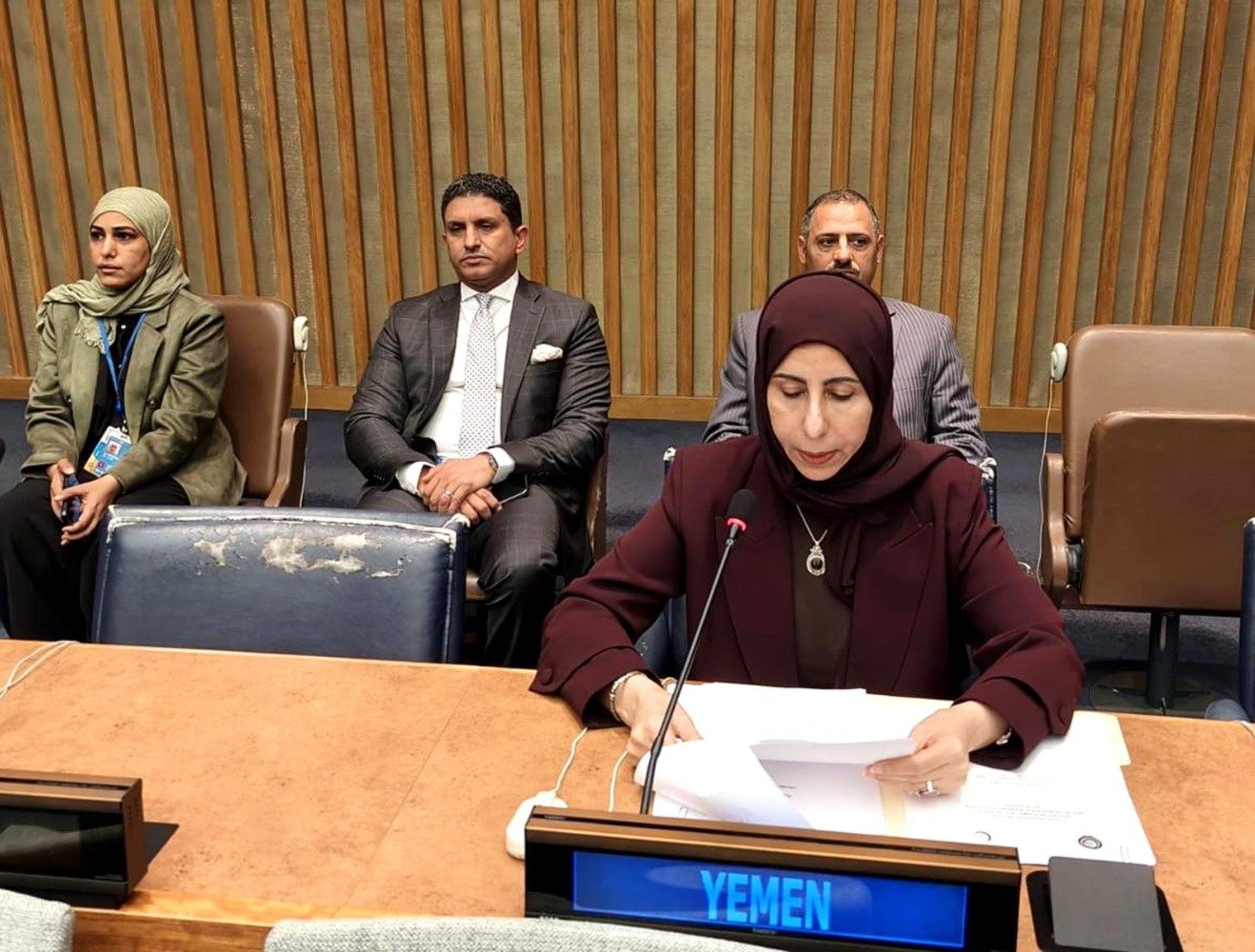
NEW YORK, United States — Yemen’s foreign minister asked Arab and Islamic states to move from statements to diplomatic action on Jerusalem, at a joint ministerial meeting in New York.
Afrah al-Zouba spoke on 26 September at a joint meeting of the Arab League and the Organisation of Islamic Cooperation, held on the sidelines of the 81st session of the UN General Assembly.
She called for urgent international political and diplomatic action to protect Jerusalem and its holy sites, according to Saba, Yemen’s state news agency.
She also called for an end to violations against the Palestinian people, and for Israel to be compelled to comply with international resolutions, the agency reported.
The account of al-Zouba’s remarks rests on Saba. Yemen Herald found no independent report of what she said, although the meeting itself was covered elsewhere.
Saba operates rival newsrooms. The Aden-based service reports for the internationally recognised government, while a separate operation in Sanaa serves the Houthi authorities.
Al-Zouba said Jerusalem was not merely a political issue but one tied to the historical and legal rights of the Palestinian people, and to the city’s significance for Arab and Muslim populations, Saba reported.
She said East Jerusalem was an integral part of the occupied Palestinian territory and the capital of an independent Palestinian state along the 4 June 1967 borders, in line with international resolutions and the Arab Peace Initiative.
Israel disputes that description. It treats Jerusalem as its undivided capital, a position most states do not recognise.
Al-Zouba described raids on Al-Aqsa Mosque, settlement expansion, home demolitions and forced displacement as connected practices that threatened the character of the city and the prospects for peace, according to Saba.
She said unilateral changes to the legal status of Jerusalem contradicted international law, the agency said.
She urged the international community to go beyond repeated diplomatic statements, towards what she called more effective political and diplomatic action, and to oppose annexation and displacement.
Yemen reaffirmed its support for joint Arab League and OIC initiatives on the holy sites and on Palestinian rights, Saba reported.
Other accounts of the meeting confirm that it took place.
The Palestinian news agency Wafa reported that the Arab League and the OIC held a meeting on Jerusalem at the UN on 26 September.
Arab League Secretary-General Nabil Fahmy told the meeting that the international community should go beyond condemnation, and should act to protect Jerusalem and its holy sites and compel Israel to halt what he called colonial and expansionist activities, Wafa reported.
Fahmy rejected attempts to alter the demographics of the Palestinian territories, the agency said. He said Israeli policies were aimed at changing the identity, character and legal and historical status of Jerusalem.
Qatar also took part in the meeting, Gulf Times and The Peninsula reported.
The two organisations have worked on Jerusalem together before. Arab and Muslim ministers launched a plan to protect religious sites in the city on 5 August, Al Jazeera reported.
That plan was agreed at a meeting in Jordan by the Arab ministerial committee on Jerusalem, with representatives from Turkiye, Pakistan, Indonesia and Malaysia, according to Al Jazeera.
The declaration set out a permanent mechanism to document alleged Israeli violations at Islamic and Christian holy sites in East Jerusalem, and a media platform to publicise them.
It also called for a joint ministerial meeting during the assembly’s high-level week in New York. That is the meeting al-Zouba addressed.
The ministers said in August that Jerusalem was in escalating danger and that its Islamic and Christian sanctuaries were threatened, Al Jazeera reported. They named the Al-Aqsa Mosque and the Church of the Holy Sepulchre.
Al-Zouba was appointed foreign minister on 23 July, the first woman to hold the post in Yemen.
She had been minister for planning and international cooperation since February.
Before entering the cabinet she was executive director of the Executive Bureau for Accelerating Aid Absorption and Supporting Policy Reforms, from 2021, and an adviser on humanitarian relief and development to Prime Minister Maeen Abdulmalik from 2019.
She served as first deputy secretary-general of the National Dialogue Conference between 2013 and 2015, and sat on the Constitution Drafting Committee.
She worked as a UN consultant on Yemen peace process consultations from 2016 to 2017, and earlier as a programme officer for USAID.
Al-Zouba holds a pharmacy degree from Sanaa University, a master’s degree in community health and health economics from Malaysia, and an MBA from the University of Science and Technology in Yemen.
She is from al-Bayda, in central Yemen.
The Arab League secretary-general and al-Zouba discussed developments in Yemen in August, the league said in a statement at the time.
Yemen is a member of both the Arab League and the Organisation of Islamic Cooperation.
The Arab Peace Initiative, which al-Zouba invoked, was adopted at an Arab League summit in Beirut in 2002. It offers Israel normal relations with Arab states in return for withdrawal from territory occupied in 1967 and a settlement for Palestinian refugees.
Yemen does not have diplomatic relations with Israel, and has never recognised the state.
The Organisation of Islamic Cooperation was founded in 1969 and is based in Jeddah. It has 57 member states.
Yemen’s internationally recognised government has been based in Aden since 2015.
About the Author