Germany and Qatar call on Iran to stop arming the Houthis in Berlin declaration
 Adel Haddad
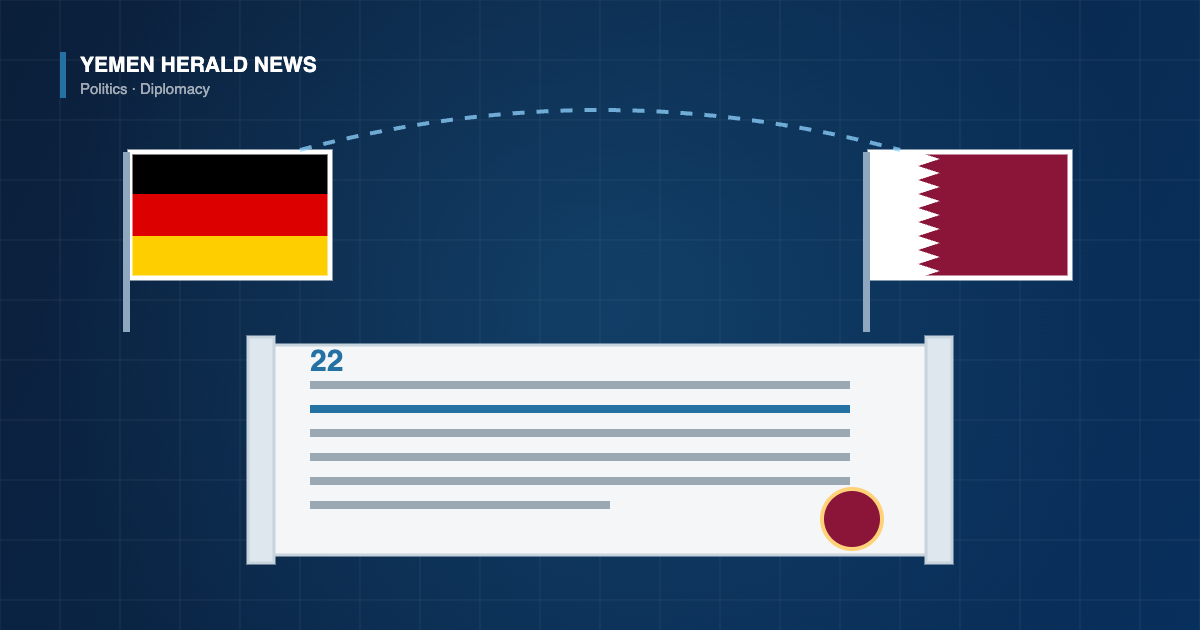
BERLIN, Germany — Germany and Qatar called on Iran to end its arming of and support for the Houthis in a joint declaration issued during a state visit on Friday.
The declaration condemned continued Houthi strikes in Yemen and against Saudi Arabia.
It expressed full solidarity with the government of Yemen and with Saudi Arabia.
It called on the Houthis to stop all military action immediately, along with all threats and attacks against civilian shipping.
It asked them to return to the political process in good faith.
It reaffirmed both governments’ commitment to Yemen’s unity, sovereignty, independence and territorial integrity.
And it backed the efforts of Hans Grundberg, the United Nations special envoy, toward a negotiated settlement the text called Yemeni-led and Yemeni-owned.
That is paragraph 22 of the declaration, five sentences on page seven of ten.
It sits in a section the document titles Global Challenges, Rules-based Order and Multilateral Cooperation.
Its placement is the part that carries meaning.
Paragraph 22 follows three consecutive paragraphs on Iran, and precedes the paragraph on the Middle East peace process.
The declaration does not name the Red Sea anywhere. The words civilian shipping appear only in the Yemen paragraph.
The Iran paragraphs run first. Paragraph 19 condemns Iranian attacks on Qatar and on other countries in the region.
It calls those attacks a violation of sovereignty and territorial integrity, and a breach of international law and the United Nations Charter.
It condemns Iranian attacks and threats against commercial vessels, and rejects any action that would close the Strait of Hormuz or impede freedom of navigation through it.
It calls for compliance with Security Council Resolution 2817, adopted this year.
Paragraph 21 says Iran must meet its obligations under the Non-Proliferation Treaty and to the International Atomic Energy Agency, and that it shall never develop or acquire a nuclear weapon.
The same paragraph calls for an end to ballistic missile threats, and to Iran’s support for, financing of and arming of affiliated armed groups in the region.
The Yemen paragraph then names one of those groups.
The declaration was published by the German federal government.
The visit ran from 20 to 21 November, at the invitation of President Frank-Walter Steinmeier.
Sheikh Tamim bin Hamad Al Thani, the Emir of Qatar, held talks with Chancellor Friedrich Merz.
Saba, Yemen’s state news agency, reported the condemnation from Berlin on Saturday.
The agency said the two sides had expressed full solidarity with the Yemeni government and Saudi Arabia, and had called on Iran to stop arming the Houthi militia.
Saba named no German official and gave no figures.
The Peninsula, a Qatari newspaper, published the declaration on Saturday, splitting the Yemen paragraph in two.
The declaration runs to about 34 numbered paragraphs across ten pages.
It covers security, trade, energy, climate, Gaza, Ukraine, Syria, water, culture and education alongside the regional war.
Paragraph 18 says trade routes must stay open and free, with no fees or other payments, and that diplomacy must be the first response to conflict.
Paragraph 20 commits both countries to implementing provisions of the International Maritime Organization and the United Nations Convention on the Law of the Sea.
Paragraph 28 says food security is being hit by the blockade in the Strait of Hormuz, Russia’s war in Ukraine and effects on Black Sea shipping.
Paragraph 3 says diplomacy and dialogue are the only means of sustainable conflict resolution, and records a memorandum on peace and reconciliation.
Paragraph 23 sets out a two-state solution on the 4 June 1967 border.
It covers the Gaza plan and roadmap under Security Council Resolution 2803, including the disarmament of Hamas and the withdrawal of Israeli forces from Gaza.
Paragraph 24 calls for unimpeded humanitarian access and compliance with international law.
Paragraph 25 supports Ukraine’s independence and territorial integrity and calls for a cessation of hostilities.
Paragraph 26 names the economic and financial recovery of Syria as a priority.
The European Union and Britain condemned the same escalation in their own summit statement the same day, in Brussels.
That text named the Red Sea and the Bab al-Mandab Strait, and did not name Iran in its Yemen paragraph.
The Berlin declaration names Iran and leaves out the Red Sea.
Qatar has acted as a mediator in the regional war. Al Jazeera reported this week that Iran said it had held talks with Qatari mediators.
Dr Ahmed bin Mohammed Al Sayed, Qatar’s minister of state for foreign trade, and Stefan Rouenhoff, a parliamentary state secretary in Germany’s economic affairs ministry, are named in the declaration. So are the two countries’ interior ministers.
The declaration names no Yemeni official.
It sets no timetable for the demands it makes of the Houthis, and names no consequence.
It does not mention Taiz, the Bab al-Mandab Strait or Hodeidah.
Grundberg is named without a further title.
Yemen Herald read paragraph 22 in the text published by the German government and in the Qatari newspaper’s version, and found the wording the same.
The two texts differ in punctuation, and in where the Yemen paragraph breaks.
Yemen Herald found no account of paragraph 22 from an independent wire service.
The German government posted the English text as a document on its website.
About the Author