Yemen’s agriculture ministry plans 2027 food security work as World Bank and UNDP list a December closing
 Adel Haddad
CAIRO, Egypt — Yemen’s agriculture ministry met partners in Cairo to plan 2027 work on a food security project that World Bank and UNDP documents record as closing in December.
A delegation from the Ministry of Agriculture, Irrigation and Fisheries discussed the Yemen Food Security Response Project with the World Bank, the U.N. Food and Agriculture Organization, the U.N. Development Programme, the International Committee of the Red Cross and local implementing partners, the state news agency Saba reported Saturday.
The talks covered the project’s progress, its achievements to date and planned interventions for 2027, Saba said. The agency named no officials and gave no figures.
Saba said the delegation praised the World Bank and the other organizations for supporting the government’s food security work.
The delegation called for closer coordination between the ministry, the World Bank and the implementing organizations, according to the agency.
It also pressed for a larger ministry role in planning, supervision, monitoring and evaluation across the project’s interventions, Saba said.
Published records from two of the institutions at the table give an end date that sits before the year the ministry was planning for.
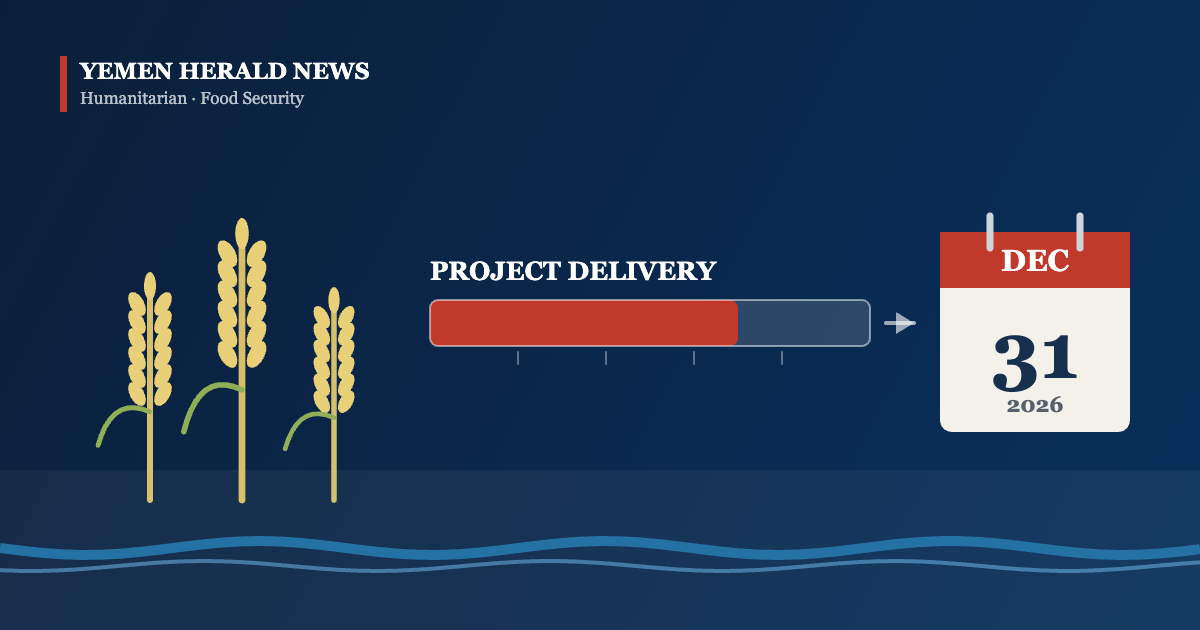
The World Bank’s most recent published status report on the project, dated Feb. 11, 2026, lists an operation closing date of Dec. 31, 2026.
A fact sheet issued by the U.N. Development Programme in June, covering the second quarter of 2026, says the project ends in December 2026. The agency’s project page gives a start date of July 2021 and an end date of December 2026.
Yemen Herald could not establish whether the closing date has been extended since those documents were published.
A report carried by Saba in October gave a third timeline. Yemen Herald reported on Oct. 29 that the ministry and FAO, reviewing progress in Aden, said the project began in August 2021 and was scheduled to run until March 2028.
That account put completion at about 70 percent and listed nine governorates: Lahj, Dhale, Taiz, Abyan, Shabwa, Dhamar, Hudaydah, Hajjah and Al-Jawf.
The World Bank approved original financing of $127 million on May 11, 2021, its status report says. The operation became effective on Aug. 6, 2021.
The bank approved additional financing of $150 million on Dec. 1, 2022, which became effective on Feb. 2, 2023, the same document says.
The report rates progress toward the project’s development objective as moderately satisfactory, and overall implementation progress as moderately satisfactory.
It rates the project’s overall risk as high. Political and governance risk, macroeconomic risk and fiduciary risk are each rated high, and environmental and social risk is rated substantial.
The status report says the project had reached more than 3.2 million beneficiaries.
It records 13 million small ruminants vaccinated against peste des petits ruminants and sheep and goat pox, against a closing target of 20 million.
Some 553,692 smallholder farm households had received productivity support through climate-smart interventions, against a target of 800,000, the report says.
It puts the number of people benefiting from community-based climate-resilient infrastructure at 42,199, against a target of 60,000.
The share of households with an improved food insecurity experience scale score stood at 16 percent, against a closing target of 35 percent.
The report lists 139 sub-projects completed and 110 under way, about 200 kilometers of rehabilitated roads and about 1.3 million workdays created.
It says rapid adjustments were needed to maintain implementation momentum, and that recently agreed action plans must accelerate.
The assessment drew on a World Bank support mission carried out from Nov. 16 to Nov. 27, 2025.
The project’s components, as costed by the bank, run to $38 million for cash-for-work on agricultural production infrastructure, $51 million for production and sale of nutritious crop, livestock and fish products, and $27 million for the nutritional status of vulnerable rural households.
A further $21.65 million is set against capacity building for food security management and climate resilience, and $12.35 million against project and knowledge management.
The U.N. Development Programme’s fact sheet describes the project as implemented by that agency, FAO and the World Food Programme across 50 districts.
The agency’s own component improves agricultural production infrastructure and builds climate resilience in partnership with the Social Fund for Development and the Public Works Project, the fact sheet says.
It records 1,362,158 workdays created, of which 132,269 went to women, and 43,883 people given work opportunities, of whom 4,069 were women.
The document lists 23,043 farmers with improved access to water and 17,755 with improved access to land.
It also records 8,896 hectares of improved and protected land, 13,785 hectares of irrigated agricultural land and 205.1 kilometers of improved agricultural roads.
The agency’s project page sets expected results at 1,547,000 workdays, of which 190,700 for women, and 52,900 people benefiting from climate-resilient infrastructure.
Yemen’s government has sought international support for food security as fighting has displaced hundreds of thousands of people since August.
The International Organization for Migration put displacement at 356,602 people in figures reported on Nov. 19.
The U.N. humanitarian response plan for Yemen published in March said more than 22 million people needed assistance and 18.3 million were acutely food insecure.
That plan recorded more than 2.2 million children under five as acutely malnourished, of whom 516,157 were severely malnourished, and sought $2.16 billion to reach 12 million people.
Saba timed its report from Cairo at 11:59 a.m. on Saturday.
About the Author