Yemen’s Riyal Recovers While Cash Disappears From Government-Held Cities
 Yemen Herald News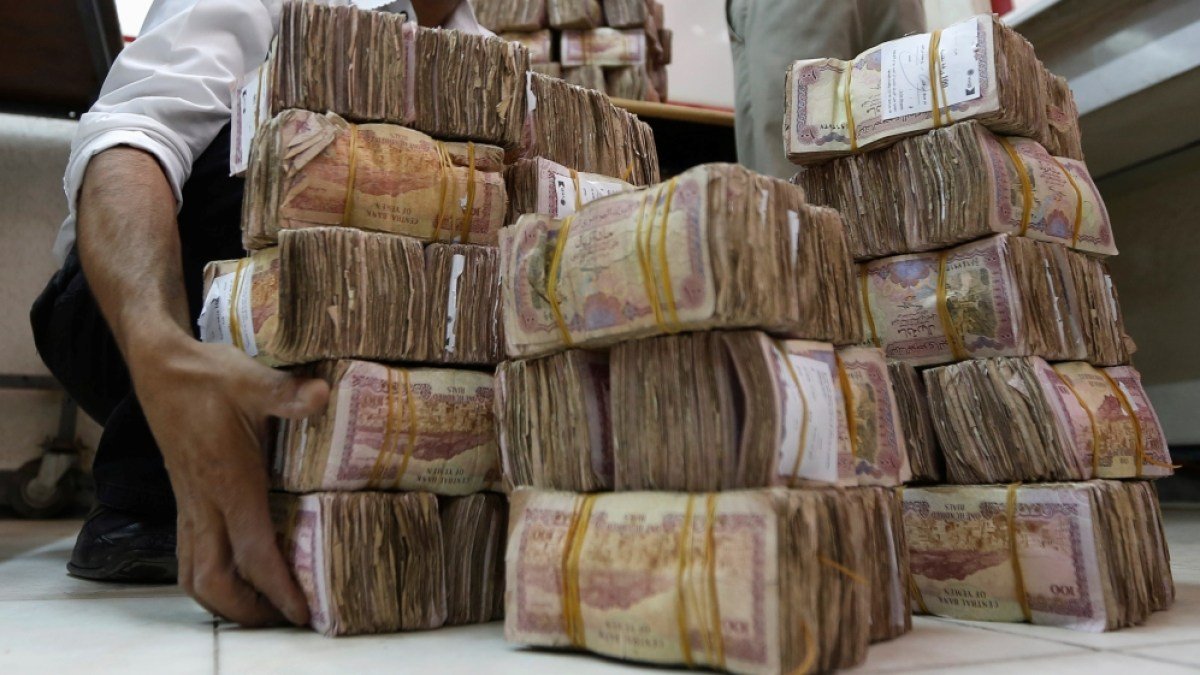
Yemen’s riyal staged a striking recovery in the first months of 2026, and the recovery brought a problem of its own. The currency, which had fallen to around 2,900 to the United States dollar, was trading at roughly 1,500 by April. In the same period residents of government-held cities reported that physical banknotes had become extremely hard to obtain, producing the awkward position of a stabilising currency that people could not get their hands on.
The scale of the earlier collapse is worth stating plainly, because it sets the baseline against which the 2026 recovery was measured. The riyal traded at roughly 215 to the dollar before the war. At 2,900 it had lost well over ninety per cent of its value, which in a country importing the great majority of its wheat, rice, fuel and medicine translates directly into what a household can afford at the market. A move back to 1,500 does not undo that.
The measures behind the recovery were taken by the central bank in Aden. It closed unauthorised exchange houses it accused of speculating against the riyal, brought internal remittances under a centralised and controlled system, and set up a committee to oversee imports and channel hard currency to traders. Those steps did what they were meant to do to the exchange rate. Halving the cost of a dollar in a country that imports most of its food and fuel is not a small achievement, and it fed through to import prices.
What followed was a liquidity squeeze rather than a devaluation. Reporting from Aden, Taiz, Mukalla and other cities under government control in April 2026 described an unprecedented shortage of riyal notes in circulation. Exchange companies said they could not obtain enough cash to meet demand. Yemenis described being unable to convert Saudi riyals, which circulate widely in the south, into local currency, and there were accounts on social media of patients turned away from health facilities that would not accept Saudi notes while exchange offices declined to change them.
Several explanations circulated at the time and they are not mutually exclusive. The most commonly cited was fiscal rather than monetary: governorates under government control, among them Marib, Hadramout, Al-Mahra and Taiz, had been withholding revenues from the centre. Local authorities that keep customs, tax and fuel receipts within their own boundaries starve the central bank of the deposits it needs to push notes back into the wider economy, and the effect concentrates in whichever cities depend most on transfers from Aden.
The second explanation is behavioural. Analysts pointed to very large sums held outside the banking system by traders and exchange firms, accumulated over years when holding riyals was a speculative position rather than a store of value. Money held for that purpose does not circulate. If a substantial share of the note supply sits in private hands waiting for a rate movement, the shortage inside banks is real for anyone queuing at a counter even though the notes exist somewhere in the country.
There is also a physical constraint that predates both. Yemen’s banking system split in 2016 when the central bank was relocated to Aden, leaving two institutions issuing conflicting instructions, and the printing and distribution of new notes has been contested ever since. Northern authorities have rejected notes printed for Aden, which limits where a given banknote can be used and effectively fragments the currency into circulation zones. A shortage in one zone cannot be relieved by a surplus in another.
The human consequence of all this is not abstract. Salaries in government-held areas are paid in riyals and are frequently late. Households buy food and medicine in cash, in markets where card payment barely exists. A person holding value in Saudi riyals or in a bank balance but unable to obtain physical local currency is, for practical purposes, without money on the day they need it. That is a different kind of hardship from inflation, and it hits hardest the people with the least room to wait.
Aid operations felt the squeeze alongside households. Humanitarian agencies working in government-held areas pay local staff, suppliers and transport contractors in riyals, and cash-transfer programmes hand physical money to beneficiaries. When notes are unobtainable, those payments stall regardless of how well funded the programme is, and the delay lands on people who already have no other income.
It is also a political problem for the government in Aden, which had presented the exchange-rate recovery as evidence that its economic management was working. That claim was defensible on its own terms. But the public experience of the same policy period was of queues, refused transactions and inaccessible cash, and a population that cannot withdraw its own money is unlikely to credit the authorities with a stronger currency. The government’s difficulty is that fixing the cash shortage requires the governorates to remit revenue to the centre, which is a question of political authority rather than of monetary technique.
Both problems, in the end, run back to the same source. A central bank cannot conduct monetary policy over territory whose fiscal flows it does not control, and it cannot manage a note supply that another authority refuses to recognise. The exchange-rate intervention showed that the institution in Aden retains real capacity when it acts within its reach. The cash shortage showed how short that reach still is.
About the Author