
Yemen’s Human Rights Ministry and IOM Discuss Support for Migrants Arriving from the Horn of Africa
 Yemen Herald News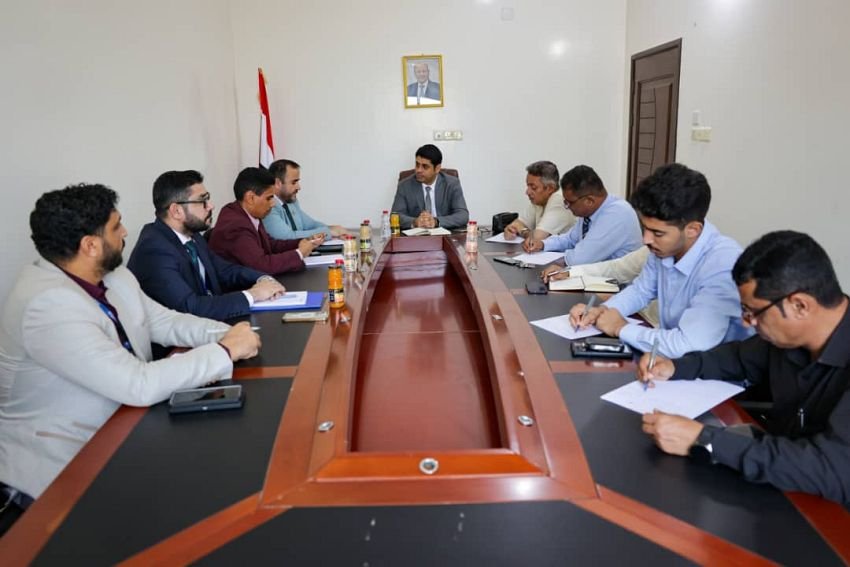
Yemen’s Minister of Human Rights, Mishdal Omar, held talks with Abdusattor Esoev, chief of mission of the International Organization for Migration in Yemen, on cooperation over the treatment of migrants transiting the country, according to reports at the time. The discussion covered coordination mechanisms between the ministry and the agency, protection for people most exposed to exploitation, and the delivery of humanitarian services to migrants and to Yemenis displaced by the war.
Yemen occupies an awkward position on one of the world’s busiest and most dangerous irregular migration routes. The country sits at the junction of the Arabian Peninsula and the Horn of Africa, separated from Djibouti by the narrow Bab al-Mandab strait, and it functions for most of those who arrive not as a destination but as a corridor towards work in Saudi Arabia and the Gulf. That transit role means Yemen absorbs the humanitarian cost of the route while having little control over what drives it.
The scale of that traffic increased sharply in early 2026. IOM figures recorded 57,414 arrivals from the Horn of Africa between January and March, the highest quarterly total since 2019 and an increase of about 81 per cent on the 37,166 recorded in the same period of 2025. Ethiopians accounted for roughly 95 per cent of arrivals in the quarter, some 54,643 people. Men made up about two-thirds of the total, with women and children each accounting for around 17 per cent. Djibouti remained the principal departure point, with Somalia the second.
Those journeys are made in small boats across a strait notorious for drownings, and they frequently involve smuggling networks that trade in coercion once passengers are ashore. IOM has documented patterns of abduction for ransom, forced labour and sexual violence along the route through Yemen, and the agency has repeatedly warned that first responders on the Yemeni coastline lack the capacity to meet arriving boats, leaving survivors of incidents at sea and migrants in distress without immediate assistance.
For migrants who reach Yemen, conditions are severe. They arrive in a country where the health system operates on a fraction of its pre-war capacity, where food insecurity is widespread among the resident population, and where they have no legal status, no access to formal employment and limited recourse if they are detained or exploited. Many become stranded when they run out of money before reaching the Saudi border, and some seek voluntary return, a process IOM administers by charter flight when funding and permissions allow.
This is layered on top of Yemen’s own displacement crisis. Millions of Yemenis have been forced from their homes since the war began in 2015, many of them repeatedly, and camps for the displaced are concentrated in governorates that also lie along the migration route. Competition for the same scarce shelter, water and health services can generate friction between displaced Yemenis and migrant populations, particularly in areas where local resources were already inadequate before either group arrived.
The ministry’s engagement with IOM reflects a broader argument the government has made to international agencies: that assistance channelled entirely through external bodies meets immediate needs but leaves Yemeni institutions no stronger. Officials have consistently pressed for training, technical support and capacity-building for ministries and local authorities alongside direct service delivery. Donors, for their part, have cited concerns about oversight and administrative capacity in explaining their preference for multilateral channels.
There is a policy dimension the meeting could not resolve. IOM’s expertise lies in migration management, but management assumes a functioning state with control over its territory, borders and coastline. Yemen’s government controls only part of the country, the coastline through which most migrants arrive spans areas under different authorities, and the smuggling networks operate across those boundaries with practised ease. Formal cooperation agreements can improve the treatment of migrants once they are identified; they cannot by themselves change the economics of the route.
Nor is the route driven by anything happening in Yemen. Arrivals rise and fall with conditions in Ethiopia and the wider Horn, with drought, conflict and the absence of employment at home, and with the demand for low-wage labour in the Gulf. Restrictions on one crossing point tend to displace traffic to another rather than reduce it, and the more dangerous the crossing becomes, the higher the price smugglers charge and the greater their leverage over passengers.
IOM has for some time argued that the response to the Horn of Africa–Yemen route requires an approach that treats it as a single regional system rather than as a series of national emergencies, coordinating countries of origin, transit and destination. Funding has been the persistent obstacle. Appeals covering the route have been met only partially in recent years, and agencies have had to prioritise life-saving assistance over the longer-term protection and reintegration work that might reduce the flow.
Against that background, meetings of the kind held between the ministry and IOM are incremental by nature. They establish channels, clarify responsibilities and set the terms on which agencies can work with Yemeni authorities. Whether they translate into better outcomes for the tens of thousands of people crossing the strait each quarter depends on resources that neither party to the discussion controls.
About the Author




