Yemen’s al-Alimi Presses Europe for a Bigger Role in Recovery in Aden Talks With the Dutch Ambassador
 Yemen Herald News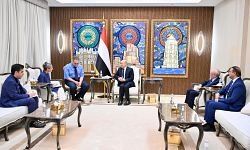
President Rashad al-Alimi, chairman of Yemen’s Presidential Leadership Council, called on European nations to take a more decisive role in the country’s recovery and in confronting the challenges posed by the Houthi movement during a meeting in Aden with the Netherlands’ ambassador to Yemen, Jeannette Seppen. The talks centred on strengthening bilateral ties and broadening cooperation across economic, humanitarian and institutional sectors, and they came as Yemen’s internationally recognised government presses its foreign partners for sustained help in rebuilding areas under its control.
Officials said the discussion highlighted Dutch development priorities in Yemen, including support for economic reforms, the strengthening of public institutions, and the construction of modern water and irrigation systems. The two sides also reviewed initiatives tied to food security, agriculture and fisheries, alongside efforts to upgrade the country’s ports and logistical infrastructure, areas seen as essential to reviving an economy battered by more than a decade of conflict, currency collapse and disrupted trade.
Al-Alimi acknowledged the steady support Yemen has received from the Netherlands over the years, praising its active engagement within the European Union and its sustained contributions to humanitarian and development programmes. He described the Netherlands as one of Yemen’s most important European partners, particularly in development assistance, and expressed hope that cooperation would deepen further in the months ahead. Beyond direct budget support, the Netherlands has backed United Nations programmes in Yemen, including a partnership with the UN Development Programme aimed at improving access to justice and strengthening the rule of law, part of a wider effort to rebuild institutions hollowed out by the war.
The president pointed to several areas where Dutch involvement could expand, among them vocational and technical education, the empowerment of women and young people, and job creation. He stressed the importance of rehabilitating healthcare facilities and supporting private-sector growth in areas retaken from the Houthis, arguing that greater European investment in these sectors would help anchor stability in regions emerging from years of fighting.
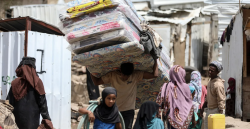
Ambassador Seppen briefed al-Alimi on her recent visit to Marib province as part of a European delegation. Marib, an oil- and gas-rich governorate east of the capital, hosts one of the largest concentrations of internally displaced people in the country, with hundreds of thousands sheltering in crowded camps after fleeing front-line areas. The province has remained a focal point of both military pressure and humanitarian need throughout the war.
The humanitarian backdrop to the talks remains severe. The United Nations estimates that 19.5 million people in Yemen need some form of humanitarian assistance and protection in 2025, roughly 1.3 million more than the previous year, while about 4.8 million people remain displaced, many of them more than once. As of late 2025, some 18.1 million people faced acute hunger, more than 2.2 million children under five were acutely malnourished, and aid agencies warned that the response plan was funded at only around 29 per cent, forcing painful cuts to food, water and health programmes.
Chronic water scarcity, a weakened health system and recurring disease outbreaks, including cholera and measles, have deepened the crisis and intensified the need for predictable international support. Yemeni officials argue that investment in basic services and local institutions is the most effective way to stabilise communities and reduce dependence on emergency relief.
Seppen’s trip formed part of broader European engagement with Yemen’s internationally recognised government. In recent months, EU ambassadors based in the region have travelled to Aden, the interim capital, to meet al-Alimi and other officials and to reaffirm the bloc’s backing for the Presidential Leadership Council and the government it oversees. The Dutch envoy has also held talks in Aden with Prime Minister and Foreign Minister Shaya Mohsen al-Zindani on development cooperation, service delivery and women’s empowerment, underscoring the Netherlands’ prominent place in those efforts. European officials have framed their renewed outreach as a signal that the bloc intends to stay involved in Yemen even as global attention is pulled toward other crises.
The conflict, which escalated in 2015 after the Houthis seized the capital, Sanaa, has hardened into a multi-layered crisis with political, social and economic dimensions. Yemen’s internationally recognised government, seated in Aden and led by al-Alimi, has struggled to reassert control over territory held by the Houthis, who are widely reported to receive backing from Iran. A fragile truce brokered by the United Nations in 2022 has largely held in many areas, but a comprehensive political settlement has remained elusive.
The fighting has also fuelled regional security concerns, given Yemen’s position along the Red Sea and the strategic Bab al-Mandab strait, a chokepoint for global shipping. Houthi attacks on commercial vessels since late 2023 have disrupted one of the world’s busiest maritime routes and drawn international naval responses, reinforcing the view among Yemen’s partners that the country’s stability carries consequences well beyond its borders.
Against that backdrop, al-Alimi’s appeal for stronger European support carries added weight. Yemeni officials have repeatedly argued that capacity-building and infrastructure development in areas outside Houthi control are critical to recovery and long-term stability, contending that such investment could also blunt the appeal of extremist groups that exploit poverty, unemployment and a sense of marginalisation. The emphasis on empowering women and young people reflects a recurring theme in Yemen’s recovery agenda, where officials and donors alike see education and economic opportunity as the foundation for a more durable peace.
About the Author