Yemen’s deputy foreign minister convenes Aden meeting on smuggling and recruitment of Yemenis abroad
 Yemen Herald News
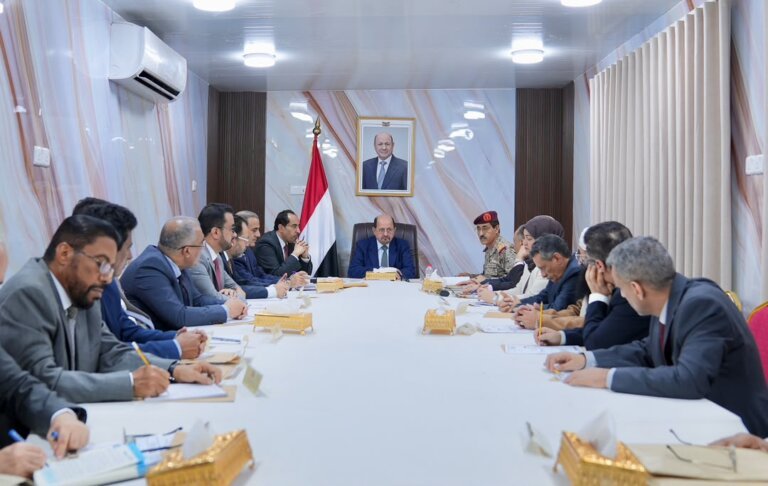
Yemen’s deputy minister of foreign affairs and expatriates, Mustafa Noman, chaired a meeting in Aden in mid-2026 with representatives of the ministries of interior and defence and the national security services to discuss the protection of Yemenis living abroad, according to accounts of the meeting published at the time. Officials described the session as an effort to improve coordination and information-sharing between the bodies that handle travel documents, border control and consular protection, and identified the smuggling of Yemenis abroad and the recruitment of young Yemenis into foreign conflicts as the two most pressing concerns.
The Ministry of Foreign Affairs and Expatriates operates from Aden, the seat of Yemen’s internationally recognised government, and is headed by Shaya al-Zindani. Noman, who serves as its deputy minister, has represented the ministry in a series of external engagements over the past year, including meetings with European governments and with United Nations officials in Aden. The expatriate portfolio sits within the same ministry as foreign policy, an arrangement that reflects how central the diaspora is to Yemen’s economy.
That centrality is not rhetorical. Yemen has one of the larger diasporas in the Arab world relative to its population, with substantial communities in Saudi Arabia and the Gulf states, in Djibouti, Somalia and Ethiopia across the Red Sea, and in south-east Asia, Britain and the United States. Remittances sent home by those communities have for years been among the country’s largest sources of foreign currency, in several assessments exceeding the value of international humanitarian aid. They are also one of the few forms of income that reach households directly rather than passing through institutions divided between rival authorities.
The diaspora is correspondingly exposed. Yemenis working in the Gulf have limited legal protection under sponsorship-based labour systems, and large numbers were expelled from Saudi Arabia in 2013 and again in the years after 2015 as residency rules tightened. Those returning arrive in a country with no capacity to absorb them. Consular services have been weakened by the division of Yemen’s institutions: passports and civil documents issued by one authority are not always recognised by the other, leaving some Yemenis abroad unable to renew papers, regularise their status or travel.
Smuggling routes run in both directions across Yemeni territory. The country sits on the long-established eastern migration corridor, along which tens of thousands of Ethiopian and Somali migrants cross the Gulf of Aden each year in the hope of reaching Saudi Arabia, a movement documented in detail by the International Organization for Migration. Those migrants face abuse, extortion and detention inside Yemen. Yemenis themselves also leave irregularly, and officials have warned that the networks moving people out of the country overlap with those trafficking arms and goods.
The recruitment question is the newer of the two concerns. International media have reported over the past two years that Yemeni men were recruited under false pretences, often through promises of well-paid work or residency abroad, and ended up fighting in conflicts outside Yemen, including in Russia’s war in Ukraine. Yemeni officials have acknowledged the reports and said they are investigating the brokers involved. The scale of the practice is not established, and the accounts available rest largely on the testimony of returning recruits and their families rather than on official data.
Coordination between ministries is a modest instrument against either problem. The Yemeni government’s writ does not extend to the country’s principal population centres in the north, which remain under Houthi control, and its own security bodies in the south are fragmented between forces answering to different commands. Salaries in much of the civil service are paid irregularly, which weakens the administrative capacity any such coordination would depend on. Officials at the meeting were reported to have called for stronger preventive measures, without describing specific mechanisms or funding. No budget was announced alongside the meeting.
Yemen’s economic conditions are the underlying driver. The rial has lost much of its value in government-held areas since 2015, imported food and fuel have become steadily less affordable, and formal employment is scarce for young people in particular. Where a broker offers documented work abroad, the incentive to accept without scrutiny is considerable. Aid agencies and Yemeni officials have both made the connection between economic collapse and vulnerability to trafficking, and neither has identified a remedy that does not begin with the economy.
There is also a diplomatic dimension. Protecting Yemenis abroad requires cooperation from host states, and Yemen’s leverage in those relationships is limited. Its ability to press Gulf governments on labour conditions, or to pursue recruitment networks operating across several jurisdictions, depends on the goodwill of countries whose priorities in Yemen are primarily political and security-related. The ministry’s public statements on expatriate affairs tend to be framed accordingly, in terms of partnership rather than complaint.
As with much government activity in Aden, the meeting is best read as a statement of intent. It signalled which issues the ministry regards as urgent and which bodies it considers responsible for them. Whether it produces changes that Yemenis abroad can observe will depend on resources and on political conditions that remain, for the present, unresolved. For now the ministry’s own account of the session, carried by Yemeni state media, is the only record of what was agreed, and no follow-up timetable was made public.
About the Author