STC Rally in Al-Mahra Backs Hadramout and Condemns Crackdown on Southern Protesters
 Yemen Herald News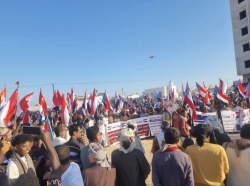
A large solidarity rally was held on Friday in the Al-Masila district of Al-Mahra governorate, organised by the Southern Transitional Council (STC) to voice support for the people of Hadramout and to denounce what participants described as the repression of demonstrators across several southern Yemeni governorates. The gathering drew a member of the STC’s Presidency, local officials and community representatives, who framed the event as a show of unity against what they characterised as mounting injustices.
Abdulrahim Al-Sadeq, who heads the STC’s executive body in Al-Mahra, told the crowd that the rally symbolised a collective refusal to accept oppression or violations of rights. He called for solidarity among the southern regions and for stronger grassroots initiatives to confront the pressing challenges facing residents, casting the demonstration as part of a wider civic movement rather than an isolated protest.
Other speakers reinforced that message. Abdelkader Al-Hamed, a member of the Advisory Council, affirmed solidarity with the people of Hadramout and all southern regions and condemned what he called arbitrary actions against those peacefully expressing their grievances. His remarks reflected a recurring theme of the event: that peaceful assembly should not be met with force, and that southerners were entitled to articulate their demands openly.
Hassan Baabad, head of the STC executive in Al-Masila, welcomed attendees and acknowledged the widespread discontent with the prevailing political situation. He said the peaceful demonstration reflected a collective stance against any forceful imposition of authority and demonstrated the southern population’s awareness of what he described as their legitimate rights, which participants pledged to uphold under the leadership of STC president Aidarous al-Zubaidi.
A prominent demand voiced at the rally was for an international investigation into the violations allegedly suffered by demonstrators in the south. Organisers argued that independent scrutiny was necessary to document abuses and hold those responsible to account, presenting the call as a way of internationalising grievances that they said had gone unaddressed by domestic authorities.
The rally took place against a backdrop of serious unrest across southern Yemen in 2026, during which protests linked to the STC have repeatedly been met with force. In early February, security forces opened live fire on STC-supporting protesters in Seiyun in Wadi Hadramout, wounding several, and on 11 February a demonstration in the city of Ataq, in neighbouring Shabwa governorate, ended with multiple protesters killed and dozens wounded, according to reports from the region.
Hadramout itself has been a focal point of the confrontation. On 4 April, a peaceful demonstration called by the STC in the port city of Mukalla was followed by a wide-scale arrest campaign, with reports indicating that scores of participants, including a number of minors, were detained, and that protesters were killed or injured by security gunfire during the crackdown. Authorities were also reported to have ordered the arrest of local STC figures on accusations of inciting the protests.
These episodes have hardened sentiment among southern activists and lent added weight to solidarity gatherings such as the one in Al-Mahra. For many participants, the rallies serve as both a memorial for those killed and a platform to insist that peaceful political expression continue despite the risks, framing the demonstrations as a sustained campaign rather than a series of isolated flashpoints.
The Al-Mahra event forms part of a broader trend in the south of voicing discontent with governmental and military practices that many residents regard as oppressive. With authority in Yemen fragmented after years of war, the growing coordination among southern groups has been presented by the STC as a drive toward empowerment and, ultimately, self-determination, a goal that has sharpened tensions with the internationally recognised government.
Those tensions have at times spilled into open confrontation between STC-aligned forces and government troops, adding a volatile dimension to the political disputes playing out in the streets. As public anger over unmet basic needs and contested governance persists, organisers indicated that further demonstrations were likely, and that the movement intended to maintain pressure through peaceful means.
The humanitarian backdrop lends the grievances additional urgency. Conditions across Yemen remain dire, with the United Nations estimating that more than 22 million people will require assistance and protection in 2026. In that environment, provincial demonstrations over services, security and rights have become increasingly common, and their organisers argue that political marginalisation compounds the daily hardships endured by ordinary southerners.
The Southern Transitional Council, established in 2017 and long backed by the United Arab Emirates, has emerged as the most powerful advocate of southern independence, reviving aspirations that date back to the era before Yemen’s unification in 1990. During 2026, the council escalated its political demands, with reports of moves toward a constitution for an independent south and calls for a vote on self-determination, steps that placed it on a collision course with the internationally recognised government even as both nominally opposed the Houthi movement in the north.
Looking ahead, the STC’s capacity to galvanise support and present a unified voice for the southern populace may shape the future direction of the political struggle within Yemen. Debates over self-governance, regional autonomy and public freedoms are likely to define the trajectory of future protests. At the same time, the prospect of meaningful dialogue among the government, the STC and local leaders remains uncertain but, many observers argue, essential to defusing the grievances that gatherings like the Al-Mahra rally continue to express.
About the Author