Yemen’s Health Minister Seeks Expanded Partnership With France to Rebuild Health System
 Yemen Herald News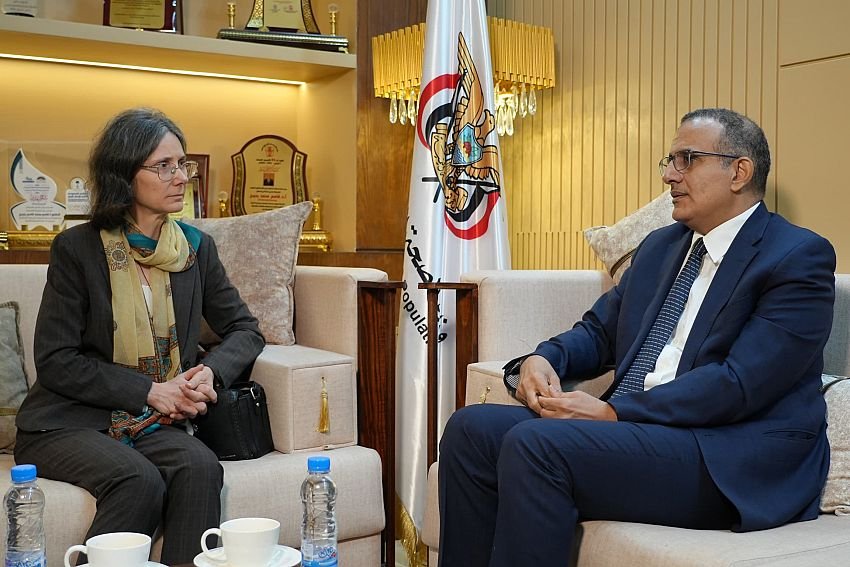
Yemen’s Minister of Public Health and Population, Dr. Qasem Buhaybeh, met the French Ambassador to Yemen, Catherine Corm Kammoun, in the interim capital of Aden to discuss deepening cooperation between the two countries in the health sector. The talks centred on the priorities for developing Yemen’s battered health system, improving primary healthcare services and promoting the sustainability of care across the country’s governorates, at a moment when the sector remains under intense strain from years of conflict and a deep humanitarian emergency.
Yemen has endured civil war since 2015, and the fighting has left the health system fragmented and chronically under-resourced. The scale of need has continued to grow rather than ease. According to the United Nations Office for the Coordination of Humanitarian Affairs, some 22.3 million people, roughly half the population, are expected to require humanitarian assistance in 2026, an increase of about 2.8 million on the previous year. More than 18 million people face acute food insecurity, and recurrent outbreaks of preventable disease have compounded the pressure on hospitals and clinics that were already fragile before the war began.
Against that backdrop, Dr. Buhaybeh used the meeting to underline the value of international partnerships in sustaining basic services. He praised the cooperation with Paris in warm terms, describing it as a template for the kind of support Yemen needs. “The partnership with the French Republic represents a model of constructive cooperation in supporting the health sector,” he said, framing France’s engagement as an example that could encourage wider involvement from other governments and institutions.
The minister set out several areas where he hoped the relationship could expand. He pointed to capacity building for Yemeni health workers, support for health and educational institutions, and the strengthening of primary healthcare programmes as the priorities most likely to deliver durable results. “We’re looking forward to expand areas of cooperation to include capacity building, supporting health and educational institutions, and strengthening primary healthcare programmes,” he told the ambassador, stressing that investment in training and institutions matters as much as immediate relief.
Catherine Corm Kammoun, for her part, confirmed her government’s commitment to continuing its support for Yemen’s health sector and to working closely with the Ministry of Public Health and Population. She acknowledged the urgency created by the ongoing crisis and reaffirmed France’s readiness to remain a partner as the ministry tries to rebuild services and extend their reach beyond the main cities.
After the talks, the minister and the ambassador made a joint field visit to the headquarters of the Supreme Medical Council and to the Dr. Amin Nasher Higher Institute of Health Sciences. Such visits allow officials and donors to see facilities first-hand, to gauge where equipment, staffing and funding are most lacking, and to identify the areas that require immediate intervention. The Higher Institute, which trains health personnel, illustrates why capacity building featured so prominently in the discussion: rebuilding the workforce is central to any lasting recovery.
The condition of Yemen’s health system helps explain the emphasis both sides placed on sustained support. Aid agencies report that a large share of health facilities are no longer fully operational, with roughly 40 per cent either not functioning or at risk of closing because of funding shortfalls and the decision by some partners to scale back their operations. That erosion has coincided with serious disease outbreaks. Yemen recorded one of the highest cholera caseloads in the world between early 2024 and late 2025, with hundreds of thousands of suspected cholera and acute watery diarrhoea cases and more than a thousand associated deaths, while measles has also spread widely, killing scores of people, many of them children.
The push to shore up the health sector also carries a strategic dimension. Yemen’s war has drawn in outside actors, with the Houthi movement receiving backing from Iran and a Saudi-led coalition supporting the internationally recognised government seated in Aden. In that contested environment, strengthening public services is viewed not only as humanitarian relief but as a contribution to broader stability, since functioning hospitals and clinics help reassure communities and reduce the pressures that fuel displacement and unrest.
Health specialists have long argued that tackling Yemen’s public health emergency is bound up with the wider effort to stabilise the country. Malnutrition, limited access to clean water and repeated disease outbreaks continue to deepen the vulnerability of ordinary Yemenis, and progress on health is difficult to separate from progress on food, water and basic infrastructure. Officials hope that a durable partnership with France could serve as a reference point for how targeted cooperation delivers tangible results even in extremely difficult conditions.
For now, the outlook remains cautiously hopeful. The cooperation discussed in Aden aims to improve immediate medical services while also building a longer-term framework capable of meeting the needs of Yemenis across the governorates. Much will depend on whether commitments translate into sustained funding and delivery, but the ministry has signalled that partnerships of this kind are central to its recovery plans. As the international community continues to watch Yemen’s humanitarian situation, further steps flowing from this engagement could shape the wider response, underlining how cooperation with countries such as France may help the health sector emerge gradually from the shadow of a long conflict.
About the Author