Taiz Governor Nabil Shamsan says province’s security is a red line
 Yemen Herald News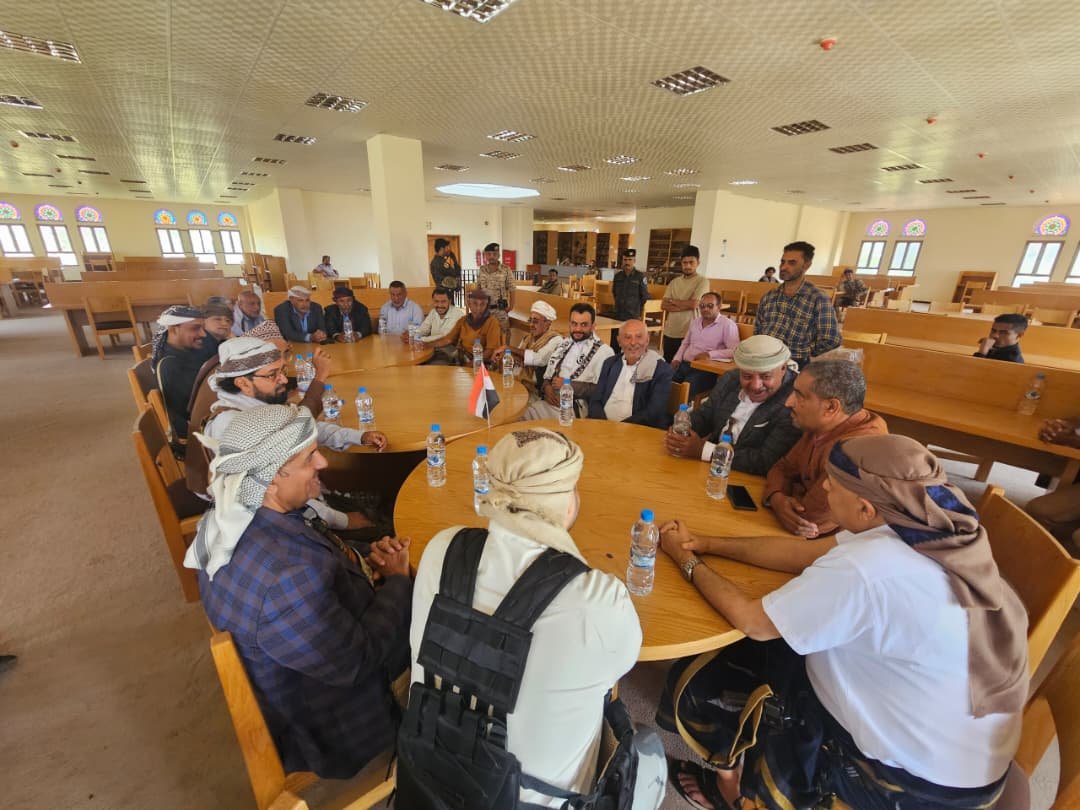
TAIZ, Yemen — Taiz Governor Nabil Shamsan said the security of his province is a red line that cannot be compromised.
He spoke at a meeting with sheikhs, community leaders and social figures from the Al-Hujariya districts of southern Taiz, the state news agency Saba reported on Thursday.
Shamsan said Taiz would remain steadfast. It would not allow the return of sectarian ideology, external tutelage, or any attempt to undermine its security, dignity and stability, he said.
The sacrifices of the province’s people are national principles that cannot be compromised, the governor said.
The account of the meeting rests on Saba, the news agency of Yemen’s internationally recognised government. No independent confirmation of the governor’s remarks has been published.
Shamsan called for strengthening national cohesion and uniting the internal front against the Houthi movement. Saba refers to the group as a militia.
He praised armed forces units deployed on the Taiz and Tur al-Baha fronts, along with the Giants Brigades and popular resistance forces. He said they had repelled simultaneous Houthi infiltration attempts.
The attempts were aimed at positions near the road linking Taiz with Aden and Lahj, according to the governor.
Government forces have reported a comparable attempt in the same area. They said they repelled an attempted Houthi infiltration in Taiz province near that road, Arab News reported.
The armed forces said the attack began at about 10:10 p.m. local time. Houthi fighters tried to push toward Wadi al-Maqatrah in the Hayfan area, according to the statement.
Units from the Taiz and al-Turbah military axes, the Giants Brigades and the Popular Resistance took part in that fighting, the statement said.
Asharq Al-Awsat carried a similar account, reporting that the army had repelled Houthi attempts to advance west of Taiz.
The Houthis have not confirmed either account. The group disputes government claims of repelled attacks as a matter of routine.
The road carries weight for both sides. It is the main link between Taiz and Aden, the seat of the internationally recognised government.
Yemen Monitor, a Yemeni news site, has described the fighting in the area as a contest for the dominant heights. It said control of those heights would let the Houthis reach al-Turbah and tighten the siege of Taiz by cutting the Aden road.
Taiz has been partly encircled by Houthi forces since 2015. Supplies reach the city along detour routes.
Tur al-Baha, one of the fronts the governor named, is a district in neighbouring Lahj governorate. The Taiz and al-Turbah axes are regional commands inside Taiz.
Shamsan was briefed at the meeting on preparations to reinforce the front lines, Saba said.
He thanked President Rashad al-Alimi, chairman of the Presidential Leadership Council, for efforts to unify the military ranks.
Those efforts include bringing separate formations under a joint operations room supervised by the Ministry of Defense, according to the agency.
The council was formed in April 2022, when Abd Rabbu Mansour Hadi transferred his powers to it. Al-Alimi has chaired it since.
Command unification has been one of its stated goals. Forces aligned with the government include units raised by regional backers and local resistance groups that have answered to separate chains of command.
The Giants Brigades are one of those formations. The force fought along Yemen’s west coast before deploying to other fronts.
Al-Alimi said this week that Yemen’s armed forces were capable of regaining the initiative and ending the Houthi threat, Saba reported. That claim has not been independently assessed.
Shamsan also commended Saudi Arabia’s continued support for Yemenis and their efforts to restore the state, Saba said.
Saudi Arabia leads the military coalition that intervened in Yemen in March 2015 on the side of the government.
The governor described Taiz as a model of resistance and coexistence and a strategic reservoir of national cadres, according to the agency. He said the province would not allow internal divisions to create openings for its adversaries.
Sheikhs and community leaders from Al-Hujariya reaffirmed their support for the local authority and state institutions, Saba reported. They said they were ready to continue making sacrifices to strengthen security and stability.
The meeting followed weeks of fighting along Yemen’s western fronts. Al Jazeera reported on 11 September that Houthi forces had advanced along Yemen’s Red Sea coastline and taken a position astride the Bab al-Mandab strait.
The group seized the port city of Mokha during the same push, according to that reporting. The Saudi-led coalition carried out strikes as the advance continued, according to reporting on 22 September.
The council was formed with eight members. Hadi had led the government since 2012.
Saba has operated as two separate newsrooms since 2015. The Aden-based agency publishes for the internationally recognised government, while a rival operation in Sanaa publishes under Houthi control. The report on the Taiz meeting came from the Aden-based agency.
Bab al-Mandab links the Red Sea to the Gulf of Aden. It is one of the shipping lanes between Europe and Asia.
Al-Turbah is the main town of the Al-Shamayatain district in southern Taiz. It sits on the route between the city and Aden.
Al-Hujariya covers a group of districts in the south of Taiz governorate. Hayfan, where the reported infiltration attempt took place, is among them.
About the Author