Aden Airways Receives Its First Owned Aircraft at Aden Airport
 Yemen Herald News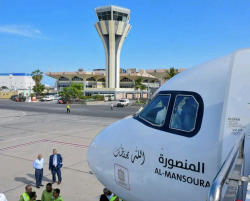
Aden Airways has taken delivery of its first fully owned aircraft, marking a significant milestone for the young carrier and for Yemen’s aviation sector. The aircraft, named “Al-Mansoura,” arrived at Aden International Airport on Wednesday and was welcomed with an official ceremony following the completion of its technical and operational preparations.
The introduction of the aircraft marks a pivotal moment for the airline as it transitions to fleet ownership, a step expected to enhance its operational capacity and to allow it to expand its services. Owning aircraft outright, rather than relying solely on leased planes, can give an airline greater flexibility and control over its operations and its growth.
During the inauguration, Abdul-Salam Al-Wardi, Vice Chairman of the Al-Qatibi Group, said the arrival of “Al-Mansoura” represented the official launch of the Aden Airways project. He set out the group’s vision to develop Yemen’s aviation sector and to strengthen the country’s regional and local air connections, framing the aircraft’s arrival as the beginning of a broader endeavour.
Al-Wardi indicated that the company had ambitious plans for expansion, including the enhancement of its operational capabilities and the introduction of new destinations. He added that a second aircraft was expected to join the fleet soon, signalling an intention to build the airline’s capacity in the period ahead.
The development comes at a difficult time for aviation in Yemen. Years of conflict have severely disrupted the country’s air travel, damaging infrastructure, restricting operations at key airports and limiting the connectivity on which trade, travel and the movement of people depend. The emergence of a new carrier represents a notable step amid these challenges.
Aden International Airport, the setting for the arrival, serves as a principal gateway for the interim capital and a hub for the government’s activities. Its functioning is important both practically and symbolically, and the arrival of a locally owned aircraft there underscores efforts to revive and develop the country’s aviation capabilities.
The transition to fleet ownership is significant for the airline’s prospects. Airlines that own their aircraft can exercise greater control over scheduling, maintenance and deployment, and building a fleet is a foundation for expanding routes and services. For a new carrier, acquiring its first owned aircraft is an important step toward establishing itself.
The vision articulated by Al-Wardi to develop Yemen’s aviation sector reflects an ambition that extends beyond the airline itself. A more developed aviation sector could improve the country’s connectivity, support economic activity and facilitate the movement of people, contributing to recovery and to the reintegration of Yemen with regional and international networks.
Improving regional and local air connections, a goal highlighted at the ceremony, addresses a real need in a country whose connectivity has been diminished by conflict. Reliable air links are important for commerce, for travel and for maintaining ties between Yemen and the wider world, and expanding them is valuable for a country seeking to recover.
The plans for expansion, including new destinations and additional aircraft, reflect an intention to grow the airline over time. Building a network of routes and a larger fleet is central to the development of a carrier, and such plans signal confidence in the prospects for aviation in Yemen despite the challenges of the current environment.
The involvement of the Al-Qatibi Group points to the role of private enterprise in the development of the aviation sector. Private investment can bring resources, expertise and initiative to bear on rebuilding and expanding services, complementing the efforts of the state and contributing to the revival of an important sector of the economy.
Aviation carries significance for economic development more broadly. Air transport underpins trade, tourism and investment, connecting markets and enabling the movement of goods and people. A functioning and growing aviation sector can act as a catalyst for economic activity, making its development relevant to Yemen’s broader recovery.
The naming of the aircraft “Al-Mansoura” lends the occasion a local character, and the ceremony marking its arrival reflected the significance attached to the milestone. Such events mark not only the practical acquisition of an aircraft but the aspirations invested in a project seen as contributing to the development of the country’s aviation.
Realising the ambitions set out at the inauguration will depend on a range of factors, including the security situation, the state of infrastructure and the commercial viability of the airline’s operations. Building a successful carrier is a demanding undertaking, particularly in a challenging environment, and the airline’s progress will unfold over time.
The emergence of a new carrier also speaks to the wider difficulties that have beset air travel in Yemen, where the national airline has struggled with the loss of aircraft, restrictions on the use of some airports and the strains of operating in a divided country. Additional capacity and competition could, in principle, improve the availability and reliability of flights for a population that has often found itself cut off, with limited and costly options for reaching destinations abroad. Whether Aden Airways can sustain and expand its operations will depend on commercial realities and on the broader trajectory of the conflict, but its launch offered a rare piece of encouraging news for a sector long defined by disruption.
For now, the arrival of “Al-Mansoura” represents a hopeful development for Yemen’s aviation sector and a concrete step in the establishment of Aden Airways. As the airline pursues its plans for expansion, its progress will be watched as an indicator of the prospects for reviving and developing air travel in a country working to reconnect with the world.
About the Author