Europe Faces a Tighter Gas Market as Hormuz Disruption Meets Low EU Storage
 Yemen Herald News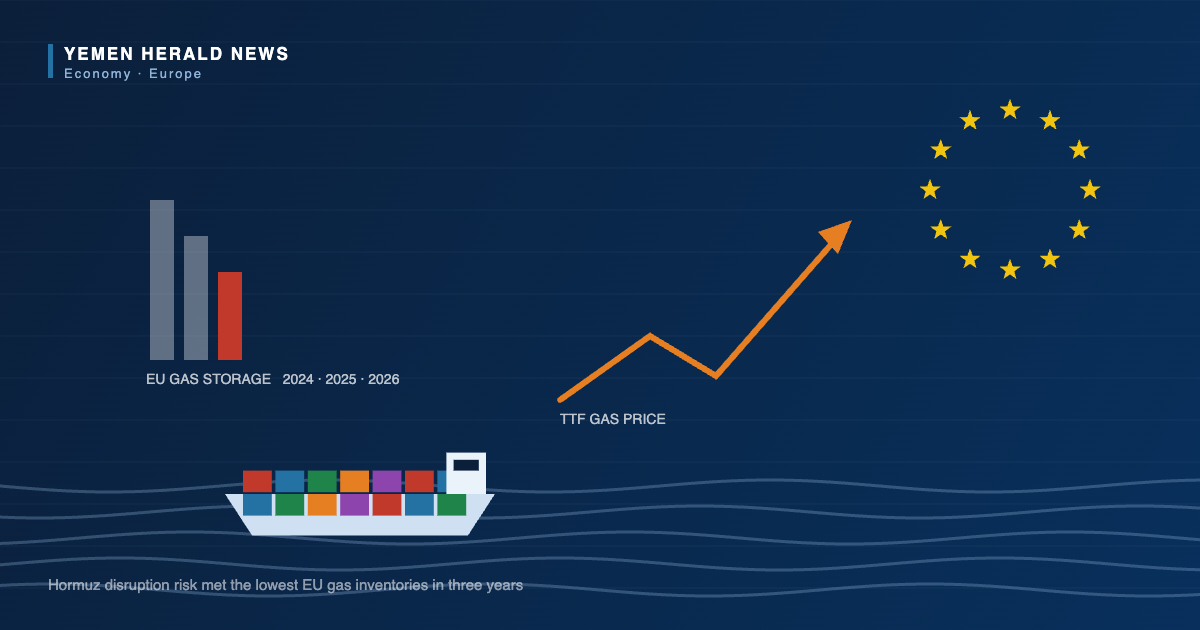
Europe entered the spring of 2026 facing an energy squeeze of a kind it had hoped it was past. Fighting in and around the Gulf raised the prospect of disruption to the Strait of Hormuz, the shipping channel through which roughly a fifth of the world’s liquefied natural gas passes, at precisely the moment when European storage sites were emptier than they had been in years. The combination did what markets always do when a supply risk meets a thin buffer: it moved prices, quickly.
The immediate reaction came on 2 March 2026, when crude oil rose about eight per cent and the European benchmark gas price jumped roughly twenty per cent in a single morning. Analysts at the Bruegel think tank noted at the time that the market was testing levels not seen since the acute phase of the post-Ukraine energy crisis, with talk of prices approaching €90 per megawatt hour. Later in the disruption, as the interruption persisted, European gas traded above €60 per megawatt hour for an extended stretch.
The storage picture explains why the market reacted so sharply. European Union gas inventories stood at about 46 billion cubic metres at the end of February 2026, against 60 billion at the same point in 2025 and 77 billion in 2024. Expressed as a fill rate, EU stocks were below 31 per cent, compared with 40.7 per cent a year earlier. Two of the bloc’s largest consumers were thinner still: German sites were reported at around 20.7 per cent and French sites at 21.1 per cent. Storage that low leaves little room to absorb a shock and makes the summer injection season—when Europe must refill for the following winter—considerably more expensive.
Europe’s exposure in this episode ran principally through LNG rather than pipeline gas. The continent spent the years after 2022 deliberately reducing its reliance on Russian supply, building and expanding import terminals along the Atlantic and North Sea coasts and signing long-term contracts with alternative producers. That strategy worked in the sense that it removed a single dominant supplier. Its cost is that Europe is now a price-taker in a global seaborne market, competing cargo by cargo with buyers in Japan, South Korea, China and India.
Qatar sits at the centre of the vulnerability. It is the world’s largest LNG exporter and its output leaves the Gulf through Hormuz. Reporting during the disruption indicated that QatarEnergy production facilities had sustained damage, compounding the shipping risk with a supply-side one. When Qatari volumes are curtailed for any reason, the tightening is felt immediately in the global spot market rather than in any one region, because the cargoes that would have gone to Asia are no longer available to be diverted to Europe—or the reverse.
That dynamic is the heart of the problem for European buyers. In a comfortable market, a European utility short of gas can outbid an Asian counterpart for a flexible cargo and the system rebalances. In a market where a fifth of global supply is in question, the same bidding contest simply raises the clearing price for everyone without producing additional molecules. Storage that should be refilling instead refills more slowly and at a higher cost, and the burden eventually reaches industrial users and household bills.
European policymakers had a limited set of levers. Demand-side measures, coordinated purchasing, and flexibility in storage-filling targets were all discussed as ways of easing the pressure without simply bidding prices up further. In April 2026 Chatham House argued that the episode strengthened rather than weakened the case for the EU’s carbon pricing approach, on the reasoning that a durable price signal encourages the substitution and efficiency investment that reduce exposure to exactly this kind of shock.
Not every consequence was negative for the continent’s longer-term position. Each price spike since 2022 has accelerated investment in renewables, heat pumps, grid interconnection and industrial efficiency, and has made the economics of gas-dependent processes harder to defend. The 2026 episode reinforced a lesson that had already been learned expensively: diversifying suppliers reduces the risk of coercion by any single exporter, but it does not insulate a region from a genuinely global supply interruption.
Nor is the exposure evenly distributed. Countries with substantial domestic storage, strong interconnection and diversified import routes weathered the volatility better than those dependent on a narrow set of entry points. Southern and central European states with limited terminal access faced the sharpest constraints, and the disparity revived long-running arguments inside the bloc about how the costs of collective energy security should be shared.
The wider question left by March 2026 is how much residual risk Europe is prepared to carry. A storage system that starts the year at 31 per cent full has, in effect, priced in a mild winter and an uninterrupted global market. When either assumption fails, the adjustment happens through price. Whether the bloc responds by mandating higher minimum storage levels, by accelerating the substitution of gas altogether, or by accepting more volatility as the price of a diversified market, will shape how the next disruption is felt. For Gulf producers the episode carried its own warning: a chokepoint that concentrates a fifth of global LNG in a single strait is a commercial liability as well as a strategic one, and buyers who have just been reminded of that tend to remember it when the next round of long-term contracts is negotiated.
About the Author