Masam says it cleared 1,256 mines in Yemen in the first four days of October
 Yemen Herald News
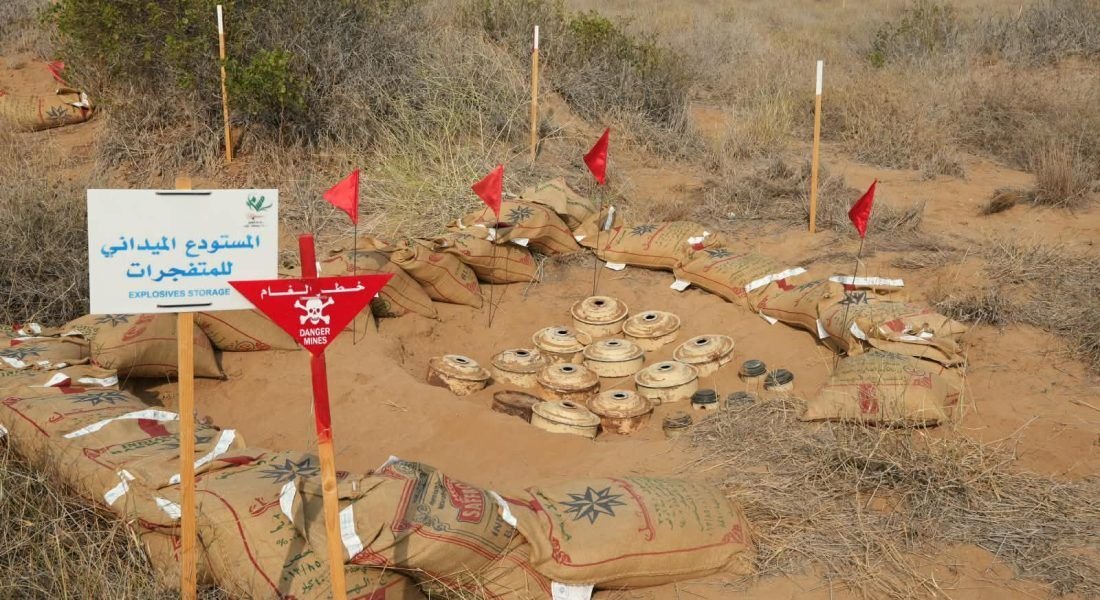
ADEN, Yemen — A Saudi-funded demining project said it cleared 1,256 landmines and unexploded munitions from Yemeni land in the first four days of October.
The clearance covered Oct. 1 to Oct. 4, the project said.
The Saudi Project for Landmine Clearance in Yemen, known as Masam, said the total was made up of 1,201 items of unexploded ordnance, 41 anti-tank mines and 14 anti-personnel mines.
Unexploded ordnance accounted for most of the October figure.
The numbers come from the project itself and were carried by the state news agency Saba. Yemen Herald could not independently verify them, and no independent monitor has published a matching tally for the period.
Ousama Algosaibi, the project’s managing director, said teams had removed 594,745 mines, unexploded shells and improvised explosive devices since work began at the end of June 2018.
That running total is dated to Oct. 2.
Masam broke it down as 425,161 items of unexploded ordnance, 153,148 anti-tank mines, 7,749 anti-personnel mines and 8,687 improvised explosive devices.
Arab News reported on Sept. 25 that the project had cleared 593,489 devices by that date. The two totals differ by the 1,256 reported for October.
Masam is paid for by the King Salman Humanitarian Aid and Relief Centre, the Saudi state aid body known as KSrelief.
Its teams worked in eleven areas during the period, the project said. They were Marib, Aden, Jawf, Shabwa, Taiz, Hodeidah, Lahj, Sanaa, Bayda, Dhale and Saada.
The project runs 45 engineering teams in territory held by the internationally recognised government, according to Arab News. It had 42 teams a year earlier.
Masam says it gives priority to villages, roads and schools, so civilians can move and aid convoys can pass.
It also trains Yemeni deminers, supplies detection equipment and pays for care for people maimed by explosives.
The project says 33 of its staff have been killed in eight years of operations.
Each demining team has ten members, among them six deminers, a medic and an ambulance driver.
The project employs about 580 people in all, including administrative, logistics and security staff.
Algosaibi said the work was continuing through the current fighting. “We remain committed to our humanitarian mission and our responsibility to secure roads,” he told Arab News.
He said shelling had landed several kilometres from work areas and drones had been seen near some sites.
In a separate statement issued by the project, Algosaibi said: “The planting of mines has not stopped for a single day.”
He also said there was no part of Yemeni territory that could be considered safe from what he called Houthi mines. The group has not commented publicly on the project’s accounts.
Maj. Gen. Amin al-Aqili heads Yemen’s National Mine Action Committee. Brig. Gen. Qaed Haitham runs the Aden branch of the Yemen Executive Mine Action Centre.
KSrelief extended the project’s contract by a year on May 29, 2025, at a cost of $52,994,413, the Saudi Press Agency reported.
Dr. Abdullah bin Abdulaziz Al Rabeeah, Advisor at the Royal Court and KSrelief Supervisor General, signed the extension. The project put its running total at 495,855 devices at the time.
Masam was renewed for a ninth year in June 2026, the project said. It had cleared 81,343,277 square metres of land by June 12.
Arab News put the cleared area at 85.8 million square metres as of Sept. 25.
The project reported clearing 5,164 mines and explosive remnants in the first 25 days of September, an average of about 207 a day. The October figure averages about 314 a day.
Yemen Monitor reported that the project cleared 6,786 mines and war remnants in June.
On Sept. 30 Masam destroyed 299 landmines and munitions in a controlled detonation in the Zukhar area of Dhale governorate.
The project cleared nearly 11,000 mines and explosive remnants in Midi district in Hajjah governorate, Arab News reported in July. It began work there in September 2025.
Algosaibi said Midi “witnessed one of the largest mine-laying campaigns during the conflict.”
Masam operates in twelve regions, with its main bases in Aden and Marib.
Other clearance work has stopped. The HALO Trust, a British demining charity, said in a report released on Sept. 30 that it had suspended work in Taiz and Mokha and moved staff to Aden.
The charity warned that displaced families risked moving onto ground that had not been surveyed.
The October tally covers days in which the war widened. Rashad al-Alimi, chairman of the Presidential Leadership Council, said on Oct. 4 that government forces had begun operations to retake Houthi-held territory.
He said in a televised address that Yemen had moved “from the stage of preparation to the stage of action to restore the state.”
The International Organization for Migration said 145,308 people had been displaced in Yemen since June.
The United Nations put the number of Yemenis needing aid at more than 22 million in its March 2026 humanitarian plan, with 18.3 million acutely food insecure.
The plan recorded 5.2 million people displaced inside the country and more than 2.2 million children under five acutely malnourished, 516,157 of them severely.
The United Nations sought $2.16 billion this year to reach 12 million people.
Masam issues its tallies every few days.
About the Author