Yemen’s human rights minister raises Taiz siege with UN rights office in Geneva
 Yemen Herald News

GENEVA, Switzerland — Yemen’s human rights minister asked the UN Human Rights Office on Wednesday to condemn Houthi violations and press for an end to the siege of Taiz.
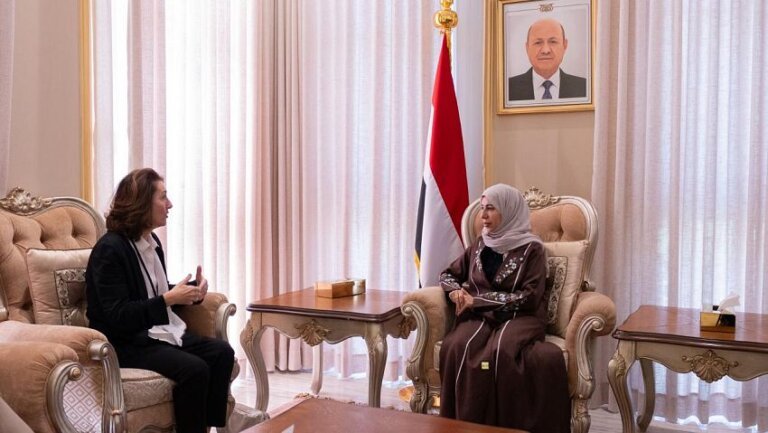
Mashdal Mohammed Omar met Mohammed al-Nsour, head of the Middle East and North Africa section at the office, the state news agency Saba reported.
Omar raised the forced displacement of more than 250,000 people, Saba said.
He described the difficulties facing displaced families in Aden and Lahj.
He also warned of the risks of a renewed siege of Taiz, including restrictions on food, medicine and fuel, according to the agency.
The minister asked the UN to condemn Houthi violations clearly, hold those responsible to account, lift the siege and ensure aid reaches civilians.
Al-Nsour said the office was monitoring developments in Taiz and was considering an urgent statement on the city’s humanitarian situation, Saba reported.
The account of the meeting rests on Saba, Yemen’s state news agency. No independent confirmation of the meeting or of the exchange has been published, and Yemen Herald could not verify al-Nsour’s remarks.
The UN human rights chief had spoken the day before. Volker Türk said on Oct. 20 that he was alarmed by the encirclement of Taiz.
Türk said the closure of the only supply route linking Taiz to Aden placed civilians at grave risk, blocked humanitarian aid and cut off essential supplies.
His office has monitored restrictions on access to water and essential goods along the Al-Dhabab route, the statement said.
Commodity prices have risen and many people are without food or other basic necessities, according to the office.
The office recorded 32 civilians killed across Taiz governorate between Aug. 1 and Oct. 19, including 14 children and nine women.
It recorded 115 civilians injured over the same period, including 36 children and 34 women.
Türk said the risk of civilian death and injury rises as fighting moves closer to densely populated areas.
He called for aid to be let in immediately and for civilians who wish to leave to be able to do so freely and safely.
He asked the parties to refrain from using explosive weapons with wide-area effects in populated areas.
He also sought the release of UN and aid agency staff held arbitrarily, and the disclosure of the whereabouts of people held incommunicado.
Türk issued the statement from Geneva, where the UN Human Rights Office is based.
The displacement figure the minister cited matches the UN refugee agency’s count. UNHCR said more than 250,000 people were displaced inside Yemen between the start of August and Oct. 17.
Taiz governorate accounts for 76% of the newly displaced and hosts 52% of them, the agency said. Lahj hosts 23% and Aden 13%.
Around half of those recently uprooted have sought shelter in Taiz.
More than 3,800 Yemenis have reached Djibouti since August and more than 240 have reached Somalia.
Clashes between the Houthis and the internationally recognised government resumed after a period of calm that followed a truce agreed in 2022.
Aid officials describe access to Taiz city and governorate as essentially blocked.
Akhil Iyer, UNICEF’s representative in Yemen, told a briefing from Aden that Taiz was the agency’s foremost concern.
Displaced people arrive in overcrowded camps or communities with little or no food and almost no clean water, Iyer said.
Sanitation services have halted and rubbish is piling up, particularly in Taiz city, he said.
Ten of Taiz’s 16 districts are already classified at emergency levels of food insecurity, according to UNICEF.
The agency pre-positioned ready-to-use therapeutic food before the fighting intensified but cannot distribute it because the routes are closed, Iyer said.
Diesel is needed to run pumping stations in and around Taiz city, and supplies are threatened by the blocked routes from Aden.
Wheat flour stocks in affected areas of Taiz are nearly exhausted, the World Food Programme said.
Twelve hospitals in Taiz have about four days of fuel left, World Health Organization spokesperson Tarik Jasarevic said.
Oxygen cylinders are in daily deficit and 115 of 127 essential medicines have about a week of stock or less, he said.
Yemen is contending with cholera and measles outbreaks, with suspected cases of diphtheria and dengue. UNICEF has warned the health emergency could worsen.
About 65,000 refugees and asylum seekers in Yemen need urgent support, most of them Somali and Ethiopian, UNHCR spokesperson Matthew Saltmarsh said.
Saltmarsh said access problems were preventing aid teams from reaching those most in need, and that protection work was continuing only where access allowed.
Aid agencies appealed in March for $2.16 billion to reach 12 million people in Yemen this year, the UN Office for the Coordination of Humanitarian Affairs said.
That plan counted 22.3 million people in need of assistance and protection, and 18.3 million as acutely food insecure.
It found more than 2.2 million children under five acutely malnourished, including over half a million with severe acute malnutrition.
The plan put the number of internally displaced people at 5.2 million, a count taken before this year’s escalation.
Omar was appointed human rights minister in February, according to his ministry.
Saba filed its account of the Geneva meeting on Wednesday morning.
About the Author