Al-Alimi launches Saudi relief package for Yemen on Riyadh visit
 Yemen Herald News
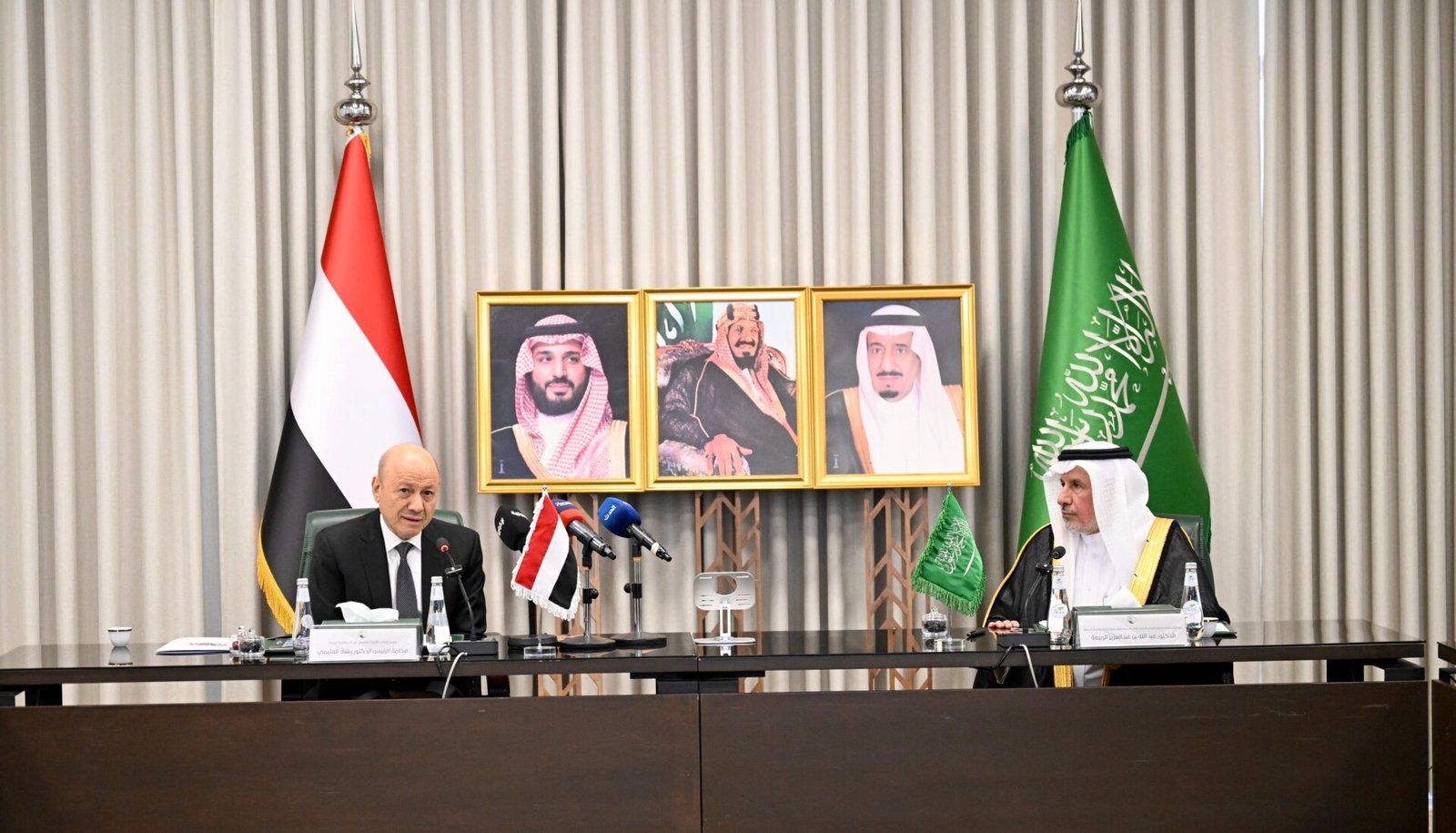
RIYADH, Saudi Arabia — Rashad al-Alimi, chairman of Yemen’s Presidential Leadership Council, launched a package of Saudi relief projects for Yemen on Tuesday during a visit to Riyadh.
The package was announced at the King Salman Humanitarian Aid and Relief Centre, which said the projects are expected to reach 3,435,000 people.
Abdullah al-Rabeeah, an adviser at the Saudi Royal Court and the centre’s supervisor general, received al-Alimi, according to the Saudi Press Agency.
Mohammed al-Jaber, the Saudi ambassador to Yemen, attended, Asharq Al-Awsat reported. So did Salem Saleh bin Breik, Yemen’s ambassador to Saudi Arabia.
Al-Jaber also supervises the Saudi Development and Reconstruction Programme for Yemen, which runs separately from the relief centre.
Representatives of United Nations organisations and centre officials were also present, the newspaper reported.
The centre said the main package covers emergency food, shelter, clean drinking water and health care.
The centre said its work in Yemen spans health, food and agricultural security, shelter, humanitarian coordination, water and sanitation, education, early recovery and logistics.
The food component covers 250,000 food baskets, distributed as 500,000 cartons.
The sixth phase of the centre’s emergency shelter plan provides 25,000 shelter kits and 17,500 tents for displaced families.
The water projects are measured in volume. The centre listed 2.9 million litres of drinking water for displaced people in Lahj, 4.7 million litres in Taiz and 3.78 million litres in Aden.
A separate water, sanitation and hygiene project covers 5.3 million litres for displaced people in Lahj.
Taiz city receives 5,000 food baskets, 9,960 tins of infant formula, and medicines and medical supplies, Asharq Al-Awsat reported.
Arab News, citing the Saudi Press Agency, put the water component at more than 16 million litres across Lahj, Taiz and Aden, and the infant formula at nearly 10,000 containers.
The centre said it would also supply medicines, equipment and supplies to Yemen’s Ministry of Health.
In Hajjah governorate, the package includes a residential complex of 232 homes with public service buildings and solar power for displaced families.
Al-Alimi separately launched 100 Saudi volunteer programmes in Yemeni governorates. The centre said they are expected to reach 265,000 people.
It named three of them: Saudi Pulse, covering open-heart surgery and cardiac catheterisation; a programme treating blindness; and Saudi Hearing, covering cochlear implants and auditory rehabilitation.
Others provide specialised surgery, training and economic empowerment.
Al-Rabeeah said Yemen has always been and remains the centre’s first priority.
He said the centre has carried out 1,238 projects in Yemen worth more than $4.8 billion, working with 362 United Nations, international and local organisations.
He put its wider record at 4,525 projects in 113 countries worth more than $8.638 billion, and said Yemen is the largest recipient.
Saudi Arabia has provided more than $29 billion in assistance to Yemen over the past decade, al-Rabeeah said. He put its total assistance to 175 countries at more than $145 billion.
Of the projects in Yemen, he said 568 worth more than $585 million were directed at women and 559 worth more than $806 million at children.
Al-Rabeeah said King Salman and Crown Prince Mohammed bin Salman had instructed the centre to widen its work, particularly in areas of displacement.
That instruction followed the campaign the government calls Operation Dawn of Yemen, which al-Alimi announced on Oct. 4.
Al-Rabeeah said Houthi obstruction, the detention of aid workers including United Nations staff, and attacks on assistance were holding relief work back.
He asked the United Nations and other governments to press the group to open humanitarian corridors into Taiz. The Houthis did not respond to the accusations.
Al-Alimi thanked King Salman and the crown prince, and said the assistance had reached all regions and social groups without discrimination.
He praised the centre’s Masam project, which clears landmines in Yemen, describing it as a long-term investment in the lives of Yemenis.
The figures in this account come from the centre’s own announcement, carried by the Saudi Press Agency and by Saba, the state news agency of Yemen’s internationally recognised government. They have not been independently verified.
Other agencies have published their own assessments of need. The International Organization for Migration says renewed fighting has displaced more than 276,000 people since June, with Taiz recording the highest number, followed by Lahj and Aden.
The World Food Programme estimates that 18.3 million people in Yemen face acute food insecurity and that 2.2 million children under five are acutely malnourished.
The United Nations humanitarian plan for 2026 counts more than 22 million people in need and 5.2 million people displaced inside the country. It puts the number of severely malnourished young children at 516,157 and seeks $2.16 billion to reach 12 million people.
The food baskets, shelter kits and tents are to be distributed across Yemeni governorates, the centre said. It did not give a cash value for the new package.
Asharq Al-Awsat reported that the Masam demining project has received Yemen’s highest honours. The newspaper said the Saudi and Yemeni governments describe Operation Dawn of Yemen as a campaign to restore the Yemeni state.
Al-Alimi chairs the Presidential Leadership Council, the eight-member body formed in April 2022 that governs the areas outside Houthi control.
The centre was established in 2015 and is based in Riyadh.
About the Author