Al-Alimi says Yemen’s forces can regain the initiative on the western coast
 Yemen Herald News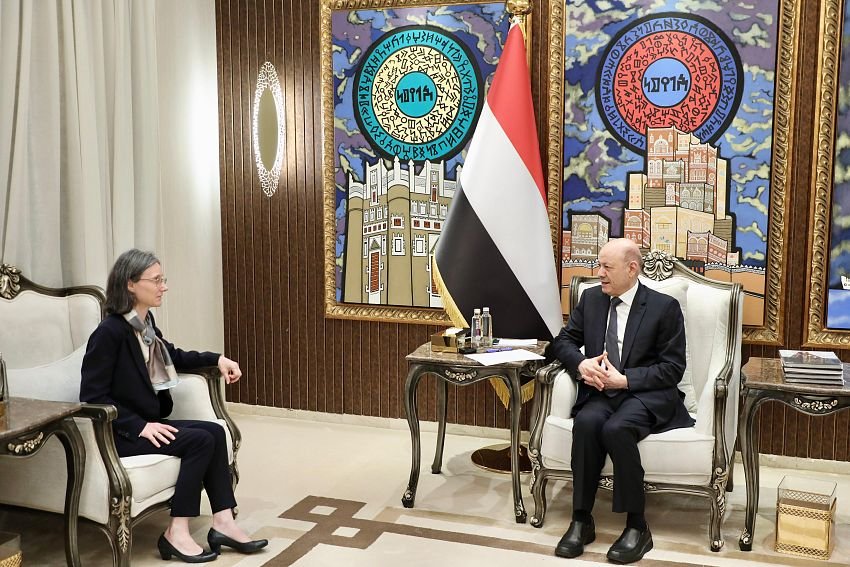
RIYADH, Saudi Arabia — Yemen’s Presidential Leadership Council chairman said Thursday that government forces could regain the initiative on the country’s western coast.
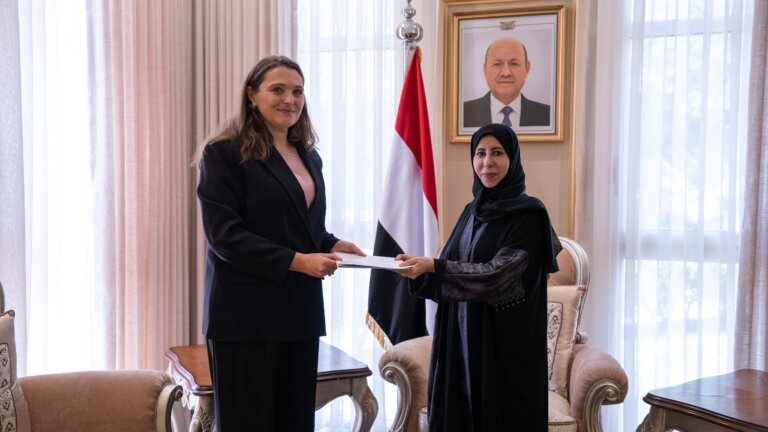
Rashad al-Alimi made the remarks while receiving France’s departing ambassador to Yemen, Catherine Corm-Kammoun, the state news agency Saba reported.
She was paying a farewell call marking the end of her tenure.
Al-Alimi said the state and its armed forces were capable of retaking the initiative and of continuing efforts to recover all Yemeni territory, according to the agency.
The account of the meeting rests on Saba, which is the government’s own news agency. No independent report of it has been published.
Al-Alimi said any temporary change on the battlefield would not alter Yemenis’ determination to restore national institutions.
He said the armed forces were continuing operations on several fronts and had inflicted heavy losses on the Houthis in Taiz, Marib, Lahj, al-Jawf, Hajjah, al-Bayda and Dhale, according to Saba. The Houthis dispute government accounts of their losses, and the claim could not be verified.
Forces were being redeployed and their capabilities strengthened, he said, to stop temporary gains from becoming permanent or from being used to threaten shipping lanes.
He said the Houthis had once believed their seizure of Sanaa was irreversible, before government forces recovered Aden and what he put at more than 70 percent of Yemeni territory. The Houthis reject that account of how much ground each side holds.
Al-Alimi thanked Corm-Kammoun for her work on relations between the two countries.
He cited France’s opposition to the Houthi escalation, its calls to cut off the group’s weapons and funding, and its position that freedom of navigation in the Red Sea is not negotiable, Saba said.
France holds the presidency of the UN Security Council this month. Its permanent representative, Jerome Bonnafont, chairs the council’s sessions.
Yemen’s foreign minister, Afrah al-Zouba, wrote to Bonnafont and to UN Secretary-General Antonio Guterres this month asking for a “clear and firm” position on the Houthi escalation, Saba reported at the time.
The letter covered fighting in Taiz and Hodeidah provinces and the risks of Houthi movements toward the Bab al-Mandab Strait.
Houthi movements in western Taiz and southern Hodeidah could not be read as an isolated local military move, al-Zouba wrote, but as part of an effort to impose a new military reality.
The Security Council met on Yemen on 10 September.
Fighting on the coast has moved quickly since the start of September.
Yemeni media reported on 10 September that Houthi forces had entered Hays and al-Khawkhah districts in southern Hodeidah after government and allied forces withdrew. Anadolu Agency said it could not independently verify those reports.
Government forces announced the same day that they had set up a command centre south of Mocha, near the strait.
Axios reported on 16 September that the Houthis controlled the coastal area and several islands in Bab al-Mandab, and that Saudi Arabia had increased its airstrikes without its Yemeni allies mounting an effective ground counteroffensive.
Washington has declined Saudi requests to join the fighting, according to the same report.
The strait links the Red Sea to the Gulf of Aden and carries a large share of trade between Europe and Asia.
A senior Houthi official, Abdul Aziz bin Habtoor of the group’s Supreme Political Council, said last week that international shipping “will remain safe.”
He described the situation on the western coast as “a Yemeni sovereign matter” and said Yemen’s exercise of sovereignty over its coasts posed no threat to navigation.
Bin Habtoor said the group rejected positions that treated Yemeni sovereignty through “double standards,” and called sovereignty over Yemeni territory an inherent right.
He warned against further military escalation and said the Security Council should examine what he called the causes of the escalation.
Al-Alimi told Egypt’s departing ambassador, Ihab Abu Sarea, in Riyadh on 10 September that protecting the Yemeni coast was a “shared Yemeni, Egyptian, Arab and international interest,” Saba reported.
He said then that any attempt to change the military situation near Bab al-Mandab could not be treated as a purely Yemeni matter.
“The strait is a vital international passage, and any threat to it extends directly to the Red Sea, the Suez Canal and global trade,” he said on that occasion.
He accused the Houthis of escalating with the help of expertise linked to Iran’s Revolutionary Guard, particularly on the coast of Taiz province. Iran denies arming the group.
He said Tehran was seeking, through the Houthi push toward the coast, to give the group the ability to influence Bab al-Mandab and the Red Sea.
Al-Alimi asked on Thursday for relations with Yemen’s international partners to move beyond crisis management toward a security and deterrence partnership.
That would cover protecting ports and territorial waters, countering terrorism and smuggling, and disrupting the financing and arms networks of armed groups, he said.
Fighting resumed in Yemen in early July after a truce that began in April 2022.
The Houthis have held Sanaa and much of the north since September 2014. A Saudi-led coalition has backed the government since March 2015.
Fighting between the Houthis and Saudi Arabia has widened in recent days. The group launched a drone toward Mecca and fired missiles at other Saudi cities, according to Axios, and Saudi Arabia has stepped up its airstrikes in Yemen.
Saba did not say when Corm-Kammoun would leave the post, or who would succeed her.
About the Author