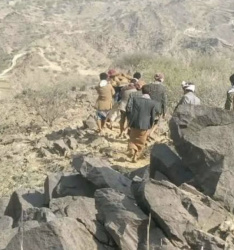
Taiz camps overflow as local authority counts 65,845 people displaced since August
 Yemen Herald News
TAIZ, Yemen — More than 65,000 people have fled fighting in Taiz governorate since 10 August, the local authority that manages displacement camps said.
Ali al-Shumairi, director-general of the Executive Unit for the Management of IDP Camps in Taiz, put the number at 65,845 through 15 September.
About 95 percent came from five districts where the fighting was heaviest, he said: Jabal Habashi, al-Maafer, Maqbana, al-Waziiyah and Mawza.
The Executive Unit is the government body that registers displaced families in the governorate and allocates shelter to them.
The movement followed a Houthi offensive along Yemen’s Red Sea coast that began in the first week of September.
The offensive opened on 3 September with an attempt to cut the roads leading to Mocha, and widened along the coast over the following week.
The group took the port city of Mocha and nearby areas close to the Bab al-Mandab Strait in the week to 10 September.
It also took the Greater and Lesser Hanish islands in the Red Sea during the advance.
The strait links the Red Sea to the Gulf of Aden and the Indian Ocean.
Forces loyal to Yemen’s internationally recognised government have since struck Houthi positions from the air in an effort to retake the port.
Those forces say they have retaken some positions and are advancing in southwestern Taiz. The Houthis dispute the government’s account of the fighting there.
The United Nations refugee agency said at least 100,000 people across Yemen had left their homes since the fighting resumed.
Most left with few belongings because of the speed of the advance, UNHCR said.
The International Organization for Migration put the national figure at 85,818 on 14 September, a rise of about 10,000 in a day.
The migration agency had recorded about 46,000 earlier that week and 76,000 the previous day.
More than 82,000 of the 14 September total were people forced from their homes since the start of the month, it said.
The agency said entire villages had been emptied in Maqbanah, Jabal Habashi and al-Maafer, and that its recorded total was rising by the hour.
The two agencies count displacement by different methods and their totals have not been reconciled.
Osama al-Wafi supervises the Mushrifa camp in Wadi Bikhawlan and represents the Executive Unit in Jabal Habashi district.
More than 1,500 families reached that camp over six days, he said, and most were living in the open for lack of shelter.
He described the situation as dire and tragic, saying those arriving had lost homes, farms and livestock.
Al-Wafi said those at Mushrifa were looking above all for shelter.
Another site, the al-Munij camp in the al-Bireen area, sits about 40 kilometres southwest of Taiz city.
It was set up for people displaced by earlier fighting in 2020 and has since spread across about two square kilometres.
Camps in the area have been enlarged repeatedly since they were first pitched.
Residents say drinking water reaches the camp only intermittently and that there are few toilets.
Taiz city itself has been partly encircled for years.
UN agencies and the Yemeni government say Taiz governorate has absorbed the largest share of the recent displacement.
Both say the city is among the Houthis’ likely next objectives after the coastal advance. The Houthis have not set out such a plan publicly.
Thousands of people have also left Yemen by sea.
UNHCR said more than 2,400 crossed the Bab al-Mandab Strait to Djibouti over four days to 15 September.
They came ashore mainly at Obock, Khor Angar, Moulhoule and Godoria, the agency said.
More than 60 percent were women, children and older people.
UNHCR said those reaching Djibouti needed shelter, food and medical care on arrival.
UNHCR said it had staff deployed at Obock to meet the boats.
Arrivals are moved from the coastal landing points to the Markazi refugee village for registration.
That site has room for about 5,000 more people, the agency said, while it is preparing for more than 10,000 arrivals.
IOM reported on 14 September that more than 2,000 people had reached Djibouti by that point.
Displacement has also been recorded in Hodeidah, Lahj, Aden, Abyan, Marib, al-Dhalea and Shabwa, according to UNHCR.
Yemen’s civil war passed its tenth year before the current escalation.
The Houthis have held Sanaa since 2014, and the internationally recognised government has been based in Aden since then.
A truce brokered by the United Nations halted large-scale fighting in 2022.
Combat resumed in July after the Houthis declared a maritime blockade on Saudi Arabia and began attacking ships linked to the kingdom in the Red Sea.
The Houthis, who call themselves Ansar Allah, hold most of northwestern Yemen, including the capital, Sanaa.
Aid needs in the country were already among the largest in the world before September.
The UN humanitarian plan issued in March 2026 recorded more than 22 million Yemenis in need of assistance.
It listed 18.3 million people as acutely food insecure and more than 2.2 million children under five as acutely malnourished, of whom 516,157 were severely malnourished.
The plan counted 5.2 million people already displaced and sought 2.16 billion dollars to reach 12 million of them.
Al-Wafi said registration of new arrivals at Mushrifa was continuing.
About the Author