Water Minister Tawfiq al-Sharjabi signs 1.2 million euro water and sanitation deal for Yemen’s western coast
 Yemen Herald News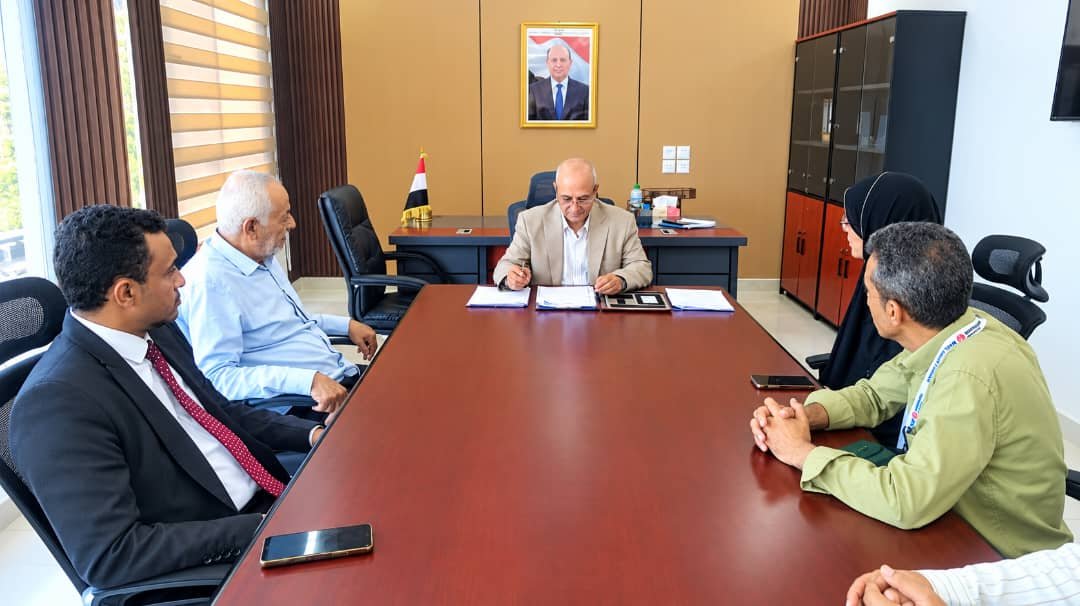
ADEN, Yemen — Yemen’s water minister signed an agreement with Solidarités International on Tuesday to fund water and sanitation work in four western coast districts, the state news agency Saba said.
The agreement is worth 1,205,000 euros and runs for 12 months, according to the agency.
It is funded by the European Commission’s humanitarian aid department, ECHO.
The four districts are Hays, Mawza, al-Mokha and al-Khokha.
Saba said 55,634 people are expected to benefit. They include displaced people, host communities and residents the ministry classed as most vulnerable.
The project covers water, environmental sanitation, health and nutrition, the agency said.
It will rehabilitate four water supply systems and nine health facilities and centres, according to Saba.
The work also includes building toilets and distributing hygiene supplies.
Water and sanitation committees are to be trained to manage and maintain the services, the agency said.
Tawfiq al-Sharjabi, the minister of water and environment, signed for the ministry. Saba did not name the signatory for Solidarités International.
The account of the signing and its terms rests on Saba, the news agency of the internationally recognised government. Yemen Herald found no independent confirmation of the agreement or its figures.
Hays and al-Khokha lie in the south of Hodeidah governorate. Mawza and al-Mokha lie in the west of Taiz governorate.
All four sit on or near Yemen’s Red Sea coast, in the stretch of territory known as the western coast.
Government forces said on 6 September that they had taken full control of Hays district in Hodeidah governorate, one of the four areas covered by the agreement. Al Jazeera said it could not independently verify battlefield claims from either side.
Solidarités International is a French humanitarian organisation that works on water, sanitation and hygiene.
It is running 11 projects in Yemen, funded by donors that include ECHO, the US Bureau for Humanitarian Assistance and the UN humanitarian pooled fund.
The organisation describes itself as one of the first aid groups to gain access to the western coast.
It keeps offices in al-Mokha, Taiz and Marib, and works in areas close to the front lines in Marib, Hodeidah and Maqbanah.
Its water and sanitation work in Yemen includes water trucking, repairs to water networks and the construction of emergency latrines and showers.
It also distributes hygiene kits and runs hygiene promotion and cleaning campaigns.
The organisation also runs food security and livelihoods programmes in Yemen, managed from its Aden office.
Saba reported earlier this year that al-Sharjabi discussed a project on climate-resilient urban water supply and sanitation in Taiz with the group’s country director, Damaris Bevindt.
That discussion covered aligning the project with Yemen’s national water strategy, according to the agency.
Saba has also reported meetings between al-Sharjabi and the Food and Agriculture Organization on cooperation in the water and environmental sectors.
Aid agencies expect 14.4 million people in Yemen to need water, sanitation and hygiene assistance during 2026, according to the UN Office for the Coordination of Humanitarian Affairs.
OCHA has attributed those needs to water scarcity and damaged infrastructure.
Only about a third of Yemen’s population is connected to a piped water network.
The International Committee of the Red Cross has put the number of people without access to safe drinking water and sanitation services at more than 14.5 million, most of them in rural or hard-to-reach areas.
UNICEF has given a higher figure, saying more than 16 million people need water, sanitation and hygiene assistance, among them 8.47 million children.
The agencies use different definitions, and their totals do not match.
Yemen’s groundwater is being drawn down faster than it is replenished. The rate of overdraft is about twice the rate of recharge.
Qat cultivation accounts for more than 40 per cent of Yemen’s renewable water resources and about 32 per cent of groundwater withdrawals.
The 2026 Humanitarian Needs and Response Plan, published in March, seeks 2.16 billion dollars to reach 12 million people.
The plan says more than 22 million people in Yemen need humanitarian aid.
It puts the number of acutely food insecure people at 18.3 million.
More than 2.2 million children under five are acutely malnourished, according to the plan. It records 516,157 of those cases as severe.
The plan counts 5.2 million internally displaced people across the country.
Cholera has spread over the same period. OCHA said the outbreak had reached 98 per cent of the country by late 2025.
It recorded 93,496 suspected cases and 248 deaths as of December 2025.
Emergency water and sanitation support is directed at cholera hotspots under the response plan.
OCHA has said the 2026 response remains underfunded and that agencies have had to prioritise.
ECHO is the European Union’s humanitarian aid arm, funding relief work through partner organisations.
The European Commission set an initial humanitarian budget of 1.9 billion euros for 2026.
It allocated 448 million euros of that to the Middle East, covering Yemen alongside Gaza, Iraq, Syria and Lebanon. The Commission did not publish a Yemen-only figure.
The 2026 humanitarian budget was announced by Hadja Lahbib, the European commissioner responsible for humanitarian aid.
The Commission announced more than 193 million euros for Yemen in 2023 and pledged 154 million euros in 2022.
The ministry has not published a timetable for the first works under Tuesday’s agreement.
Al-Mokha is a Red Sea port town north of the Bab al-Mandab strait.
About the Author