Bahrain’s crown prince receives Yemen’s foreign minister and a letter from al-Alimi
 Yemen Herald News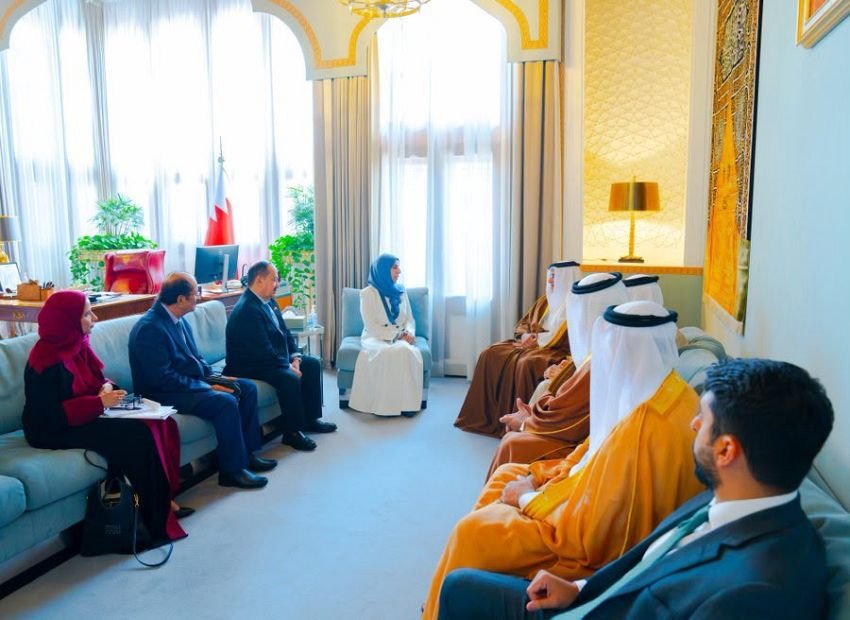
MANAMA, Bahrain — Bahrain’s crown prince and prime minister, Prince Salman bin Hamad Al Khalifa, received Yemen’s foreign minister Afrah al-Zouba on Wednesday and took delivery of a letter for King Hamad.
The letter was written by Rashad al-Alimi, chairman of Yemen’s Presidential Leadership Council, and addressed to King Hamad bin Isa Al Khalifa, the Yemeni state news agency Saba said.
Bahrain’s Gulf Daily News reported the same meeting and placed it at Riffa Palace. Saba gave no venue.
The two discussed relations between the two countries and ways to develop them, along with the latest developments in Yemen and the region, according to Saba.
Prince Salman said Bahrain was keen to continue cooperation across various fields, the agency reported, and restated the kingdom’s support for security, stability, development and peace in Yemen.
He congratulated al-Zouba on her appointment as foreign minister, the Gulf Daily News said.
Al-Zouba expressed Yemen’s appreciation for Bahraini support for the Presidential Leadership Council, the government and state institutions, according to Saba.
She described the government’s efforts to restore state institutions, and what Saba called continuing Houthi escalation and threats to navigation.
Al-Zouba also restated Yemen’s condemnation of what she called Iran’s unjustified attacks on Bahrain and the Gulf Cooperation Council states, the agency said.
She reaffirmed Yemen’s solidarity with those countries and its support for the measures they take to protect their security, sovereignty and territorial integrity, according to the report.
Her remark refers to a campaign that began in February. Iranian missile and drone attacks on Bahrain, the United Arab Emirates, Saudi Arabia, Oman, Qatar and Kuwait started on 28 February, according to a statement by the Gulf Cooperation Council’s ministerial council, which said they hit civilian facilities, service sites and residential areas.
On 12 July the council’s secretary-general condemned what he called Iran’s repeated attacks on six member states and Jordan, and assaults on commercial vessels.
Tehran has described its July strikes as a response to renewed United States bombing of cities on Iran’s southern coast. Neither Saba nor the Bahraini report carried an Iranian comment on Wednesday’s meeting.
Bahrain’s foreign minister, Abdullatif al-Zayani, attended the crown prince’s meeting, Saba said, along with the minister of finance and national economy, Sheikh Salman bin Khalifa Al Khalifa, and other senior officials.
Al-Zouba held separate talks with al-Zayani the same day, Saba reported. They discussed resuming Yemenia flights to Bahrain, and entry and residence procedures for the Yemeni community there.
The two ministers stressed the importance of direct coordination between their foreign ministries and of widening economic, trade and development cooperation, according to the agency. They also discussed capacity building and diplomatic training.
Al-Zouba said she wanted to draw on Bahraini experience in digital transformation and institutional development, Saba said. The agency did not say when flights to Bahrain might resume, or whether either side set a timetable.
Saba rendered the Yemeni minister’s name as al-Zoubi in this report and as al-Zouba elsewhere the same day. Yemen’s foreign ministry uses al-Zouba.
The meeting opened a Gulf tour. Al-Zouba arrived in Manama on Wednesday at the start of a trip covering several Gulf Cooperation Council states, Saba reported separately.
She took the foreign ministry in late July, the first woman to hold the post in Yemen’s history. She had been minister of planning and international cooperation since February.
Al-Zouba spent more than 25 years in development and peacebuilding work before entering government. She served as first deputy secretary-general of the National Dialogue Conference.
Her first weeks in office involved calls with counterparts in Egypt, Sudan and Djibouti on Red Sea security and support for the government. She met the Gulf Cooperation Council secretary-general, Jasem Albudaiwi, in Riyadh on 3 August.
The government she represents has changed leadership twice this year. The Presidential Leadership Council named Shaya Zindani prime minister on 15 January, moving him from the foreign ministry, and appointed his predecessor Salem Saleh bin Braik as an adviser on financial and economic affairs.
The tour comes during a sharp escalation. A United Nations-brokered truce agreed in 2022 has broken down, and international news organisations reported that the collapse followed a Saudi air strike on the runway at Sanaa airport on 13 July.
International reporting dates the start of the wider regional war to 28 February. A naval monitoring group reported on 22 July that Houthi forces had deployed missiles and drones against ships in the southern Red Sea.
Yemen’s transport ministry said a Houthi strike on the Egyptian-owned, Tanzania-flagged cargo ship Tihamah in the Bab al-Mandab strait on 12 August killed four crew members, three of them Pakistani and one Indonesian, and two rescuers. Al Jazeera, NBC News and CNBC reported those deaths.
The UN Office for the Coordination of Humanitarian Affairs said in its response plan published in March that more than twenty-two million Yemenis need assistance and that more than eighteen million are acutely food insecure. Its appeal sought just over two billion dollars to reach twelve million people.
Yemen Herald could not independently verify the Yemeni account of what was said in the room. The Bahraini report corroborates that the meeting took place and that the letter was delivered.
Saba did not say how long the meeting lasted, neither report named the next stop on the tour, and neither gave the contents of the letter the minister handed over.
About the Author