Yemen’s parliament speaker meets China’s acting envoy before 70th anniversary of ties
 Yemen Herald News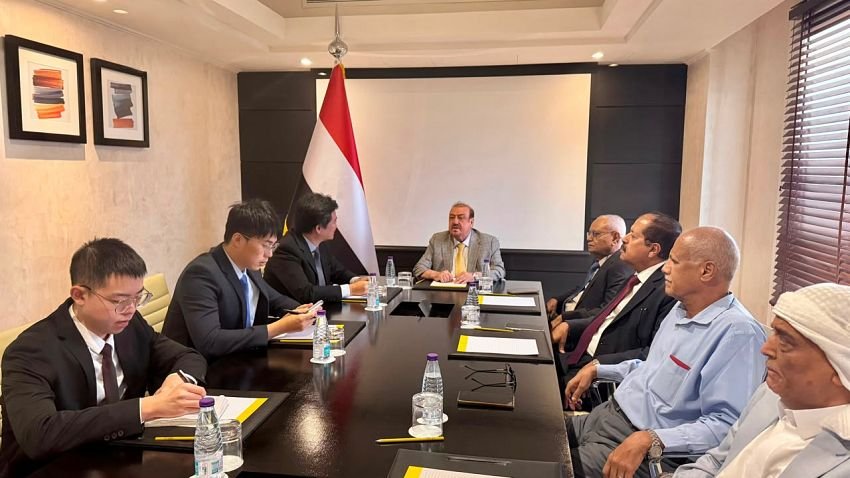
RIYADH, Saudi Arabia — Yemen’s parliament speaker, Sultan al-Barakani, met the Chinese embassy’s acting head of mission, Shao Zheng, on Wednesday, the state news agency Saba said.
The two discussed relations between the two countries and developments at home and in the region, according to the agency.
Al-Barakani called the relationship historic, robust and constructive, Saba reported. He said he appreciated Chinese support for Yemen, the Presidential Leadership Council, the government and the parliament.
He said China had shown concern for Yemen’s unity, sovereignty, security and territorial integrity.
The speaker valued Chinese contributions to Yemeni development including highways, schools, a hospital and technical institutes, the agency said.
Shao pointed to the coming 70th anniversary of diplomatic relations between the two countries, describing it as a milestone for reviewing cooperation, according to Saba.
He said Beijing would continue to support Yemen and wanted to widen areas of cooperation, and restated Chinese backing for Yemen’s unity, sovereignty, security and stability.
The anniversary falls next month. China established ministerial-level diplomatic relations with the Mutawakkilite Kingdom of Yemen in September nineteen fifty-six, the same year several Arab states opened relations with the People’s Republic, and raised the relationship to ambassadorial level in February nineteen sixty-three.
After the unification of north and south in 1990, the two governments designated 24 September 1956 as the official founding date of relations.
Saba’s account of the Chinese diplomat’s remarks placed the development contribution in the early 1950s, which precedes the establishment of relations by several years.
China’s engagement with Yemen extends beyond development projects. Beijing announced tariff exemptions for Yemeni products in 2025 and said it was ready to resume more than 100 Chinese projects in the country once the conflict ends.
Its position on the war at sea has been more reserved. China abstained from a UN Security Council resolution demanding that the Houthi movement halt attacks on Red Sea shipping, with its representative citing ambiguities in the text and the risk of worsening regional tensions.
The Red Sea and the Gulf of Aden form part of the maritime route of China’s Belt and Road Initiative, and carry a large share of Chinese trade to Europe and Africa through the Suez Canal.
Research organisations including the Stimson Center have reported that Chinese-sourced dual-use materiel has reached the Houthis through private companies and smuggling networks. Beijing has not confirmed those findings, and neither man raised them, according to Saba.
Al-Barakani used the meeting to set out the government’s position on the war. He blamed the Houthi movement for prolonging the conflict, Saba said.
He argued that the internationally recognised government had exhausted every peaceful option, and that Houthi rejection of peace made the restoration of state institutions an irreversible goal, whether by peace or war.
Those are the speaker’s characterisations. The Houthi authorities in Sanaa reject the description of their takeover as a coup and blame the government and its backers for the war. Saba carried no Houthi response.
Yemen Herald could not independently verify the account of the meeting, which rests on the Yemeni state agency. The Chinese embassy had published no readout at the time of writing.
Al-Barakani has led the chamber since twenty nineteen. He was elected at a session held in Seiyun, in Hadramout, in April that year.
Saba filed Wednesday’s report from Riyadh, where much of the government’s senior leadership is based. It datelined two other government statements the same day from Aden.
The government has changed leadership twice this year. The Presidential Leadership Council named Shaya Zindani prime minister on 15 January, moving him from the foreign ministry, and appointed his predecessor Salem Saleh bin Braik as an adviser to council chairman Rashad al-Alimi on financial and economic affairs.
The foreign ministry passed on 23 July to Afrah al-Zouba, the first woman to hold the post.
The meeting took place during a sharp escalation. A United Nations-brokered truce agreed in 2022 has broken down, and international news organisations reported that the collapse followed a Saudi air strike on the runway at Sanaa airport on 13 July.
International reporting dates the start of the wider regional war to 28 February, when Iranian missile and drone attacks struck Bahrain, the United Arab Emirates, Saudi Arabia, Oman, Qatar and Kuwait, according to a Gulf Cooperation Council statement.
A naval monitoring group reported on 22 July that Houthi forces had deployed missiles and drones against ships in the southern Red Sea.
Yemen’s transport ministry said a Houthi strike on the Egyptian-owned, Tanzania-flagged cargo ship Tihamah in the Bab al-Mandab strait on 12 August killed four crew members, three of them Pakistani and one Indonesian, and two rescuers. Al Jazeera, NBC News and CNBC reported those deaths.
The UN Office for the Coordination of Humanitarian Affairs said in its March 2026 response plan that more than 22 million Yemenis need assistance and 18.3 million are acutely food insecure.
OCHA put the number of young children with acute malnutrition above two million, of whom more than half a million are severely malnourished, and the number of people displaced inside the country at above five million. Its appeal sought just over two billion dollars to reach twelve million people.
Saba did not say where in Riyadh the two men met, whether any anniversary events have been scheduled, or when Beijing intends to return a full ambassador to the post that Shao currently covers.
About the Author