Drone Strike on Iraqi Intelligence Headquarters in Baghdad Kills an Officer
 Yemen Herald News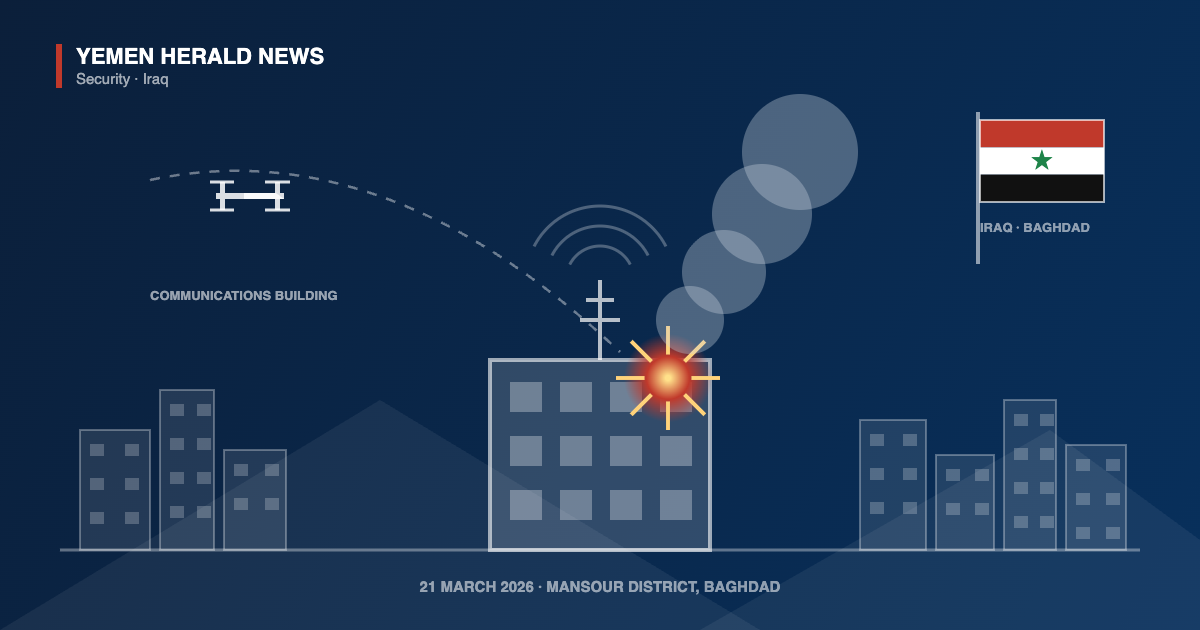
A drone struck near the headquarters of Iraq’s National Intelligence Service in western Baghdad on the morning of Saturday 21 March 2026, killing one officer. The attack hit the Mansour district at about 10am local time, or 07:00 GMT. General Saad Maan, who heads the Iraqi government’s security media cell, confirmed the strike in a brief statement issued the same day, and the account was carried by international news agencies.
The intelligence service attributed the launch to what it called outlaw groups, the formulation Iraqi officials generally use for armed factions operating outside state control. A security official, speaking to AFP on condition of anonymity, said the drone had targeted a communications building housing an Iraqi security agency that works with American advisers on security matters. No group claimed responsibility in the immediate aftermath.
Reports at the time described a second drone, apparently filming the operation, crashing into a private sports club frequented by Iraqi officials and foreign diplomats. No casualties were reported at that location. The detail, if accurate, pointed to a degree of operational sophistication beyond a single opportunistic launch, and it was the element of the attack that most unsettled Baghdad’s diplomatic community.
The strike came at the end of a night of attacks across the capital. At least three drone attacks were reported overnight against the Camp Victory logistics hub at Baghdad International Airport, which supports American diplomatic and military functions. One official said a fire broke out near the base after the third of them. By the time the Mansour strike occurred, the city had already absorbed several hours of intermittent alarms.
Iraq had been pulled into a confrontation that began with joint American and Israeli strikes on Iran on 28 February 2026. Iran-aligned armed groups operating inside Iraq responded by attacking American positions and interests in the country, and the United States struck back at them. Within three weeks Iraqi territory had become one of the principal arenas of a war that was nominally being fought between other states.
The Pentagon acknowledged in March, for the first time in that round of fighting, that combat helicopters had carried out strikes against pro-Iran armed groups in Iraq. AH-64 attack helicopters were used against Iranian-aligned militias following the deaths of six American service members in an aircraft crash, in what American officials described as an effort to suppress threats to United States forces and interests in the country.
The exchange proved costly for the Hashed al-Shaabi, the umbrella organisation for Iran-backed Shia armed groups that is formally part of Iraq’s security architecture. Airstrikes killed 15 of its members in a single attack that month, the deadliest strike against the organisation since the war began. A separate attack on a military airfield in northern Iraq killed one of its fighters, and the group blamed American and Israeli forces.
Mansour is not a peripheral district. It lies in western Baghdad and has long housed government offices, embassies and the residences of senior officials, and it sits outside the fortified Green Zone that shelters much of the diplomatic and governmental presence. A drone reaching a communications facility there in daylight, at ten in the morning, indicated that the layered air defences and counter-drone measures around the capital had been penetrated rather than merely tested.
That put the Iraqi government in an acutely awkward position. Baghdad hosts American forces and advisers, while the Hashed is legally part of the state security apparatus and draws a state salary. Iraqi officials warned of the country’s right to respond to strikes on its territory while simultaneously condemning attacks on the diplomatic and military facilities the government is obliged to protect. Neither position could be dropped without cost.
The scale of the campaign was substantial. Between February and April 2026, more than 600 attempted attacks on American citizens and facilities in Iraq by Iran-aligned militias were recorded. Most caused no casualties. What made the Mansour strike unusual was that it hit an Iraqi state institution rather than an American one, and that the person killed was an Iraqi officer rather than a foreign soldier.
Attacks of this kind are difficult to attribute with confidence. Drones of the type used are widely held by armed groups across the region, launch sites are mobile, and claims of responsibility are often withheld precisely to preserve deniability. Iraqi investigators said little publicly about the Mansour strike beyond the initial statement, and no findings were subsequently made public.
The pattern was familiar to Yemenis. The same category of weapon, launched by non-state actors against state institutions and foreign facilities, has defined much of the conflict in Yemen since 2015, and the difficulty of establishing who fired and from where has been a persistent feature there too. What changed in March 2026 was the geography rather than the method.
Prime ministerial statements through this period stressed that Iraq would not become a launchpad for attacks on neighbouring states, nor a theatre for others to settle their disputes. The formulation was repeated often enough to become a refrain, and its repetition tracked how little practical effect it was having on the ground.
For Baghdad the strike was a reminder of how little control the state retained over violence carried out on its own territory, in its own capital, against its own agencies. That was the message it carried, whoever launched it.
About the Author