Yemen and Germany Discuss Cooperation on Environmental Challenges
 Yemen Herald News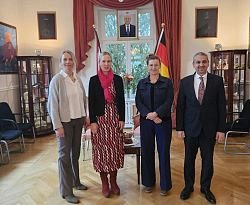
Yemen’s Ambassador to Germany, Luay al-Eryani, held talks with Eileen von Zitzewitz, a senior official at the German Federal Ministry for the Environment, to explore how the two countries might deepen their cooperation on the environmental challenges bearing down on Yemen. The meeting, held on Monday, reflected a growing recognition that the country’s ecological problems, long overshadowed by the immediate demands of war and humanitarian relief, are themselves a central part of any lasting recovery.
During the discussion, al-Eryani and von Zitzewitz stressed the importance of building stronger channels of communication with the Yemeni authorities responsible for environmental affairs, and in particular with the Ministry of Water and Environment, which carries much of the responsibility for managing the country’s scarce natural resources. Both sides spoke of the need to identify Yemen’s specific requirements in the environmental sector so that any future cooperation could be tailored to the realities on the ground rather than imposed from outside.
The talks came at a moment when Yemen ranks among the most environmentally stressed countries in the world. Even before the war, it was one of the most water-scarce nations on earth, with per-capita water availability far below regional and global averages. Years of conflict have compounded that fragility, damaging infrastructure, weakening the institutions meant to manage resources and leaving little capacity to plan for the longer-term threats posed by a changing climate.
Water lies at the heart of Yemen’s environmental predicament. Decades of over-extraction have drawn down the aquifers on which many towns, villages and farms depend, and in some areas groundwater is being pumped far faster than it can be replenished. Erratic rainfall and rising temperatures threaten to deepen the scarcity, with direct consequences for agriculture, food production and public health in a country where clean water is already in desperately short supply.
Germany has been one of the more consistent European partners in Yemen’s humanitarian and development response, contributing to relief programmes and to projects aimed at restoring basic services. Its engagement on the environment fits within a broader European approach that treats water, sanitation and climate resilience not as luxuries to be addressed once the fighting ends, but as immediate priorities bound up with the survival and stability of communities across the country.
The Ministry of Water and Environment, referenced prominently in the talks, has sought to expand its partnerships with international organisations and donor governments as it works to rehabilitate water systems, promote conservation and respond to environmental threats. Cooperation of the kind discussed with Berlin could help strengthen the ministry’s technical capacity, allowing it to draw on German expertise while adapting solutions to Yemen’s particular geography and constraints.
Climate change has become an unavoidable consideration in development planning for conflict-affected states such as Yemen. Rising temperatures, shifting rainfall patterns and the growing frequency of extreme weather events, including destructive flash floods, place additional strain on already limited resources. Preparing for such shocks, rather than simply reacting to them after the fact, is increasingly seen as essential to protecting livelihoods and preventing further displacement.
Diplomatic engagement of this sort also serves a wider purpose for Yemen’s internationally recognised government, which has worked to maintain and expand its relationships with European capitals. Meetings between Yemeni ambassadors and host-government officials help keep the country’s needs visible on the international agenda at a time when competing global crises risk drawing attention and funding away from its long-running emergency.
For a country whose environmental problems are so tightly interwoven with its humanitarian ones, the distinction between relief and recovery is often artificial. Access to clean water shapes public health; the health of the land shapes food security; and both are shaped by a climate that is growing less forgiving. Addressing any one of these strands, officials argue, requires attention to the others, and international partnerships are central to marshalling the resources and knowledge involved.
The outcome of the Berlin talks will ultimately depend on whether the general commitments expressed translate into concrete programmes and sustained funding. Environmental cooperation rarely produces immediate, visible results, and its benefits tend to accrue slowly, through better resource management and greater resilience to future shocks. Yet it is precisely this long-term horizon that Yemeni and German officials suggested was needed if the country is to move beyond crisis management toward genuine recovery.
Agriculture gives the stakes an added urgency. A large share of Yemenis still depend on farming and herding for their livelihoods, yet the sector is acutely exposed to water shortages, soil degradation and the encroachment of desertification across once-productive land. Investment in more efficient irrigation, water-harvesting techniques and the protection of remaining arable areas could help safeguard both food production and the incomes of rural communities. German expertise in these fields, Yemeni officials suggest, could prove valuable if channelled into practical programmes designed around the country’s specific conditions rather than generic templates drawn from very different environments.
As Yemen continues to navigate a complex and unresolved conflict, partnerships such as the one discussed by al-Eryani and von Zitzewitz offer a modest but meaningful avenue for progress. By keeping environmental sustainability on the diplomatic agenda, the two governments signalled that the country’s ecological future, however distant it may seem amid the daily emergencies, remains a matter worth investing in now rather than later.
About the Author