EU mission says it signed three projects worth 24 million euros for Yemen’s farming and fishing sectors
 Yemen Herald News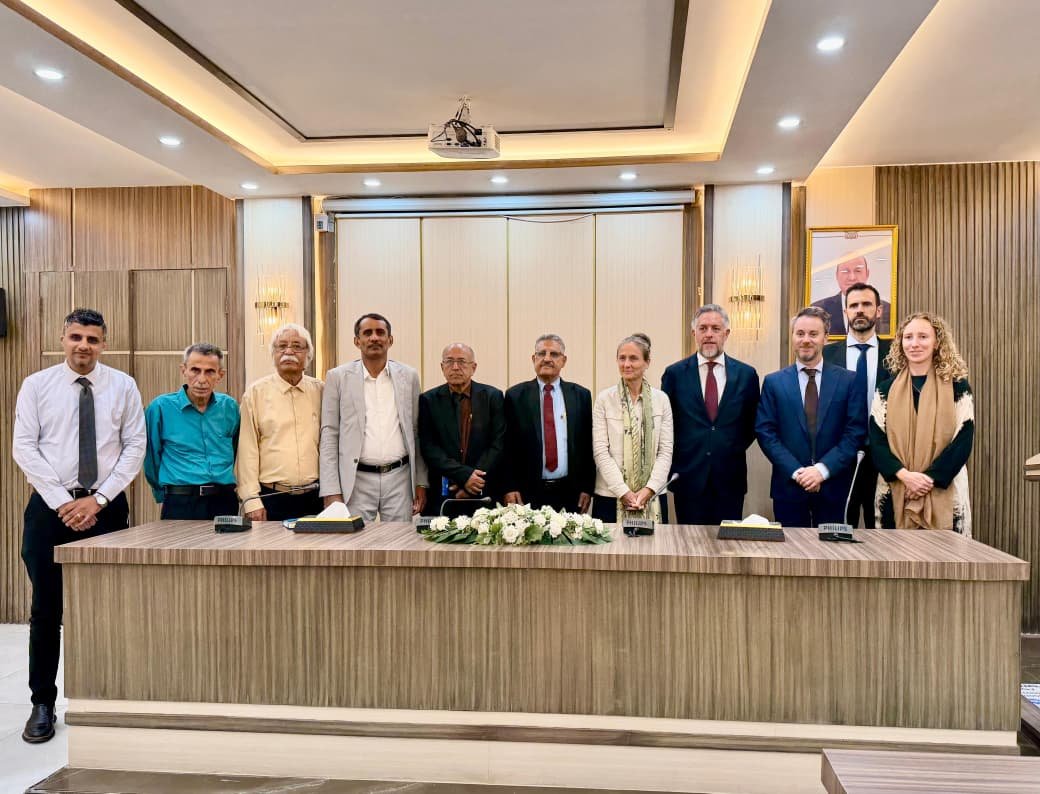
ADEN, Yemen — The European Union has signed three projects worth 24 million euros to support Yemen’s food and agriculture sectors, the bloc’s mission in the country announced Wednesday.
The announcement was made during talks in Aden with Yemen’s Ministry of Agriculture, Irrigation and Fisheries.
The account rests on Saba, Yemen’s state news agency, which reported the meeting the same day. Yemen Herald found no independent confirmation of the figure or of the projects themselves.
Saba said the head of development cooperation at the EU mission announced the signing. The agency did not name the three projects, say where they will run, or give a start date.
The agency gave the name of the EU mission’s development cooperation head in a transliteration Yemen Herald could not match against the delegation’s own records. It is omitted here.
It named the implementing partners as the Danish Refugee Council, the UN Development Programme, the Food and Agriculture Organization and Solidarités International.
Saba rendered the fourth partner’s name as the Solidarities Foundation.
EU Ambassador Patrick Simonnet and Netherlands Ambassador Jeannette Seppen attended the meeting, according to the agency.
Yemen was represented by Abdulmalik Nagi, the ministry’s undersecretary for the agricultural production sector.
The agency described Aden as the temporary capital, the seat the internationally recognised government has used since it left Sanaa.
The talks covered European and Dutch support for farming and fishing projects, Saba said. They also covered access for Yemeni produce to European markets.
Both sides discussed the technical steps Yemeni exporters must complete to meet European requirements and standards, the agency said.
They reviewed work to update Yemen’s strategy for the agriculture and fisheries sectors for 2026 to 2030. The Food and Agriculture Organization is taking part in that revision, according to Saba.
Simonnet said the EU wanted to widen cooperation with the ministry and to back the Yemeni government.
He said the bloc should move gradually from emergency response to development projects that create jobs and raise production and exports, the agency reported.
Simonnet was the EU’s special envoy for the Mediterranean from 2023 to 2025.
He was EU ambassador to Saudi Arabia from 2020 to 2023, accredited also to Bahrain, Oman, the Gulf Cooperation Council and the Organisation of Islamic Cooperation.
He headed the East Africa and Horn of Africa division at the European External Action Service from 2017 to 2020. He served as EU ambassador to Iraq from 2015 to 2017.
The UN Development Programme already runs a project in Aden to rehabilitate fishery harbours and develop fish value chains, according to its own project record.
The programme has also worked with Germany on Yemen’s fishery and water sectors, according to its own account.
Yemen relies on imports for most of its staple food, UN agencies say. Fishing is one of the few sectors the internationally recognised government has tried to build into an export earner.
The Aden talks were one of several meetings the two ambassadors held in the city this week. Saba reported that Yemen’s prime minister received them, and that the interior minister discussed coast guard support with them.
The EU delegation has reported joint visits by Simonnet and Seppen outside Aden, including to Marib.
Yemen’s planning minister chaired the first meeting of a technical committee preparing a national development and reconstruction plan for 2027 to 2029, Saba reported this week.
Yemen’s agriculture minister reviewed progress on a Pandemic Fund project for veterinary services with its team in Rome this week, according to the agency.
The education ministry signed a school feeding partnership with the World Food Programme this month.
The country’s aid needs remain large. The UN Office for the Coordination of Humanitarian Affairs said in its plan published in March that more than 22 million people in Yemen need assistance.
OCHA put the number of acutely food insecure at 18.3 million. It counted more than 2.2 million children under five as acutely malnourished, 516,157 of them severely.
The office recorded 5.2 million internally displaced people. It sought 2.16 billion dollars this year to reach 12 million of them.
OCHA said aid agencies reached 10.83 million people in Yemen between January and July. The World Health Organization said this month that nearly 20 million people need health assistance.
Fighting on the Red Sea coast has displaced more people since. The UN refugee agency said this month that nearly 100,000 more Yemenis could be displaced within three months.
OCHA said 18,000 displaced families on Yemen’s west coast had received aid. A government unit put the number displaced across the country over 18 days at nearly 147,000.
Houthi forces took the port city of Mokha in the second week of September, Al Jazeera reported. Households in Mokha and the coastal districts around it rely on fishing and daily labour, Asharq Al-Awsat reported.
The same report said Houthi authorities had begun enforcing the exchange rate used in areas they control and refusing banknotes issued by the central bank in Aden.
OCHA condemned the seizure of a humanitarian compound in Mokha that housed UN agencies and international organisations, according to that report. It said Houthi members took eight vehicles from the city’s UN humanitarian centre.
Saba did not say whether the three new projects cover any of the coastal districts now outside government control.
About the Author