Hadramout Governor Al-Khanbashi Pledges Safe Environment for UN Staff in Mukalla Talks
 Yemen Herald News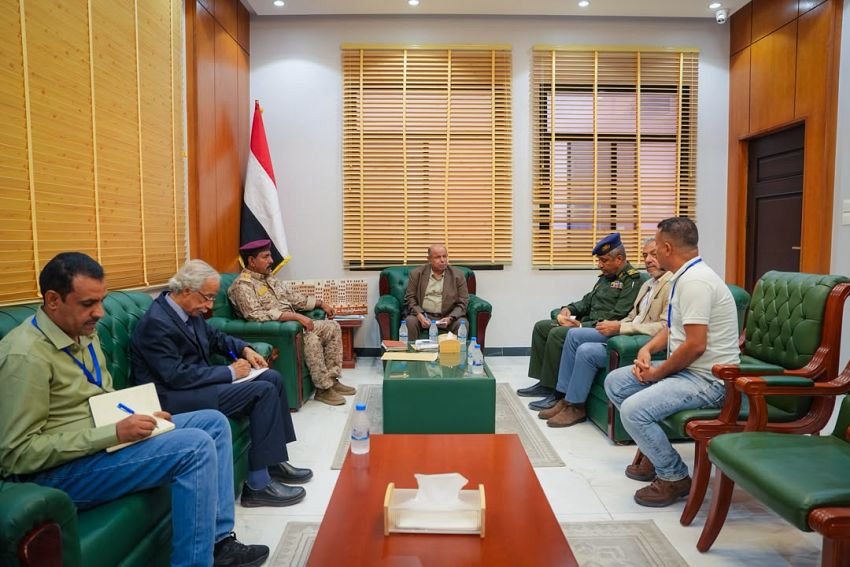
Salem al-Khanbashi, a member of Yemen’s Presidential Leadership Council and governor of Hadramout, met in Mukalla with George Torres, security adviser to the director of the United Nations Department of Safety and Security. The two discussed the protection of UN personnel and the staff of international organisations working across the governorate, the state news agency Saba reported.
The talks focused on strengthening security coordination so that aid and development staff can move safely and keep their programmes running. Al-Khanbashi told his visitor that the local authority is committed to providing a safe and stable environment for UN agencies and international organisations, and to offering the support and facilitation they need to carry out their humanitarian and development tasks.
The Department of Safety and Security is the UN body responsible for the security of the organisation’s personnel worldwide. Its risk assessments shape where UN agencies may travel, which offices stay open, and which movements require advance clearance or escort. A meeting at governor level therefore carries practical weight: in Yemen, access is negotiated governorate by governorate, and the posture of the local authority is often what determines whether a convoy leaves the compound at all.
That question has become sharper in Hadramout after an unusually turbulent start to the year. In early January, forces loyal to the internationally recognised government, the units known as Homeland Shield, took Seiyun and its airport as fighters of the Southern Transitional Council withdrew, then advanced into Mukalla, al-Rayyan airport and the coastal districts. The government announced that it had regained full control of the oil-producing province after a Saudi-backed operation that included several days of air strikes. An STC spokesman said his forces had pulled back to protect the lives of their fighters under what he described as immense pressure. Al-Khanbashi himself announced that Seiyun had been secured as the operation unfolded.
He kept the governorship after being named to the Presidential Leadership Council, the collective presidency that has headed the internationally recognised government since 2022, and was sworn in as governor by the council’s chairman, Rashad al-Alimi. Holding both posts makes him the principal interlocutor for foreign missions in a governorate that covers a large share of Yemen’s territory and much of its oil production.
The backdrop to any conversation about UN staff safety in Yemen is the detention of aid workers in areas controlled by the Houthi movement in the north. The United Nations suspended its operations in Saada governorate in February 2025 after a further eight of its employees were detained there, with the secretary-general instructing agencies, funds and programmes to halt activities in the absence of security guarantees. Human Rights Watch reported in early January that at least 69 UN staff, all of them Yemeni nationals, had been arbitrarily detained, alongside dozens of Yemeni employees of international and local non-governmental organisations. The Houthis have alleged that detained staff were spying; they have not presented evidence for the claim, and the United Nations has rejected it. A World Food Programme employee held in Houthi custody later died in detention.
That record has made the terms of engagement in government-held governorates more consequential. With access to parts of the north curtailed, agencies have leaned more heavily on hubs in the south and east, which raises the value of the assurance al-Khanbashi offered, and the cost of failing to honour it.
The scale of the need explains the urgency. The UN humanitarian office’s Humanitarian Needs and Response Plan for 2026 estimates that more than 22 million people in Yemen require humanitarian assistance and protection this year, among them 10.95 million women and girls, 5.2 million internally displaced people, some 329,000 migrants and 63,000 refugees and asylum seekers. Aid agencies aim to reach 12 million people, with 9.4 million prioritised on the basis of severity, and have appealed for 2.16 billion dollars to fund the effort. The plan records 18.3 million people as acutely food insecure and more than 2.2 million children under five as acutely malnourished, including 516,157 suffering from severe acute malnutrition.
Hadramout matters within that picture out of proportion to its population. It is Yemen’s largest governorate by area, it contains oil fields that have historically supplied a substantial share of state revenue, and its port at Mukalla and the airport at al-Rayyan are logistical assets for moving supplies and personnel along a long stretch of coastline. Instability there is felt well beyond the province.
Neither side set out a timetable or a list of specific measures in the public account of the meeting, which described the discussion in general terms of coordination and facilitation rather than announcing new arrangements. In practice, commitments of this kind are tested slowly: through the pace at which travel clearances are issued, the conduct of checkpoints on the roads between Mukalla, Seiyun and the interior, and whether local security forces consistently extend protection to aid convoys and their Yemeni staff.
For now the meeting registers as a signal rather than a settlement, with a governor who also sits on the country’s ruling council telling the UN’s security arm, in public, that his administration wants international agencies to stay and work. In a country where more than half the population needs assistance to get through the year, that assurance is the precondition for almost everything else.
About the Author