Yemen’s Health Minister and WHO Review Progress on Pandemic Fund Projects in Aden
 Yemen Herald News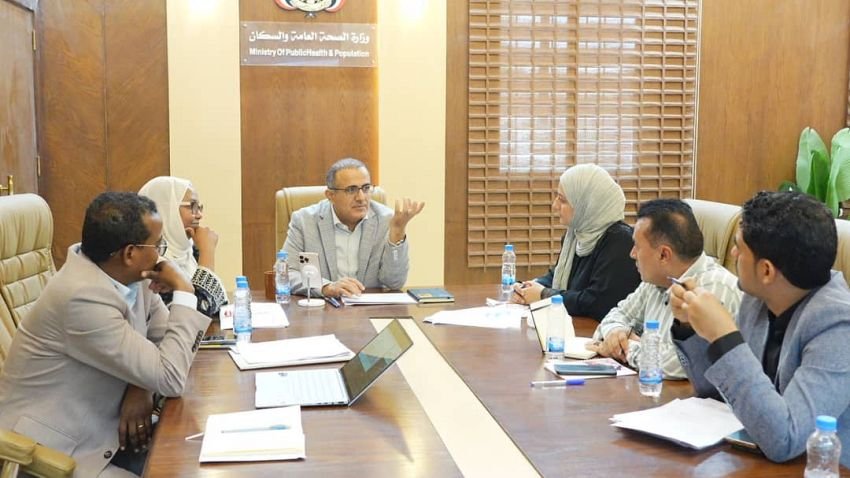
Yemen’s Minister of Public Health and Population, Dr. Qasem Buhaibeh, has met the deputy head of the World Health Organization’s office in the country, Dr. Noha Mahmoud, in Aden to review progress on health projects supported by the Pandemic Fund. Their discussions focused on accelerating implementation and addressing the obstacles that have slowed these initiatives, at a moment when Yemen’s health system remains under severe strain after years of war.
The meeting centred on projects financed through the Pandemic Fund, a global initiative launched to help lower-income countries prepare for and respond to disease outbreaks. In Yemen, the effort is anchored by a preparedness and response project supported by a grant of around 26 million dollars, which is expected to draw in tens of millions more in co-financing and co-investment to strengthen the country’s capacity to detect and contain epidemics.
The project is designed to bolster several pillars of the health system at once. According to the WHO and its partners, it aims to strengthen early warning and disease surveillance networks, expand laboratory capacity, improve the skills of the health workforce and promote coordination across the different sectors involved in outbreak response. It is implemented as a partnership involving Yemeni ministries alongside the FAO, UNICEF and the WHO.
Laboratory strengthening is a prominent component. Plans call for reinforcing central public health laboratories, improving systems for transporting and tracking specimens, and expanding genomic sequencing capacity in both Aden and Sanaa, as well as upgrading veterinary diagnostic facilities. This last element reflects a “one health” approach that recognises the links between human, animal and environmental health in the emergence and spread of disease.
Buhaibeh underscored the importance of ensuring that these projects deliver lasting rather than temporary benefits. He expressed a commitment to making the programmes transformative, arguing that investment must go beyond immediate relief to build durable infrastructure, train healthcare workers and establish reliable supply chains for medicines and equipment. Sustainability, he suggested, is the measure by which the initiatives should ultimately be judged.
The urgency of the effort is rooted in Yemen’s recent experience. The country has endured repeated outbreaks of cholera and measles, diseases that thrive amid the collapse of water, sanitation and health services. These recurring emergencies have exposed the fragility of the system and demonstrated how quickly preventable illnesses can spread when surveillance and response capacity are weak, making preparedness a matter of life and death.
The scale of Yemen’s humanitarian crisis compounds the challenge. The United Nations estimates that more than 18 million people require assistance, and the disruption of health services has left large parts of the population without reliable access to care. Many hospitals and clinics have been damaged or forced to close during the conflict, and shortages of staff, medicine and electricity continue to hamper those that remain open.
Funding pressures loom over the sector. Yemeni health officials have warned that declining resources and shrinking international funding threaten the gains that have been made, and that even well-designed projects can falter without sustained financial support. In that context, initiatives like the Pandemic Fund project are valued not only for the specific capabilities they build but for the relative predictability of the backing they provide.
The WHO’s continued engagement is central to these efforts. As one of the principal international health agencies operating in Yemen, it plays a key role in coordinating outbreak response, supporting vaccination campaigns and helping to keep essential services running. Its partnership with the health ministry, officials say, is vital to mobilising the resources and expertise needed to confront the country’s overlapping health emergencies.
Yemen’s growing role within the Pandemic Fund framework has been noted internationally; the country secured a seat on the fund’s governing board, giving it a voice in how such resources are allocated globally. For a state grappling with conflict, that position carries both practical and symbolic significance, signalling engagement with international health governance despite the pressures at home.
The push also aligns with broader planning within the ministry, which has recently set out a National Quality of Health Care Strategy intended to guide improvements in the coming years. Officials have framed the Pandemic Fund projects as one part of that larger agenda, linking immediate work on surveillance and laboratories to a longer-term vision of a more resilient, better-governed health system capable of serving Yemenis across the country.
Strengthening the health system also carries implications beyond individual wellbeing. Officials have argued that improvements in healthcare can contribute to broader social and economic recovery, and even to regional stability, given Yemen’s location near the Red Sea and the Bab al-Mandab Strait. Disease outbreaks, like the maritime insecurity affecting these waters, are challenges that rarely stay confined within national borders.
The systematic approach discussed at the meeting reflects a shift in thinking about humanitarian health work, away from purely reactive interventions and toward building the underlying capacity to anticipate and manage crises. Surveillance networks, laboratories and trained personnel are the kind of foundational investments that, if maintained, can reduce the human and financial cost of future outbreaks considerably.
Turning these ambitions into results, however, will depend on security, funding and the ability of institutions to function across a divided country. Officials acknowledge that implementation has faced obstacles, which is precisely why the meeting focused on how to accelerate progress. For Yemen’s health ministry, sustaining momentum on the Pandemic Fund projects represents an important test of its capacity to rebuild, even as the wider conflict remains unresolved.
About the Author