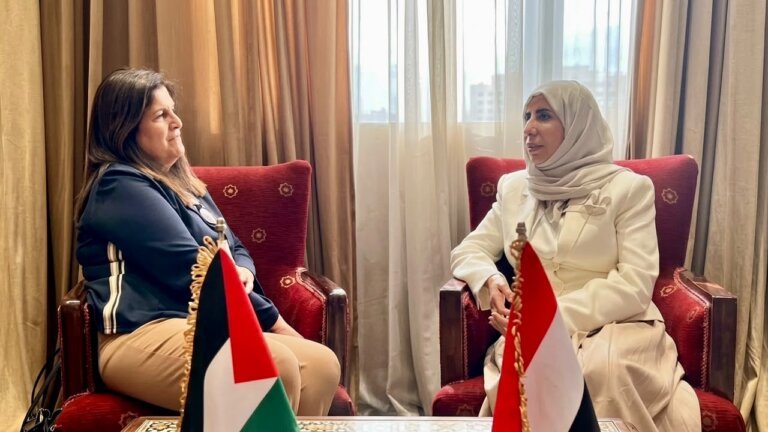
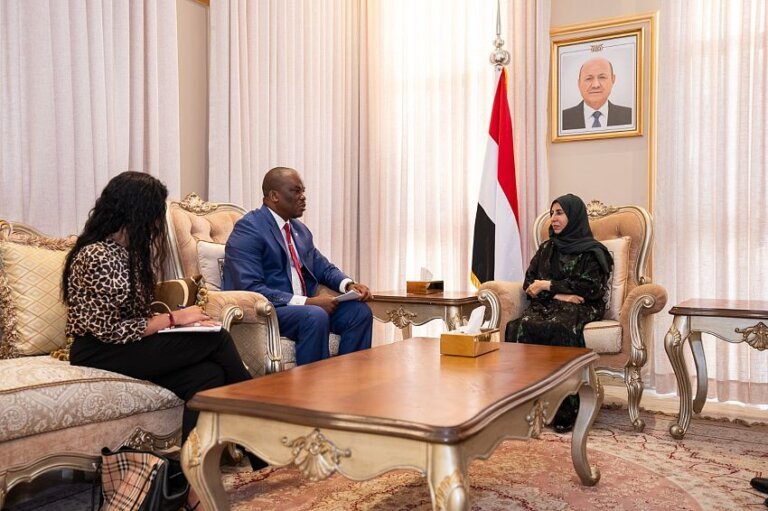
Health ministry and UNFPA review protection work by partner organisations in Aden
 Yemen Herald News
ADEN, Yemen — Yemen’s health ministry and the United Nations Population Fund reviewed protection work delivered through partner organisations at a meeting in Aden on Monday, the state news agency Saba reported.
Abdulraqeeb al-Haidari, undersecretary of the Ministry of Public Health and Population for the population sector, led the ministry’s side, Saba said.
The meeting examined activities addressing protection and gender-based violence, according to the agency. It looked at tying those activities to the ministry’s priorities and to the needs of the health facilities and communities they target.
The two sides discussed sharing more information on what partner organisations are doing and where they operate. They also discussed building joint monitoring and coordination mechanisms, Saba said.
Those steps would give the ministry a clearer view of which services are being delivered and where the gaps are, according to the agency.
The meeting also considered how to raise the quality of the response so that services reach the most vulnerable and underserved groups, Saba said.
Al-Haidari said the ministry was committed to strengthening the health response on protection, building the skills of health workers, and developing referral pathways between health facilities and partners, Saba reported.
He said work by organisations should form part of a single response led by the ministry, based on actual needs and avoiding duplication.
The account of the meeting rests on Saba, which is run by Yemen’s internationally recognised government. No independent report of the meeting has been published, and Yemen Herald could not confirm it separately.
Referral pathways are the routes by which someone who reports violence at a health facility is passed on to legal, shelter or psychosocial services.
Safe spaces are centres where women and girls can receive counselling, case management and onward referral.
The United Nations Population Fund is the UN agency for sexual and reproductive health. It has appealed for 71.9 million dollars to run reproductive health services and gender-based violence programmes in Yemen in 2026.
It had received 9 million dollars of that by March, a shortfall of 87 percent, according to its situation report for the first quarter of the year.
Operating conditions and funding cuts since 2025 have forced the fund to scale back programmes, the report says.
Between January and March the fund reached more than 165,000 people with emergency relief and with reproductive health and protection services.
That work ran through 26 health facilities, 14 safe spaces, eight shelters, seven youth spaces and five specialised mental health centres.
Two of every five health facilities in Yemen are not functioning, according to the same report, which puts the number of people needing healthcare at 19.3 million.
It counts about 662,000 pregnant women in need of life-saving services, 340,000 of them requiring emergency obstetric care.
The fund published that report in April, covering the first three months of the year.
After more than a decade of conflict Yemen remains one of the world’s largest humanitarian crises, the report says.
More than 22 million people in Yemen need humanitarian assistance, the report says, among them 10.95 million women and girls.
Nearly half of those in need are women and girls exposed to heightened risks of gender-based violence, early marriage and restricted access to essential services, according to the fund.
It records 18.3 million people as acutely food insecure, including 1.3 million malnourished pregnant and breastfeeding women.
Malnutrition raises the risk of pregnancy complications, poor birth outcomes and infant health problems, the report says.
More than 6.2 million women and girls face heightened risk of gender-based violence, the fund says, on a count that includes harmful practices such as female genital mutilation.
The fund describes gender-based violence in Yemen as endemic.
The United Nations humanitarian needs and response plan for Yemen, published in March, seeks 2.16 billion dollars to reach 12 million people. It counts more than 2.2 million children under five as acutely malnourished, 516,157 of them severely.
Al-Haidari met the fund in Aden in August, in a separate round of meetings that also included the Yamaan Foundation for Health Development, Saba reported at the time.
Those talks reviewed a health voucher programme, facility improvement plans, and training for midwives and in emergency obstetric care.
The foundation was represented at those talks by Mohammed al-Hamid, according to Saba.
Emergency obstetric care covers treatment for complications such as haemorrhage, obstructed labour and infection.
At that meeting al-Haidari and the fund’s protection team also discussed the health sector’s role within Yemen’s protection system, including referral mechanisms and assessments, according to Saba’s account of the talks.
He said then that partnerships should move away from support for individual projects and towards national systems able to keep services running.
The health ministry operates from Aden, the seat of the internationally recognised government. Houthi authorities run a separate health administration in Sanaa.
Yemen has been at war since 2015, when the Houthi movement took the capital and the government moved south. Aid agencies work across both areas of control.
The fund and the University of Aden launched a study on gendered social norms and harmful practices in northern and southern Yemen on 4 December, which they described as the first of its kind in the country.
Saba did not say which partner organisations were represented at Monday’s meeting.
About the Author