Houthi-run Yemen Petroleum Company raises petrol and diesel prices in areas it controls
 Yemen Herald News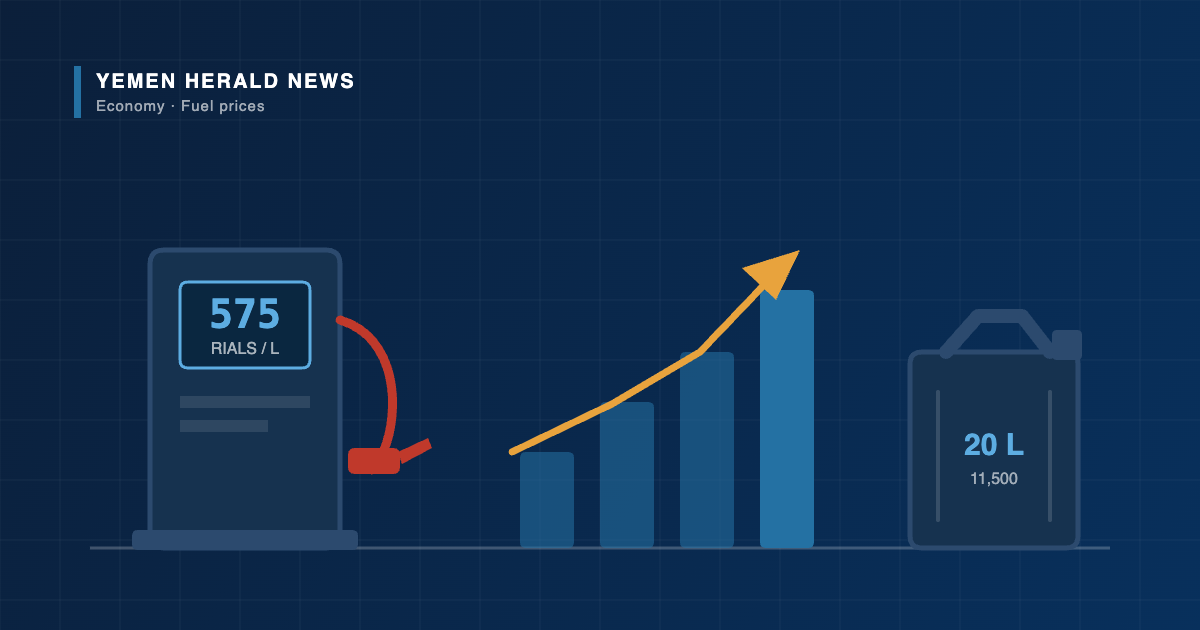
SANAA, Yemen — The Houthi-run Yemen Petroleum Company raised fuel prices across areas under the group’s control this week, lifting diesel by about 21% and petrol by about 10.5%.
The company set petrol at 525 Yemeni rials a litre. A 20-litre canister now sells for 10,500 rials, up from 9,500.
Diesel rose to 575 rials a litre. A 20-litre canister of diesel now costs 11,500 rials, against 10,500 before the change.
The new rates took effect Monday, according to the company’s announcement. They apply at both state-run and private filling stations.
Converted at the exchange rate Houthi authorities enforce on money changers in their territory, about 533 rials to the dollar, the petrol canister works out at roughly $19.70 and the diesel canister at about $21.50.
That rate is set administratively. It differs from the rate quoted in government-held areas, where the rial trades separately.
Houthi officials attributed the increase to global energy costs and to the expense of moving fuel overland, the company said.
The price schedule rests on the Yemen Petroleum Company’s own announcement. Yemen Herald could not independently verify the new rates, and no independent confirmation of the figures has been published.
Diesel carries much of Yemen’s everyday infrastructure. It fuels the generators that run hospitals, water pumps and shops where the public grid does not reach, and the trucks that move imported food across the northern highlands.
Transport costs feed quickly into food prices in Yemen, where most staples are imported.
Fuel pricing in Houthi-held Yemen is bound up with the group’s control of ports and the customs revenue that passes through them.
Al Jazeera reported on Sept. 14 that the Houthis have built a centralised financial system since taking Sanaa in September 2014, collecting taxes, customs duties, zakat and other levies.
The report cited a July 2026 study by the Mokha Center for Strategic Studies, which valued that parallel economy at about $2.5bn a year.
The study placed roughly $800m of that total in taxes and customs, $600m in additional fees and levies, and $300m in cash and in-kind contributions to the war effort.
It attributed about $100m to mobilisation events and a further $700m to indirect costs carried by businesses through higher transport, service and fee charges.
The study said Houthi authorities revoked the licences of 4,225 commercial agencies, the legal local representatives of foreign companies.
Of the nearly 68,000 commercial records it examined, 26% were in general trade and imports and 18% in food commodities.
Al Jazeera reported that the group has pressed importers to route energy shipments to Hodeidah, the Red Sea port it holds, rather than to Aden, moving customs income away from the internationally recognised government.
Hodeidah is also the main entry point for humanitarian and commercial cargo.
Most of Yemen’s population lives in the areas the group administers.
Insurers have raised premiums on vessels entering the Red Sea corridor, which importers say complicates direct fuel deliveries.
The rial has effectively traded as two currencies since January 2020, when the central bank in Sanaa barred circulation of new banknotes issued by its counterpart in Aden. Older notes stayed in use in the north, newer ones in the south and east.
The Aden institution has printed new notes to cover the government’s budget deficit, which has weighed on the rate in the areas it administers.
The increase lands on households with little wage income. A United Nations Panel of Experts report found that 3% of residents in Houthi-controlled areas rely on a monthly salary.
It put the share depending on casual labour at 54% and on food aid at 18%.
Public sector salaries in the north have gone largely unpaid for years. The panel said the group collected more than 270 billion rials during the truce period from oil, taxes and other levies, a sum it calculated would cover public sector pay in those areas for 10 months.
The increase comes during a week of fighting along the Red Sea coast. The Houthis took the port city of Mokha this month and hold ground along the coastline and at the Bab al-Mandab strait.
Government forces withdrew from stretches of the coast, and Houthi fighters reached Mayyun Island and the Greater and Lesser Hanish islands.
Brent crude traded near $108 a barrel this week after Saudi Aramco shut its East-West pipeline following a Houthi attack, and after Reuters reported that loadings had been suspended at the Red Sea port of Yanbu, citing shipping industry sources.
Displacement has risen alongside the fighting. The International Organization for Migration said at least 76,000 people have fled since July, including about 46,000 from the southwest.
The migration agency separately recorded 1,628 Ethiopian migrants returning from Yemen to Djibouti in August.
The humanitarian picture was strained before the current escalation. The UN Office for the Coordination of Humanitarian Affairs said in its March 2026 plan that more than 22 million Yemenis need assistance and 18.3 million are acutely food insecure.
OCHA counted more than 2.2 million children under five as acutely malnourished, 516,157 of them severely. It put the displaced population at 5.2 million.
The agency asked donors for $2.16bn to reach 12 million people this year.
About the Author