Yemeni army reports drone strike in al-Jawf and foiled Houthi infiltration near Taiz
 Yemen Herald News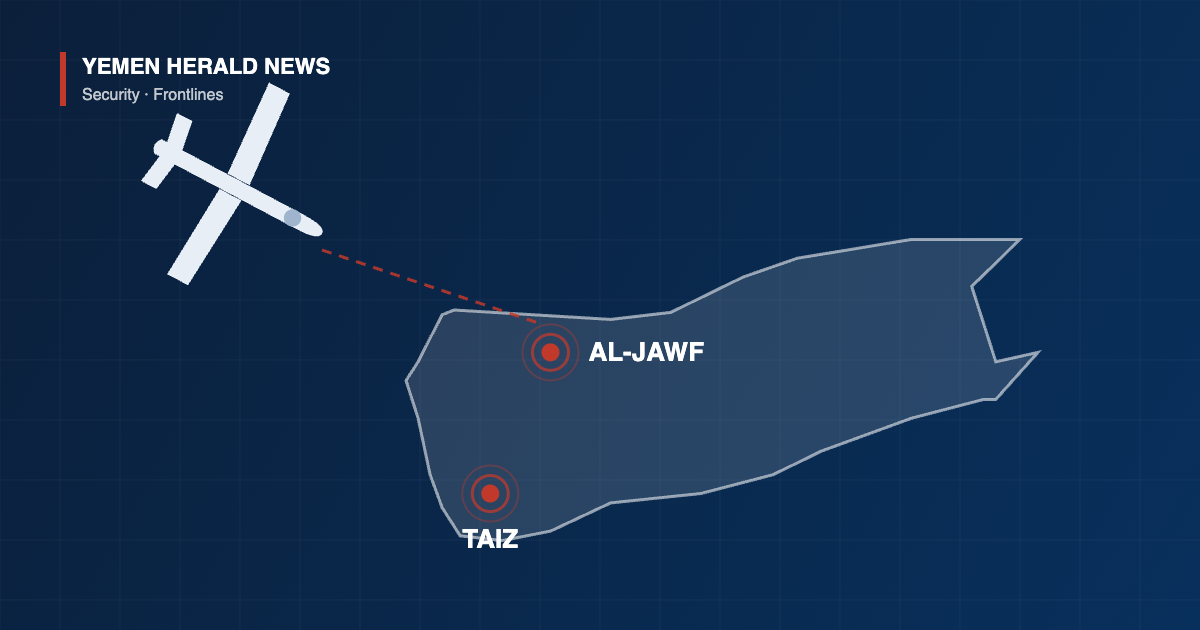
Yemen’s internationally recognised government says its forces struck a Houthi gathering with drones in the al-Aqsha area of al-Jawf province on Monday, and that troops in Taiz separately repelled an attempted infiltration by Houthi fighters at al-Dhabab, west of Taiz city. Both accounts come from the army’s own media units. The Houthi movement, which calls itself Ansar Allah, has not publicly responded to either claim, and neither has been independently confirmed.
According to the army, drone teams tracked fighters massing near the northern line of contact before launching the al-Aqsha strike, and the attack caused casualties and damage to military equipment. Government commanders have described operations of this kind as part of a shift towards persistent aerial surveillance and precision targeting along the northern fronts, in place of the costly ground offensives of earlier years.
Al-Jawf sits in the desert belt running between Marib province and the Saudi border, and it has become one of the more active fronts in the current round of fighting. Government forces say the area has seen repeated Houthi attempts to push through army lines, each of which they say has been pushed back.
Taiz, in the southwest, is a divided province. Government forces hold Taiz city while the Houthis control much of the surrounding countryside to the north, and the two sides trade artillery and machinegun fire across a largely static front line. Al-Dhabab, the area named in Monday’s announcement, sits on high ground west of the city.
The two claims land in the middle of the sharpest escalation Yemen has seen since a United Nations-brokered truce quietened most fronts in 2022. Yemen army spokesperson Colonel Majed al-Nuzaili said on Tuesday that government units had carried out at least 133 operations against Houthi capabilities and personnel in the space of 24 hours, with troops taking part along front-line positions across the country.
The escalation has both local and regional roots. Both sides began mobilising fighters in late June as tensions rose over the confrontation between the United States and Iran. In July, a strike claimed by the Yemeni government on Sanaa airport, intended to stop an aircraft arriving from Iran, prompted the Houthis to declare a naval blockade of Saudi Arabia and order a general mobilisation. Attacks on Red Sea shipping and Saudi oil facilities followed.
On 6 August, government forces launched what they called a preemptive operation against Houthi weapons-smuggling routes. The heaviest Houthi bombardment in years came in response, with missiles and drones striking government military camps at al-Ruwaik and al-Thaniyah in Marib and at al-Abr in Hadramout, killing and wounding dozens. Intermittent attacks on government-held parts of Marib and Hadramout have continued since.
From 9 August the Houthis repeatedly targeted the Red Sea port city of al-Makha, also written Mokha, in Taiz province. At least seven people were killed and 35 injured in the first of those attacks. Houthi military spokesperson Yahya Saree later claimed an attack on what he described as a Saudi-led coalition landing ship and four accompanying warships off the same port.
Drones now feature on both sides of the front. Pro-government forces have announced drone operations against Houthi positions in Marib, al-Jawf, Taiz, Hajjah and al-Dhale in recent days, while the Houthis have used drones alongside missiles against ports, camps and shipping. The result is a war fought increasingly from the air over ground lines that have barely moved.
Military analysts differ on what the pattern means. Ali al-Dhahab, a specialist in military and strategic affairs, has argued that pro-government forces have switched from a defensive posture to simultaneous preemptive strikes, a tactic he says is not new so much as newly visible after years of relative quiet. Brigadier General Abdul Rahman al-Rubaie reads the multi-front fighting as the product of restructuring, with joint operations rooms now pressing the Houthis from several directions at once.
The Houthi administration frames the escalation as self-defence. Hamid Asim, deputy governor of Sanaa under the group’s authority, has said the campaign is meant to break what he called a blockade imposed by Saudi Arabia, and has accused Riyadh of bombing Sanaa airport and massing forces near the capital. Saudi Arabia denies those accusations and says it will continue to support Yemen’s government through the coalition it has led since 2015.
The civilian cost continues to climb. The United Nations Office for the Coordination of Humanitarian Affairs estimates that 22.3 million people in Yemen need humanitarian assistance in 2026, among them 5.2 million internally displaced people. Some 18.3 million face acute food insecurity, more than 2.2 million children under five are acutely malnourished, and close to 40 percent of health facilities are only partly functional.
Marib province alone hosts more than two million displaced people, and Houthi missiles and drones have struck displacement camps there during the current fighting. Aid agencies have appealed for 2.16 billion dollars to fund the 2026 response and warn that renewed fighting will displace more families at a moment when funding is already short.
The United Nations warned in mid-August that Yemen faces its highest risk of a return to full-scale war since the 2022 truce. Analysts remain divided on whether that happens soon: al-Dhahab has suggested regional conditions do not yet favour a decisive battle, while al-Rubaie argues the balance has tilted towards the government. For people living along the al-Jawf and Taiz fronts, the daily exchanges of fire have already answered the narrower question.
About the Author