Who Is Fighting Whom in Myanmar’s Civil War
 Yemen Herald News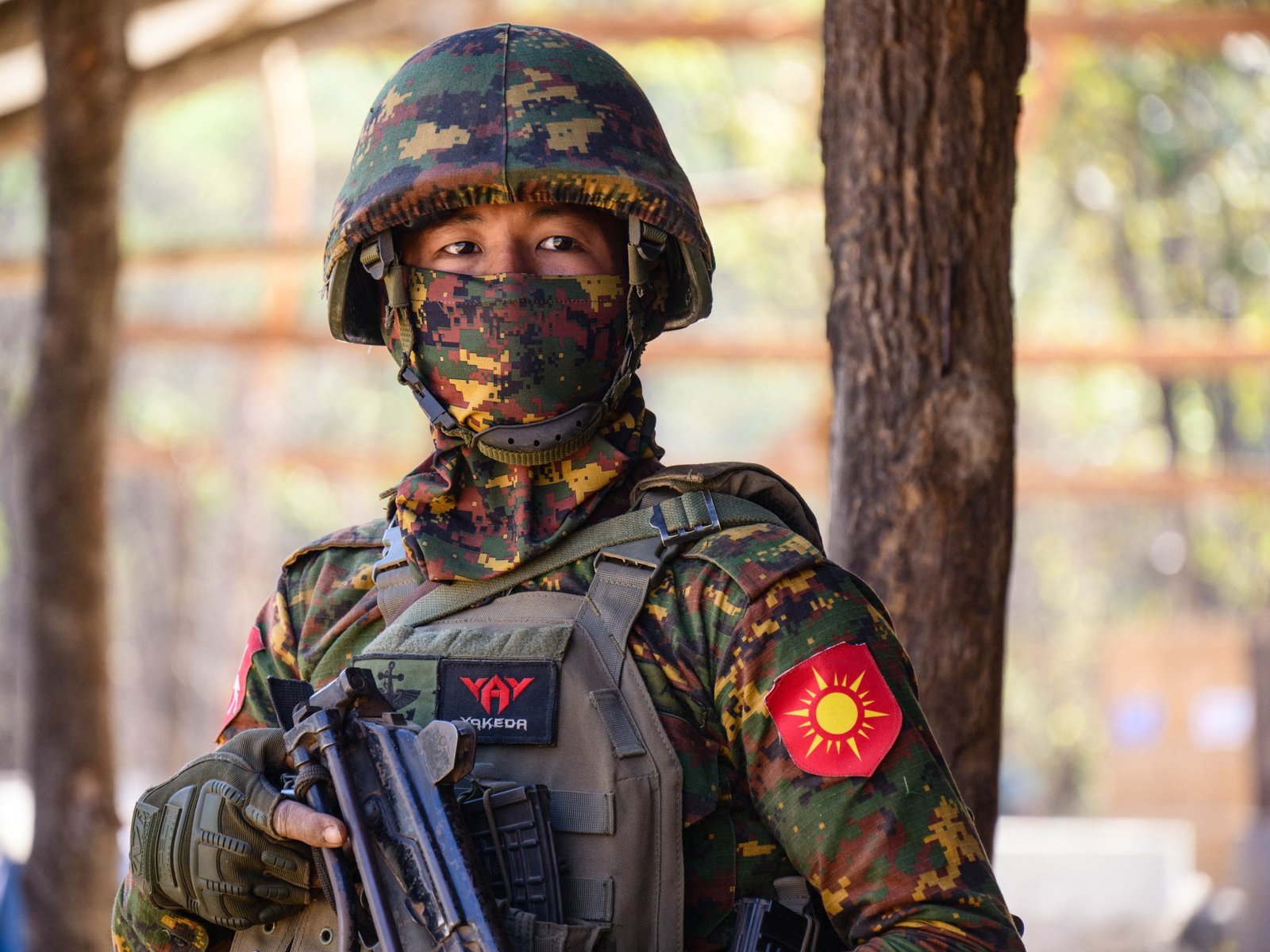
Myanmar’s civil war is among the most fragmented armed conflicts in the world, fought between a military government, a parallel administration formed by ousted lawmakers, dozens of ethnic armed organisations with their own territories and histories, and a sprawling network of locally raised militias. Understanding who is fighting whom, and for what, requires separating several overlapping struggles that are often reported as a single war.
The current phase began on 1 February 2021, when the armed forces seized power in a coup led by Senior General Min Aung Hlaing, annulling an election the National League for Democracy had won by a wide margin. The military detained the country’s civilian leadership, including the Nobel Peace Prize laureate Aung San Suu Kyi, and installed a governing body it called the State Administration Council. What began as street protests hardened within months into armed resistance across much of the country of roughly 55 million people.
The conflict’s roots run far deeper than the coup. Myanmar has experienced near-continuous internal warfare since independence from British colonial rule in 1948, making it the longest-running civil war of the modern era. Ethnic minority communities in the highland borderlands were promised a degree of autonomy at independence that was never delivered, and several of their armed movements have been fighting the central state, on and off, for seven decades.
On one side sits the Tatmadaw, the national armed forces, which has dominated Myanmar’s political life for more than sixty years and controls the state’s conventional military assets: an air force, armour and artillery, much of it acquired from China and Russia. Its structural advantage is firepower. Its structural weakness is manpower, and a requirement to hold territory across a country the size of France with a shrinking pool of recruits. Conscription has been expanded to fill the gap, which has in turn driven many young people to leave the country or join the resistance rather than report for service.
Opposing it are three broad categories of force. The first is the National Unity Government, formed by lawmakers elected in 2020 and denied their seats, which claims to be Myanmar’s legitimate authority and operates largely from exile and from resistance-held areas. The second is the People’s Defence Forces, the armed wing loosely coordinated by the NUG but in practice made up of hundreds of locally recruited units with varying discipline, equipment and command relationships.
The third and militarily most consequential category is the ethnic armed organisations. Some predate the coup by decades and hold long-established territory, tax revenue and administrative structures of their own. The most powerful bloc is the Three Brotherhood Alliance, comprising the Arakan Army, the Myanmar National Democratic Alliance Army and the Ta’ang National Liberation Army, which operate principally in Rakhine State and along the Chinese border in northern Shan State.
The turning point came on 27 October 2023, when the Three Brotherhood Alliance launched a coordinated offensive in close cooperation with People’s Defence Force units. The operation broke the pattern of localised skirmishing that had characterised the previous two years and produced the military’s most serious territorial losses since the coup, in northern Shan State, in Rakhine and in Chin State. It also demonstrated that ethnic armies and post-coup militias could coordinate at scale, which the military had assumed they could not.
Those gains accumulated through 2024. Alliance forces took Lashio, a major city and regional command centre, and Mogok, the town at the centre of Myanmar’s ruby trade and a significant source of revenue. In December 2024 the Arakan Army captured the military’s Western Command headquarters at Ann, a loss that removed the army’s principal operational base in the west of the country.
By the middle of 2025 the map had settled into an uneven pattern. Resistance groups held large stretches of the borderlands, while the military retained the central lowlands and the main population and administrative centres, including Yangon, Nay Pyi Taw, Bago and Magway. Front lines in several places had moved close enough to Mandalay, the second city, to put it within reach of resistance operations.
Losing ground has pushed the military to rely more heavily on air power, which the resistance cannot match. Data compiled by the Armed Conflict Location and Event Data Project recorded 253 air strikes targeting civilians in 2023; that figure rose to 776 in 2024, more than tripling in a single year. Schools, clinics, monasteries and displacement camps have been among the sites struck.
The humanitarian consequences have been severe. Millions have been displaced inside the country, cross-border movement into Thailand, India and Bangladesh has increased, and access for aid organisations is negotiated separately with whichever authority controls a given district. Banking restrictions, telecommunications shutdowns and fuel shortages complicate delivery even where access is granted. Aid agencies have repeatedly warned that funding for Myanmar falls far short of assessed needs, leaving displaced families dependent on local networks and diaspora remittances.
The war’s central difficulty is that the opposition is not a single entity with a single objective. The ethnic armed organisations seek autonomy or federal arrangements for their own regions; the National Unity Government seeks to restore an elected national government; and the two aims are compatible in principle but unresolved in detail. That unresolved question, more than the military balance on any given front, is what shapes what a settlement in Myanmar could eventually look like.
About the Author