Al-Alimi Urges Japan to Move from Humanitarian Aid to Development Projects in Yemen
 Yemen Herald News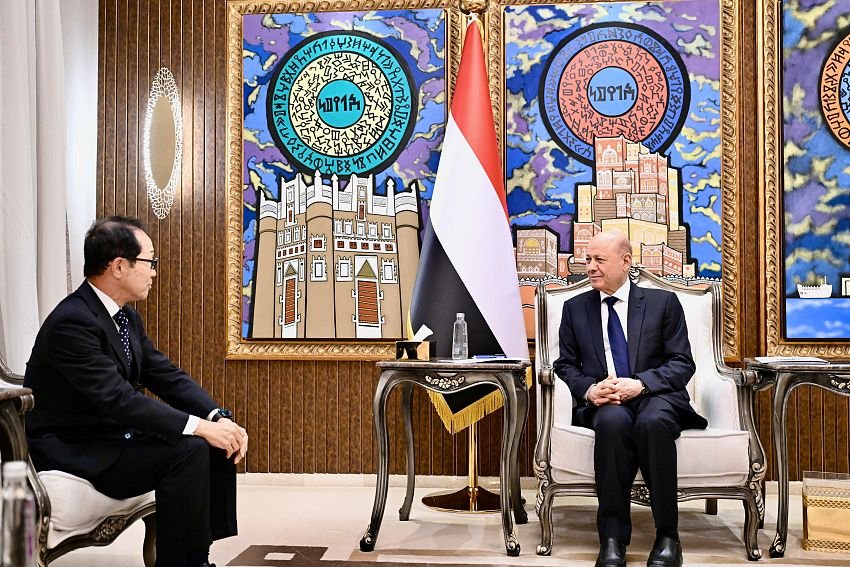
Rashad al-Alimi, chairman of Yemen’s Presidential Leadership Council, met Japan’s ambassador to Yemen, Yoichi Nakashima, in May 2026 for talks on bilateral relations, in which the Yemeni side pressed for Japanese engagement to move beyond humanitarian relief and into longer-term development work.
According to accounts of the meeting published at the time, al-Alimi asked for greater Japanese involvement in infrastructure, energy supply and technical education, and thanked Tokyo for support extended to Yemen over many years. The two also discussed security in the Red Sea and the Bab al-Mandab strait, and the effect of attacks on merchant shipping there.
The request reflects a case Yemeni officials have put to donors repeatedly. Humanitarian assistance keeps people alive but does not rebuild the systems that would make it unnecessary. Emergency funding pays for food parcels, water trucking and mobile clinics; it does not restore a power grid, repair a port, staff a technical college or pay a civil servant. Officials argue that after a decade of relief spending, the absence of investment in those systems has left the country structurally weaker each year, and that the transition to development work has to begin even while the conflict continues.
Japan occupies an unusual position among Yemen’s international partners. It has provided assistance across health, education, food security and water while avoiding any military role in the conflict, and it maintains working relations with Iran as well as with the Gulf states. That combination gives Tokyo a degree of access that most Western capitals lack, and Japanese officials have used it: the ambassador said publicly that Japan had asked Iran to press the Houthis to avoid escalation in the Red Sea.
The relationship al-Alimi was drawing on is a long one. Japan established diplomatic ties with Yemen decades before the current war and financed projects in education, water supply and infrastructure through the Japan International Cooperation Agency, the body that manages most of Tokyo’s grant and technical assistance overseas. JICA cooperation has since become a standing item in Yemeni ministers’ meetings with Japanese officials, raised by the planning ministry in connection with a proposed reconstruction workshop in Aden and by the interior ministry in relation to training and institutional support. That history is part of why Yemeni officials treat Japan as a plausible development partner rather than simply another humanitarian donor.
Most Japanese assistance to Yemen has been delivered through United Nations agencies rather than bilaterally, a consequence of the security conditions that have kept international staff largely out of the country. Moving towards the infrastructure and technical education projects al-Alimi described would require either a different security environment or new delivery arrangements, since projects of that kind need sustained supervision on the ground.
Technical education featured in the discussion for reasons that go beyond schooling. Yemen’s universities and vocational institutes have been disrupted for years, and a generation has passed through them with limited practical training. Any reconstruction programme will need engineers, electricians, technicians and project managers, and the shortage of such skills is one of the practical constraints on absorbing large-scale investment, alongside the more familiar problems of security and financing.
The maritime dimension gives Japan a direct commercial interest in Yemeni stability. Attacks on merchant vessels have pushed a substantial share of Asia–Europe container traffic away from the Red Sea and the Suez Canal and around the Cape of Good Hope, lengthening voyages by roughly ten days and raising freight and insurance costs. For a trading economy dependent on long sea routes, that is a measurable cost rather than an abstract security concern, and Yemeni officials have made a point of framing their appeals to Tokyo in those terms.
The government’s position is that naval escort operations treat the symptom. Warships can protect individual convoys, but the capability to launch attacks sits ashore in Yemen, and the government argues that restoring state authority over the coastline is the only durable answer. That argument is also a request: it implies external support for the Yemeni state, which is what al-Alimi was seeking.
Whether the appeal could be acted on quickly was doubtful even as it was made. Development projects require conditions that much of Yemen could not offer in 2026 — security sufficient for staff to work, functioning institutions to receive and manage funds, and enough political stability for a multi-year commitment to be credible. Donors have generally responded to such requests with pilot projects in the calmer governorates rather than with programmes at national scale.
The economic backdrop compounded the difficulty. The riyal had lost much of its value in government-held areas, foreign-currency shortages constrained imports of food and fuel, and public sector salaries were being paid irregularly or not at all across large parts of the country. Deposits and budget support from Gulf partners had periodically stabilised the exchange rate without addressing the underlying fiscal position.
No comprehensive ceasefire had been in force since the United Nations-brokered truce of 2022 lapsed, and successive rounds of mediation had not produced an agreed political framework. In that context, meetings such as this one served principally to keep relationships and planning alive rather than to launch programmes. Reconstruction planning conducted during conflict is not wasted work, but it is contingent work, and whether Japan’s engagement in Yemen ultimately shifted towards the development footing al-Alimi asked for would depend on conditions neither government controlled.
About the Author