Migrant Arrivals to Yemen Dipped in March, but Early-2026 Totals Hit a Record High
 Yemen Herald News
Yemen recorded a notable slowdown in the arrival of migrants from the Horn of Africa in March, even as the broader picture pointed to historically high levels of movement. According to the International Organization for Migration, 17,027 migrants entered the country during the month, the lowest monthly total recorded since the start of 2026. The figure marked a decline of about 12 percent from February, when 19,337 people made the crossing, suggesting a modest pause in a migration pattern that has otherwise trended sharply upward.
That monthly dip, however, masked a longer-term surge. Between January and March, a total of 57,414 migrants entered Yemen, a first-quarter figure that surpassed all comparable quarterly records since 2019. In other words, while March stood out as the quietest month of the year so far, the opening months of 2026 collectively marked one of the busiest periods on record for arrivals along this route. The contrast underscores how a single month’s decrease can obscure the scale of a phenomenon that continues to intensify over time.
The journey to Yemen remains perilous, yet large numbers of people keep undertaking it in search of better prospects despite the country’s conflict and humanitarian strains. The IOM’s monitoring identified Djibouti as the primary departure point, accounting for roughly 74 percent of arrivals, followed by Somalia at about 22 percent and Oman at around 4 percent. Most migrants travel the Eastern Route across the Gulf of Aden and the Red Sea, a corridor the agency describes as the world’s busiest maritime migration route and one of the most dangerous anywhere.
The demographic profile of those arriving followed familiar patterns. Ethiopians made up the overwhelming majority of new migrants, at 86 percent, or 16,370 individuals, while Somalis accounted for 584 people and a small number of others held various nationalities. The gender breakdown revealed a pronounced imbalance, with men comprising 68 percent of arrivals, women 16 percent and children 16 percent, the last group often exposed to heightened risks during the journey.
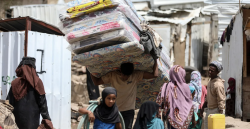
Entry points within Yemen were similarly concentrated. Migrants departing from Djibouti mainly arrived through Abyan governorate, which received around 72 percent of those crossings, with Taiz accounting for the remaining 28 percent. These coastal areas have become well-worn gateways for new arrivals, and the conditions awaiting migrants there are frequently dire. Many disembark with few resources in regions already stretched by displacement and scarcity, leaving them exposed to exploitation almost from the moment they reach Yemeni soil.
The flow has not been entirely one-directional. The IOM’s Displacement Tracking Matrix reported the departure of 1,407 Ethiopian migrants from Yemen to Djibouti during March, the bulk of those returns originating from the coastal area of Hajjah and only a small number from Abyan. That return movement reflects the difficult realities many migrants encounter once inside Yemen, where the search for onward passage to the Gulf can collapse into detention, destitution or forced return.
Protection concerns remain acute, with many vulnerable people falling prey to human trafficking or enduring severe exploitation as they look for safety or onward passage. Aid organisations have repeatedly warned that the combination of rising arrivals and limited capacity at the coastline leaves significant gaps in protection for those who survive the sea journey. The dangers begin long before landfall: in the first recorded shipwreck of 2026 off Djibouti, the IOM reported nine people dead and 45 missing, a stark illustration of how routinely the crossing turns deadly.
The region’s geopolitical realities compound these challenges. Yemen’s position at the southern entrance to the Red Sea and the Bab al-Mandab Strait makes it a crucial nexus for both migration and global trade. The ongoing hostilities between the Houthi movement and the internationally recognised government, which is backed by a Saudi-led coalition, together with the influence of Iran-aligned forces, create an environment of persistent instability. These dynamics affect not only local populations but also the patterns of migration, as people move in search of refuge from conflict and economic hardship.
The persistence of these flows reflects powerful drivers in the countries of origin. Many travellers are Ethiopians fleeing economic hardship, unemployment and the effects of drought and localised conflict, most intending to transit through Yemen toward Saudi Arabia and other Gulf states in search of work. For them, war-torn Yemen is a dangerous waypoint rather than a destination, which helps explain why arrivals keep climbing even as conditions deteriorate.
The human cost of the route is well documented. Overcrowded and unseaworthy boats operated by smugglers regularly put migrants at risk, and incidents at sea have claimed numerous lives along the corridor between the Horn of Africa and Yemen. Those who survive the crossing often face detention, abuse or extortion on arrival, and limited first-response capacity along the coast means many receive little immediate help.
Looking ahead, the IOM and other agencies have called for stronger protection measures, expanded reception capacity and sustained support to address a migration crisis that shows few signs of abating along one of the world’s deadliest routes. As long as the economic and security pressures driving people from the Horn of Africa persist, humanitarian workers say, the numbers reaching Yemen’s shores are likely to remain high, regardless of the modest fluctuations recorded from one month to the next.
About the Author