Al-Alimi Honors Departing U.S. Ambassador Steven Fagin With Yemen’s Second-Class Unity Medal
 Yemen Herald News
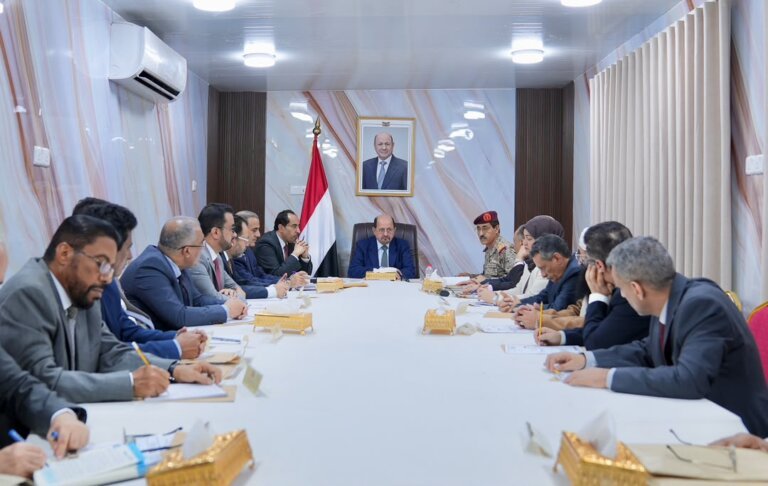
President Dr. Rashad al-Alimi, chairman of Yemen’s Presidential Leadership Council, has honoured the departing United States ambassador, Steven Fagin, with the Second-Class Unity Medal in recognition of his contributions during his tenure in the country. Al-Alimi presented the award at a reception marking the conclusion of Fagin’s diplomatic mission to Yemen, an occasion that formally acknowledged the ambassador’s role in cultivating international backing for the internationally recognised government through a difficult period.
In his remarks, the council chairman reflected on Fagin’s dedication to deepening the partnership between Yemen and the United States. Al-Alimi praised the ambassador’s work in advancing bilateral relations across a range of sectors, highlighting his involvement in mobilising support for both the government and the broader population. He framed Fagin’s service as having strengthened ties between the two countries at a moment when sustained external engagement has been vital to keeping the Yemeni state functioning.
Fagin is concluding a posting he took up in 2022, having presented his credentials in Aden that year after a long career in the U.S. Foreign Service. Over that period he became a familiar figure in Yemeni diplomatic circles, holding regular meetings with the country’s leadership on security, economic and humanitarian matters. His farewell was marked in a series of engagements with senior officials, including separate meetings in Riyadh with Presidential Leadership Council member Dr. Abdullah al-Alimi and the Speaker of Parliament, Sultan al-Barakani, during which he received repeated commendations for his efforts to advance cooperation between Washington and the Yemeni government.
Al-Alimi also drew attention to the United States’ role in bolstering regional and international security. He pointed to American involvement in safeguarding maritime routes near Yemen, an issue of particular weight given the country’s location alongside some of the world’s most important shipping lanes. The protection of those waterways has become a pressing concern as threats to commercial vessels have disrupted global trade and lent fresh urgency to security cooperation between Sanaa’s recognised government and its foreign partners.
He singled out the challenge posed by the Houthi movement, which he said continues to threaten Yemen and its neighbours. In al-Alimi’s account, the alignment between Yemeni and American objectives on counterterrorism has been an important dimension of the relationship, reinforcing efforts to contain forces the government views as a persistent danger to stability across the region.
Beyond security, the occasion provided an opportunity to review the situation inside Yemen, with particular focus on the government’s financial and administrative reforms. Al-Alimi underscored that such reforms are essential to improving public services and restoring the trust of citizens who have endured years of hardship. He reiterated the importance of continued collaboration with international partners, presenting reform and good governance as central to any durable recovery and as necessary complements to the security and humanitarian support provided from abroad.
The chairman’s comments reflected a broader hope among Yemeni officials that a fragile lull in fighting might open space for progress in the long and frustrating search for a lasting settlement. A United Nations-brokered truce first agreed in 2022 has largely reduced front-line violence in many areas, though a comprehensive political agreement has remained out of reach amid deep divisions between the warring parties and their external backers.
The geopolitical landscape surrounding Yemen remains intricate, with the Bab al-Mandab Strait standing as a focal point for competing regional and international interests. Security along that narrow waterway is critical for global shipping and trade, which makes the stability of Yemen a matter of concern well beyond its borders. The ongoing conflict, shaped in part by external influences, complicates these dynamics and has reinforced calls for comprehensive strategies that bring regional actors into a credible peace process.
Those commercial stakes are not abstract. Attacks on shipping in the Red Sea and the Gulf of Aden since late 2023 have forced some firms to reroute traffic around the southern tip of Africa, raising costs and lengthening voyages, and underscoring how instability off Yemen’s coast can ripple across the global economy. For Yemeni officials and their international partners alike, restoring confidence in the safety of these routes has become a shared priority that intertwines the country’s internal conflict with far broader strategic and commercial interests.
Fagin’s departure also reflects shifting American priorities in the wider region. In late 2025 the State Department named him civilian lead of a new coordination centre established to help implement a Gaza ceasefire and channel humanitarian aid into the territory, a senior assignment that drew him away from Yemen toward one of Washington’s most pressing diplomatic files. His move illustrates how experienced envoys are increasingly rotated between the Middle East’s overlapping crises.
The relationship between Yemen and the United States has long extended across security, diplomatic and humanitarian lines, and the medal ceremony offered a moment to take stock of that cooperation. Washington has been among the more prominent backers of the internationally recognised government, providing assistance and advocacy at key junctures. With the change of ambassador, the Yemeni leadership signalled its hope that the continuity of engagement would endure beyond any individual envoy, and that the partnership built over recent years would carry into a new and uncertain chapter.
About the Author