Yemen’s coast guard says it stopped tanker Nereida after Ras Isa delivery
 Yemen Herald News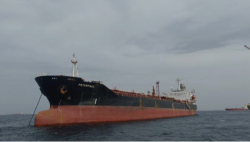
ADEN, Yemen — Yemen’s coast guard said it stopped an oil tanker in the Gulf of Aden after the vessel delivered cargo at the Houthi-controlled port of Ras Isa.
The force, which answers to Yemen’s internationally recognised government, identified the ship as the Nereida, a product tanker of 35,994 deadweight tonnes.
It said the vessel entered Ras Isa, on the Red Sea coast of Hodeidah province, without the permits the government requires and without submitting to inspection.
Cargo bound for Houthi-held ports is meant to clear the United Nations Verification and Inspection Mechanism. That body has operated from Djibouti for more than a decade, screening commercial shipments to keep weapons and other banned goods out of Houthi hands.
The coast guard said the tanker was sailing without transmitting on the Automatic Identification System, the transponder network that allows vessels to be tracked at sea.
The ship briefly switched the transponder on after leaving Ras Isa as it headed toward the Bab al-Mandab Strait, according to the same account.
Patrol boats confronted it after it entered the Gulf of Aden.
The coast guard said the tanker did not stop when ordered, and that guards aboard opened fire on the patrol vessels.
The ship then complied and was escorted to the anchorage off Aden, the force said. It reported no casualties.
The account of the boarding rests on the Yemen Coast Guard. No independent account of what happened at sea has been published, and Yemen Herald could not verify it. The Houthis have not commented on the seizure.
Parts of the vessel’s record are documented elsewhere. The tanker has been under United States Treasury sanctions since February 2025, when it sailed as the Peterpaul under International Maritime Organization number 9163269, according to maritime trade reporting.
The ship was reported sold in 2025 to buyers who were not identified.
Its flag, previously recorded as unknown, was changed to Comoros. The shipping database Equasis lists that registration as false.
The coast guard said the vessel had been linked to Iran in the past. Iran denies supplying the Houthis with weapons.
The seizure comes during an escalation on Yemen’s west coast.
Houthi forces began an assault on Thursday, Sept. 3, aimed at cutting off the government-held port of Mokha and pushing toward the Bab al-Mandab chokepoint at the southern entrance to the Red Sea, Agence France-Presse reported.
More than 300 combatants and some civilians have been killed since the offensive began, the agency said, citing military sources on both sides of the front.
Houthi forces cut the road linking Taiz to Mokha on Saturday evening, a military official told the agency.
The UN Office for the Coordination of Humanitarian Affairs said about 1,790 families fled the districts of Maqbanah and Jabal Habashi over two days as the fighting spread.
A Yemeni government body that manages displacement camps put the figure higher, saying 2,183 families had been displaced in Taiz and Hodeidah by Sept. 5, among them 1,643 families in Taiz alone.
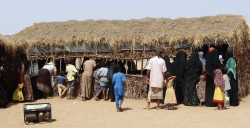
Families reaching the al-Bareen camp and makeshift sites nearby have been left without enough food, water or medical supplies, Agence France-Presse reported.
A spokesman for UN Secretary-General Antonio Guterres said he was “deeply concerned by the ongoing military clashes” and warned of “devastating political economic and security ramifications”.
Houthi strikes closed the port of Mokha earlier this month, and about 1,500 workers there lost their jobs.
The Houthis declared a blockade of Saudi shipping interests in the Bab al-Mandab and the Red Sea in July.
They have also stepped up attacks on Saudi positions on both sides of the border, and on convoys carrying supplies into Yemen, according to maritime trade reporting.
Ras Isa lies north of the port of Hodeidah and handles oil cargo for the territory the Houthis administer.
The government in Aden and the Houthi authorities in Sanaa have run parallel administrations since 2015, when the movement seized the capital and the government moved south. The Houthis hold much of the north and west, including the Red Sea coast and its ports.
Control of those ports and the revenue they generate has been among the disputes between the two sides.
Bab al-Mandab is about 30 kilometres across at its narrowest point. Traffic through it feeds the Red Sea route to the Suez Canal and on to Europe.
Shipping through the strait fell after Houthi attacks on merchant vessels began in late 2023, and volumes have not returned to their earlier levels.
The United Nations humanitarian plan for Yemen published in March put more than 22 million people in need of assistance, with 18.3 million acutely food insecure and 5.2 million displaced inside the country. It sought 2.16 billion dollars to reach 12 million of them.
More than 2.2 million children under five are acutely malnourished, 516,157 of them severely, according to the same plan.
The inspection mechanism was created to let commercial trade continue while the arms embargo on the Houthis stayed in force.
Aden is the seat of Yemen’s internationally recognised government.
The Gulf of Aden lies east of the strait and links it to the Arabian Sea.
The mechanism works with shipping companies before their vessels sail, and reports to the United Nations.
The coast guard did not say what the Nereida was carrying, how much of it was discharged at Ras Isa, or what would happen to the ship and its crew at Aden.
About the Author