Planning Minister Mohammed al-Faqmi and Germany’s ambassador discuss aid for water, health and education
 Yemen Herald News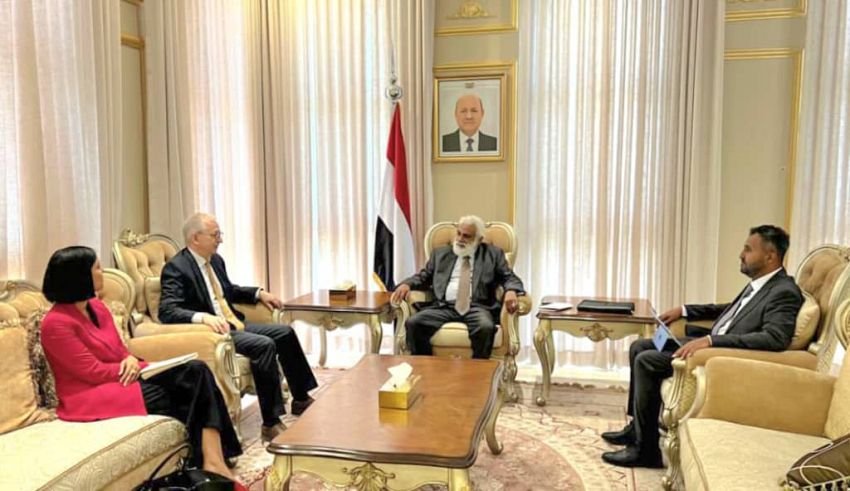
RIYADH, Saudi Arabia — Yemen’s newly appointed planning minister met Germany’s ambassador on Tuesday for talks on German-funded work in water, health, education and food security.
Mohammed al-Faqmi, minister of planning and international cooperation, held the meeting with Ambassador Thomas Friedrich Schneider, the Yemeni state news agency Saba reported.
The two discussed bilateral cooperation and German assistance aimed at improving basic services, including capacity building in Yemeni institutions, according to Saba.
Al-Faqmi thanked the German government for its contribution to development work in Yemen.
Schneider said Berlin would continue to support Yemen and the government’s efforts to address its most pressing needs, Saba reported. The two agreed to keep up regular coordination on development programmes.
Yemen Herald could not independently confirm the account. It rests on the Saba report alone, and the German embassy published no separate readout.
Saba named the ambassador as Thomas Friedrich, without his surname. The German Federal Foreign Office lists the head of its mission to Yemen as Thomas Friedrich Schneider.
The meeting was held in the Saudi capital because the German embassy accredited to Sanaa has operated from Riyadh since its service in Yemen was suspended. The Riyadh mission handles passport and visa work for the Sanaa district.
Germany was one of Yemen’s largest bilateral donors last year, according to the Federal Foreign Office. It provided 50 million euros in development cooperation and more than 25 million euros in humanitarian assistance in 2025.
The ministry says only a very limited number of German humanitarian projects run in areas controlled by the Houthis, both to protect staff and to avoid strengthening the movement.
Berlin supports the United Nations-led effort and the Office of the Special Envoy for Yemen to settle the conflict between the internationally recognised government and the Houthis, the ministry says.
Al-Faqmi took the planning portfolio after Afrah al-Zouba, who had held it since February, was appointed foreign minister on July 23. She is the first woman to hold either post.
The planning ministry coordinates Yemen’s dealings with donors and international financial institutions, and manages the government’s recovery and reconstruction programmes.
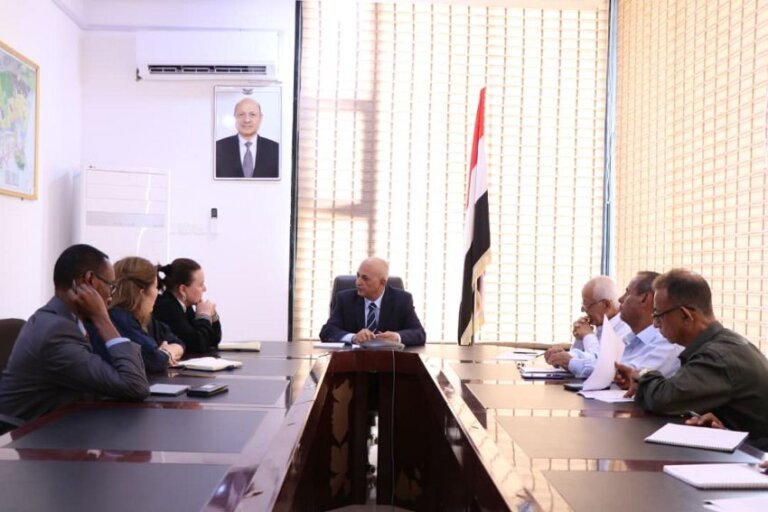
Al-Faqmi met the United Kingdom’s ambassador to Yemen, Abda Sharif, on the same day for talks on a recovery plan, Saba reported.
Saba also reported last week that Yemen’s water minister and the German ambassador were preparing a conference on Socotra to be held this month.
Water is among the most strained sectors in the country. Yemen is one of the most water-scarce states in the world, and the conflict has damaged pumping, treatment and distribution networks.
Yemen’s humanitarian position remains among the worst tracked by the United Nations.
The UN Office for the Coordination of Humanitarian Affairs said in its March 2026 response plan that more than 22 million people need assistance and that 18.3 million are acutely food insecure.
More than 2.2 million children under five are acutely malnourished, 516,157 of them severely, the plan said.
It recorded 5.2 million internally displaced people and sought USD 2.16 billion to reach 12 million people this year.
Yemen’s government moved its seat to Aden after the Houthis seized Sanaa in September 2014. Several ministries and the central bank operate from the southern port city, while others work from Riyadh.
The cabinet is led by Prime Minister Shaya Zindani, who took office in February after Salem Saleh bin Braik resigned. Zindani had previously served as foreign minister.
The Presidential Leadership Council, chaired by Rashad al-Alimi, has governed the internationally recognised side of the conflict since April 2022.
Saba said the council held a joint session with the government on Wednesday to review what the agency called comprehensive deterrent measures. It gave no detail.
Donor funding for Yemen has tightened as attention and budgets shift to other emergencies, and successive UN appeals have closed short of their targets.
Saba did not say whether the two men discussed specific German projects, budgets or timelines, and named no implementing agency.
Neither did the agency indicate whether the meeting touched on the Red Sea shipping corridor, where Houthi attacks since late 2023 have pushed many operators onto the longer route around southern Africa.
Relations between the two countries have traditionally been friendly, the Federal Foreign Office says, and Germany is well regarded in Yemen because of that record.
The ministry lists cultural cooperation in archaeology alongside development and humanitarian work as a pillar of the relationship.
Germany has reopened no mission inside Yemen, and its consular service for the country remains suspended.
Al-Zouba trained as a pharmacist at Sanaa University and spent more than 25 years in development and peacebuilding work before entering government.
She was in Kuwait on Monday, where she met her Kuwaiti counterpart, Sheikh Jarrah Jaber al-Ahmad al-Sabah, Saba reported.
Yemen’s foreign ministry condemned Iranian missile and drone attacks on Kuwait, Bahrain, Jordan and Iraq on Wednesday, describing them as a violation of those countries’ sovereignty.
The World Food Programme’s acting executive director, Carl Skau, visited Aden this week and met Zindani, Saba reported.
The UN-brokered truce that took effect in April 2022 lapsed that October, and formal negotiations have not resumed.
Saba published no photograph of the two men signing any document, and reported no new German pledge.
About the Author