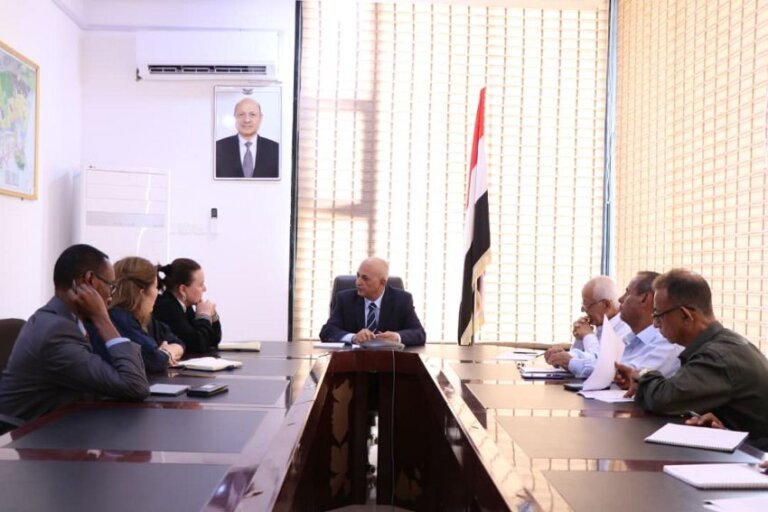
Othman Mujalli discusses Red Sea security with US chargé d’affaires Neil Hopp in Riyadh
 Yemen Herald News
RIYADH, Saudi Arabia — A member of Yemen’s Presidential Leadership Council met the acting head of the United States mission to Yemen on Tuesday to discuss Red Sea shipping security.
Sheikh Othman Mujalli held talks with Neil Hopp, chargé d’affaires of the US Embassy in Yemen, the Yemeni state news agency Saba reported.
The two reviewed bilateral relations, the protection of shipping lanes in the Red Sea and the Bab al-Mandab Strait, and efforts to interdict what the council calls Iranian arms, money and narcotics supply routes to the Houthis, according to Saba.
Mujalli said Iran had spent years building what he described as terrorist bases in the region and in Yemen.
He accused the Iranian government of financing and equipping the Houthis, sectarian armed groups, al-Qaeda and the Islamic State group.
Iran rejects allegations that it arms the Houthis. The Houthis deny acting on Tehran’s behalf.
Hopp said Washington supported Yemen’s security, stability and territorial integrity, and backed efforts to reduce Iranian influence in the country, Saba reported.
Yemen Herald could not independently confirm the account of the meeting. It rests on the Saba report alone. Neither the US Embassy in Yemen nor the Presidential Leadership Council published a separate readout.
Saba gave no figure for the volume of weapons or narcotics the two men discussed, and named no specific interdiction operation.
The talks were held in the Saudi capital. The Yemeni government and most foreign missions accredited to Yemen have operated from Riyadh for much of the war.
Mujalli is one of eight members of the Presidential Leadership Council, the executive body that has governed the internationally recognised side of the conflict since April 2022. It is chaired by Rashad al-Alimi.
The council was formed that month, when Abd Rabbu Mansour Hadi transferred his powers to it under arrangements brokered in Riyadh. Aidarous al-Zubaidi, who leads the Southern Transitional Council, also sits on it.
Saba said the council met the government in a joint session on Wednesday, chaired by al-Alimi and attended by Prime Minister Shaya Zindani, to review what the agency described as comprehensive deterrent measures. The agency gave no detail of what those measures involve.
Hopp took up the post in Riyadh this year. He met Yemen’s interior minister on Aug. 27 for talks on security cooperation, Saba reported at the time.
The meeting came a day after the US House of Representatives held a hearing titled “Countering Houthi Terrorism: Protecting American Interests and Red Sea Security.”
The hearing examined what lawmakers described as the threat posed by the Iran-backed Houthi militia to international shipping, regional stability and US interests, Saba reported.
It also came during a sharp escalation between Iran and the United States across the wider Gulf.
Iran fired ballistic missiles and drones at US bases in Kuwait, Bahrain, Jordan and Erbil in northern Iraq, Gulf News and Asharq Al-Awsat reported. Jordan said it intercepted 10 ballistic missiles and that three others fell in remote areas without casualties. Kuwait’s military said its air defences intercepted drones launched from Iran.
Iran’s Revolutionary Guards said the strike on Erbil destroyed a maintenance centre, warehouses and the guidance system of a US surveillance aerostat, Asharq Al-Awsat reported. Most of the drones fired at Bahrain were intercepted.
Yemen’s foreign ministry condemned those attacks on Wednesday, calling them a violation of the sovereignty of the four countries.
Saudi Arabia’s foreign ministry separately condemned Iran’s targeting of the Saudi tanker Sidr as it transited the Strait of Hormuz, saying crew members were killed. Yemen Herald has not independently verified that toll.
The Houthis have attacked commercial shipping in the Red Sea and the Gulf of Aden since late 2023, forcing many operators onto the longer route around southern Africa and raising insurance costs on the corridor.
Bab al-Mandab, the 18-mile strait between Yemen and Djibouti, is the southern gate to the Suez Canal route.
The Houthis control Sanaa and much of Yemen’s densely populated north-west, including the Red Sea port of Hodeidah. Yemen’s government moved its seat to Aden after the group seized the capital in September 2014.
The United States has not restored a resident diplomatic presence in Sanaa, which it evacuated in 2015. It redesignated the Houthi movement a foreign terrorist organisation in 2025.
Yemen’s humanitarian position remains among the worst tracked by the United Nations. The UN Office for the Coordination of Humanitarian Affairs said in its March 2026 response plan that more than 22 million people need assistance and 18.3 million are acutely food insecure.
More than 2.2 million children under five are acutely malnourished, 516,157 of them severely, the plan said. It recorded 5.2 million internally displaced people.
The plan seeks USD 2.16 billion to reach 12 million people this year.
Mujalli, a tribal figure from Taiz governorate, was appointed to the council when it was formed.
A UN-brokered truce took effect in April 2022 and lapsed that October. Formal negotiations have not resumed since.
Saba’s report did not indicate whether the two discussed the UN-led peace track.
Masam, the Saudi-funded mine clearance project, said it removed 819 mines and explosive devices across Yemen in the fourth week of August, bringing its running total to 588,325.
Neither Tehran nor the Houthi authorities in Sanaa responded publicly to Mujalli’s remarks.
About the Author