Three Saudi citizens including a Saudia pilot killed in attacks on Riyadh’s King Khalid airport
 Yemen Herald News
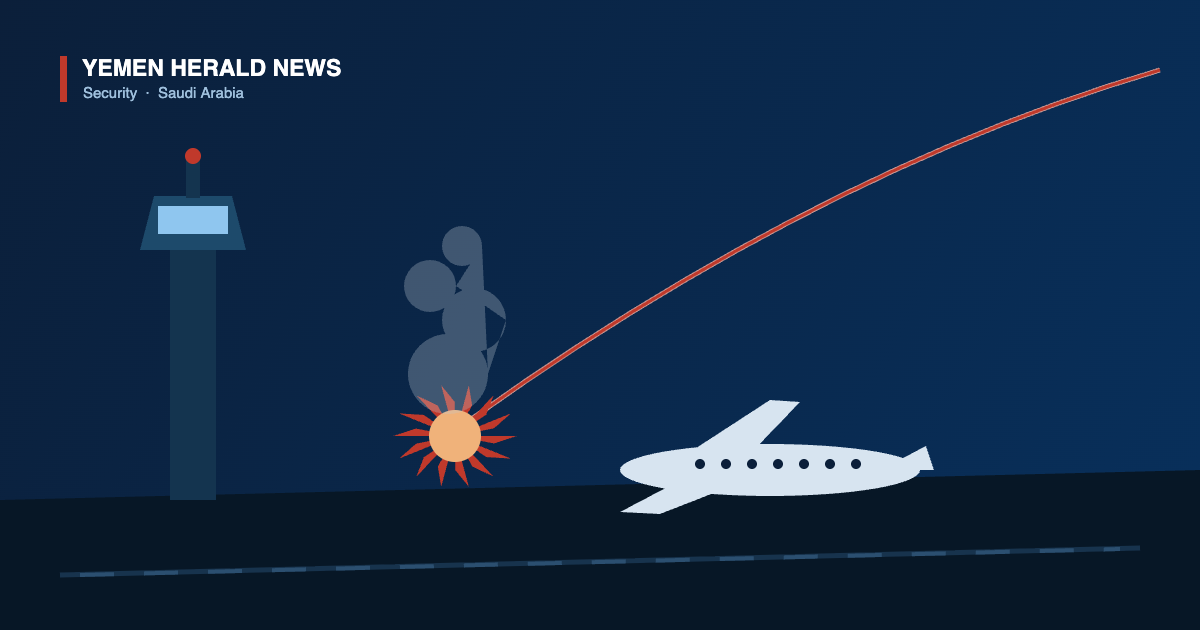
RIYADH, Saudi Arabia — Three Saudi citizens, including an airline pilot, were killed when two attacks struck King Khalid International Airport on Thursday, the civil aviation authority said.
The General Authority of Civil Aviation announced the toll on Friday in a statement posted on social media.
The first attack targeted airport facilities, the authority said. The second struck an aircraft belonging to Saudia, the national carrier.
Several people of different nationalities were wounded. Injuries ranged from minor to severe, according to the statement.
Emergency teams responded at once, the authority said. Those hurt were taken to hospital for treatment.
The attacks also caused material damage, according to the same statement.
Saudia said separately that one of its aircraft was damaged while parked at the airport. No passengers were on board.
The airline identified the dead pilot as Captain Hamoud Ali al-Kalthami. It offered condolences to his family.
Airport operations resumed the same day and air traffic returned to normal, the authority said. Saudi state broadcaster Al Ekhbariya reported that flights restarted at 6 p.m. local time, 1500 GMT, on Thursday.
A Houthi military spokesman said on Thursday that the group had fired a ballistic missile at the airport, and that the missile hit its target.
The spokesman also warned airlines to stay out of Saudi airspace.
Saudi authorities did not name a perpetrator in the statement announcing the toll.
The Houthi spokesman described the attack as retaliation for Saudi strikes on Sanaa International Airport and the airport at Hodeidah. Yemen Herald could not independently establish the sequence of those strikes.
Thursday’s attack followed a run of attacks on Saudi airports since the start of October.
Attacks on Oct. 5 targeted King Abdullah bin Abdulaziz International Airport in Jazan and Najran International Airport. Three people were wounded and both airports were damaged, Saudi authorities said the following day.
Strikes on Oct. 6 and Oct. 7 hit King Khalid International Airport and Abha International Airport.
Saudi civil aviation authorities said one person was killed in Riyadh and two in Abha. They put the number wounded in those two attacks at 36.
The three killed were a Sudanese national in Riyadh and two women, one Moroccan and one Algerian, in Abha.
Among the wounded at Riyadh were five Saudi citizens, two Egyptian residents and one Pakistani resident, the authorities said. The wounded at Abha included Saudi citizens, a Bangladeshi resident and a Filipino resident.
The Emirati foreign ministry condemned those earlier attacks and called them a violation of Saudi sovereignty.
The Saudi-led coalition said on Oct. 6 that it had intercepted Houthi ballistic missiles aimed at Khamis Mushait and at an area north of Riyadh. It said on Oct. 8 that it had intercepted three more missiles fired from Yemen.
Missile and drone strikes targeted Aden International Airport in southern Yemen on Oct. 7, in the same week as the attacks on Saudi airports.
Hans Grundberg, the United Nations special envoy for Yemen, condemned attacks on Saudi civilian and energy infrastructure in a briefing to the Security Council on Friday.
He named Abha International Airport and King Khalid International Airport among the targets.
“In the past few weeks, Yemen has slid back into full-scale war, with hostilities spreading across multiple front lines,” Grundberg told the council.
He said threats against Saudi-linked commercial vessels in the Red Sea could unsettle shipping and energy markets, and that they were becoming bound up with a wider contest over maritime trade routes.
Grundberg urged the parties to negotiate. “Unless war is to become Yemen’s permanent reality, the time to consider political strategies is now,” he said.
The council met on Friday morning and then moved into closed consultations.
The war in Yemen has run for more than a decade, according to the United Nations.
The Houthis began an offensive in September to widen their control across south-west Yemen and along the Red Sea, the organisation said.
Grundberg said Houthi forces had advanced toward Mocha and the coast along the Bab al-Mandab Strait.
Yemen’s internationally recognised government said on Oct. 5 that it had retaken the port of Mocha and positions near the strait with coalition air support. Yemen Herald could not independently confirm that account.
Fighting has intensified in Taiz governorate, which contains Yemen’s third-largest city. Grundberg said the fighting there carried “grave risks to the civilian population.”
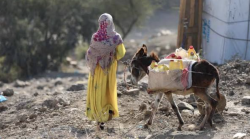
The International Organization for Migration says more than 200,000 people have been displaced since the escalation began. It put Taiz governorate’s share of that total at 57 percent.
That is the highest level of new displacement recorded since a truce took effect in 2022, the United Nations said.
UNICEF has reported an estimated 71,000 children displaced and hundreds of schools closed since Sept. 3.
The World Health Organization says cholera cases have tripled in recent weeks.
Nearly 4,000 people have crossed the Bab al-Mandab Strait to Djibouti and Somalia, according to figures given to the Security Council.
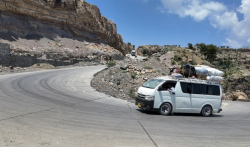
Roads linking Taiz with Mocha, Hodeidah, Sanaa and Aden are blocked, the United Nations said.
Saudi Arabia, Pakistan and Türkiye held an emergency meeting of what they call the Mecca Defense Alliance in Riyadh on Oct. 5. The three agreed to move toward carrying out collective defence commitments.
About the Author