Saudi authority says Riyadh airport attack killed 12 and injured 309
 Yemen Herald News
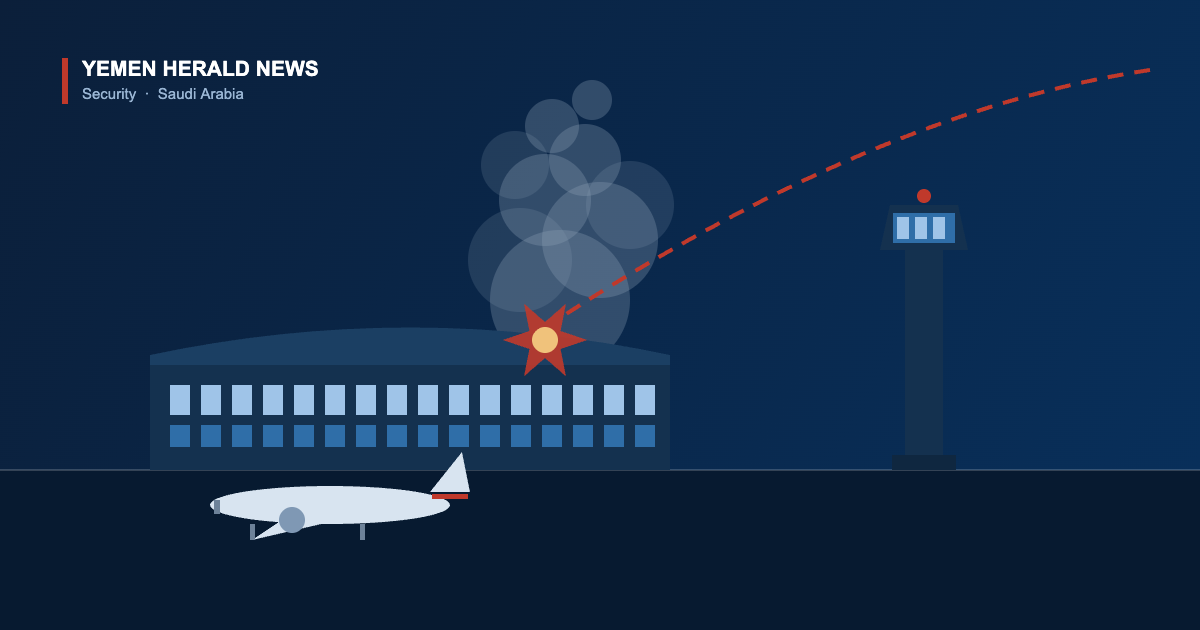
RIYADH, Saudi Arabia — An attack on King Khalid International Airport killed 12 people and injured 309 on Saturday, Saudi Arabia’s civil aviation authority said.
The General Authority of Civil Aviation said the airport “was attacked Saturday afternoon, amidst the ongoing blatant attacks targeting civil aviation facilities in the Kingdom.”
In its first statement the authority said the attack “resulted in a number of injuries, which are currently being assessed.” It announced the fuller toll early Sunday.
The injured included “individuals in critical condition,” the authority said. Officials were still assessing property damage.
It was the third attack on the airport in a week.
The dead included four Saudis and two Bangladeshis, with one national each from Palestine, the United States, Egypt, Jordan, Syria and Sudan.
U.S. Secretary of State Marco Rubio said an American citizen was among those killed. He condemned the attacks and called for them to stop.
A State Department spokesperson said Washington was in close contact with its Saudi partners.
A regional official, speaking on condition of anonymity, said a missile struck a complex housing Terminals 3 and 4, which handle domestic flights.
The authority suspended operations “until the damage assessment is completed and the safety of the facilities is verified, in coordination with the relevant authorities.” It said further updates would be announced later.
Flights stopped through midnight. Aircraft were diverted. Police blocked the entrances.
The airport told passengers to contact their airlines before travelling.
FlightAware recorded at least 291 cancellations at Riyadh over 24 hours.
Kuwait Airways cancelled flights, citing the closure and a “security situation.”
Air India, FlyDubai, Lufthansa Group and Pakistan International Airlines had already suspended services to Riyadh and other Saudi airports for varying periods.
Saudi Arabia’s foreign ministry told citizens stranded abroad to contact Saudi missions for help.
The United States, Britain, Germany, Australia, Canada and Ireland advised their citizens to stay away from the airport.
The European Union Aviation Safety Agency widened its guidance on Saudi airspace. It warned that missile and drone attacks create an increased risk of civil aircraft being misidentified.
Saudi officials blamed the Houthis. The group issued no formal military claim for Saturday’s strike.
The head of the Houthi media office wrote on X that the group had “shut down Riyadh international airport.”
The Houthis did claim attacks on the same airport on Thursday. The group’s military spokesman said a ballistic missile was fired in that assault.
The first of Thursday’s two attacks hit airport facilities and killed two Saudis, the authority said at the time. The second struck an aircraft belonging to Saudia, the national carrier, killing the pilot, Capt. Hamoud Ali al-Kalthami.
Two regional officials said those attacks damaged three aircraft. Saudia said one of its planes was hit while parked, with no passengers on board.
A strike on Abha International Airport on Tuesday killed a Moroccan woman and an Algerian woman. An attack on the Riyadh airport the next day killed a Sudanese man.
Maj. Gen. Turki al-Malki, spokesman for the Saudi-led coalition, called Saturday’s attack a “full-fledged war crime.” He said the coalition would respond in line with international humanitarian law.
Al-Malki said King Fahd International Airport in Dammam was also attacked. He reported further attacks in al-Kharj around midnight.
The coalition announced large-scale operations against the Houthis on Friday and said it had destroyed more than 130 targets.
Abdulaziz Alwasil, Saudi Arabia’s permanent representative to the United Nations, told the Security Council on Friday that Yemen would not be allowed to become a launchpad for attacks on the kingdom.
Jasem Mohamed Albudaiwi, secretary-general of the Gulf Cooperation Council, called for international action to deter the group.
Ursula von der Leyen, the European Commission president, called attacks on civilian infrastructure unacceptable and urged the Houthis to stop.
Hans Grundberg, the U.N. special envoy for Yemen, called the strike a “dangerous escalation.” He told the Security Council this week that Yemen had slid back into full-scale war.
President Donald Trump said Washington was weighing whether to join Saudi strikes on the Houthis. “We may. We’re gonna look at it,” he said.
Qatar, Jordan, Oman and Japan condemned the attacks or expressed solidarity with Saudi Arabia.
The strikes on Saudi territory followed an offensive the Saudi-led coalition began against the Houthis about a week earlier. Yemen’s government started its ground push on Monday.
The coalition is providing air support to Yemeni government forces trying to reverse Houthi gains along the Red Sea coast. Those gains give the group a wider view of shipping through the Bab al-Mandab Strait.
The Houthis recaptured Perim Island, also known as Mayyun, in September, completing their hold on the Bab al-Mandab area.
The group has declared Saudi airspace a theatre of military operations. It warned airlines “for the last time” against flying through it.
It said any aircraft over Saudi Arabia, other than over Mecca and Medina, would be treated as a target.
The Houthis have also said they would target Saudi shipping, calling it retaliation for a blockade imposed on them.
The coalition said the group recently attempted an attack on Mecca and struck an electricity station supplying the Prophet’s Mosque in Medina.
On Saturday the Houthis accused Saudi Arabia of striking Sanaa International Airport.
About the Author