Yemen’s Interior Minister and Chinese Envoy Discuss Deeper Security Cooperation in Riyadh
 Yemen Herald News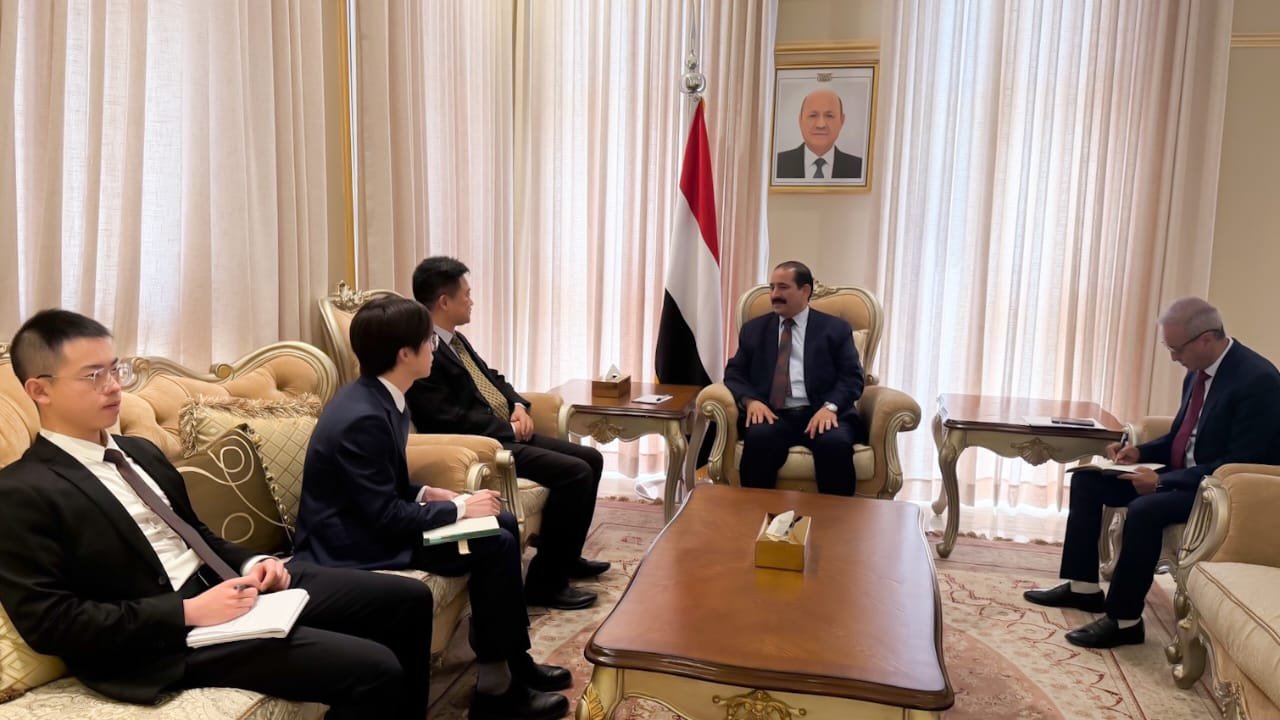
Yemen’s Minister of Interior, Major General Ibrahim Haidan, met the Chinese Chargé d’Affaires to Yemen, Shao Qing, in the Saudi capital, Riyadh, on Sunday to discuss ways of deepening security cooperation between the two countries. The talks came as Yemen’s internationally recognised government seeks to rebuild state institutions and shore up public safety after years of civil war, and they underscored Beijing’s growing interest in a country that sits astride one of the world’s most important maritime corridors.
During the meeting, Haidan thanked the Chinese government for the support it has extended to the Ministry of Interior, describing that backing as valuable to efforts aimed at restoring security and stability. He stressed the importance of expanding cooperation across a range of security fields, arguing that closer collaboration could improve the institutional performance and operational efficiency of Yemen’s police and security forces at a time of acute strain.
A central theme of the discussion was maritime security. Yemen’s position along the Red Sea and near the Bab al-Mandab Strait — a narrow passage through which a substantial share of global seaborne trade passes — has made the surrounding waters a focus of international concern. Attacks on shipping, piracy and smuggling in the region have heightened the need for surveillance and coordinated patrols, and Haidan pointed to maritime security as an area where Yemeni-Chinese cooperation could prove mutually beneficial.
The minister also emphasised the training and qualification of Ministry of Interior personnel. Rebuilding a professional security force is a long-term challenge in a country where institutions have been fractured by conflict, and Haidan suggested that investment in the skills of officers would help the government address threats more effectively and safeguard both citizens and shared interests. Capacity-building of this kind has featured prominently in Yemen’s appeals to international partners.
Shao Qing, responding to the minister, reaffirmed China’s commitment to supporting Yemen’s path toward security and stability. Chinese officials have increasingly framed their engagement in the region through initiatives such as Beijing’s Global Security Initiative, which promotes cooperation on security matters with states facing conflict and instability. Yemen’s government has previously been invited to take part in that framework, reflecting a gradual expansion of Chinese diplomacy in the Gulf and the Horn of Africa.
The timing of the talks in Riyadh is itself significant. Much of Yemen’s internationally recognised leadership operates from Saudi Arabia and the interim capital, Aden, having been displaced from Sanaa after the Houthi movement seized the capital in 2014. Riyadh has hosted numerous diplomatic engagements involving Yemeni officials, and the choice of venue reflects the close relationship between the government and the Saudi-led coalition that has backed it since 2015.
The meeting also comes as Yemen’s government, now led by Prime Minister Shaya al-Zindani, works to project competence and stability to both its citizens and its foreign backers. Rebuilding the interior ministry — responsible for policing, borders and internal security — is a core part of that effort, and officials have repeatedly sought outside expertise and funding to modernise a force strained by years of war. Cooperation with China, alongside longstanding support from Gulf partners, forms part of a strategy of diversifying the government’s international relationships.
Beijing’s interest in Yemen fits a broader pattern of Chinese involvement in the Middle East, where it has sought to expand economic and security ties without becoming entangled in the region’s rivalries. China brokered a 2023 rapprochement between Saudi Arabia and Iran, a diplomatic move watched closely by governments across the region, and its willingness to engage with Yemen’s security institutions signals a deepening footprint in an area long dominated by Western and Gulf powers.
For Yemen, foreign partnerships on security are closely tied to the country’s dire humanitarian situation. The United Nations estimates that well over 18 million people require assistance, and millions have been displaced by the fighting. Officials argue that improved security is a precondition for delivering aid safely and for creating the conditions in which displaced families might eventually return home, linking the technical language of security cooperation to the everyday needs of a suffering population.
The government’s relationships with regional powers, particularly Saudi Arabia and the United Arab Emirates, remain central to its security strategy. Those partnerships have provided military and financial support, but the war has also exposed internal divisions within the anti-Houthi camp, including tensions among the factions represented on the Presidential Leadership Council, the body formed in 2022 to unify the government’s leadership.
The Houthi movement, which controls Sanaa and much of northern Yemen, continues to pose the principal security challenge for the recognised government, and repeated efforts to reach a durable peace have faltered. Against that backdrop, engagement with a global power such as China offers the government both practical assistance and a measure of international legitimacy, even as the underlying conflict remains unresolved.
Sunday’s meeting produced no formal agreements, but it added to a series of contacts between Yemeni and Chinese officials in recent years, including earlier memoranda on development and security cooperation. Whether the discussions translate into concrete programmes will depend on the security situation and on Beijing’s appetite for deeper involvement, yet the encounter illustrated how Yemen’s government continues to court a widening circle of international partners in its effort to restore stability.
About the Author